Composite Fencing Supplier UK: Factory Direct Wholesale from China
For UK distributors, builders merchants, contractors and housing developers who procure fencing at volume, the supply chain question is straightforward: are you paying for two or three layers of margin, or are you buying direct from the source? The composite fencing market in the UK has matured rapidly since 2020, and with it has come a clearer understanding among serious buyers that the most competitive product — in terms of both price and specification — comes from factory-direct procurement in China, not from a domestic distributor who is themselves importing and marking up.
This guide explains why UK importers are increasingly sourcing WPC composite fencing directly from Chinese manufacturers, how to identify and vet a reliable factory, how the logistics chain from Guangdong to a UK warehouse actually works, and what Bohai Wood specifically offers as a long-term supply partner.
Why UK Importers Source WPC Fencing Directly from China
The UK composite fencing market is dominated by a handful of domestic brands — Ecoscape, Cladco, TekBoard, Alpha Decking — all of which import their panels from Chinese factories and sell them to UK trade buyers and consumers at a substantial margin. None of these brands manufacture WPC in the UK; the technology, raw material infrastructure and production scale simply does not exist outside of China at commercially viable price points. What varies is not who makes the product, but how many intermediaries sit between the factory gate and the UK buyer.
For merchants and contractors sourcing at scale, bypassing the UK distributor layer and purchasing directly from the factory changes the unit economics of a project entirely. Whether you are looking to expand your composite fencing wholesale UK offer or procure panels for a multi-plot housing development, factory-direct is the route most serious UK B2B buyers are now taking.
Price Advantage: Factory Cost vs UK Distributor

Factory-direct composite fencing typically costs 30–40% less per panel than equivalent products purchased through UK retail or distribution channels. To put this in concrete terms: a standard WPC privacy panel that retails through a UK distributor at £130–£180 can be purchased factory-direct for £85–£120 at equivalent specification. Co-extrusion panels — which carry a protective HDPE outer shell and command a premium — retail domestically at £190–£280, but are available factory-direct in the £150–£210 range on typical container-load orders.
The saving compounds across a full container. A 40ft FCL takes 400 sets, so a £45–£60 per-set differential is roughly £18,000–£24,000 on a single shipment. For merchants intending to resell, that margin differential represents the difference between a competitive retail price and an uncompetitive one. For contractors working on fixed-price contracts, it directly determines project profitability.
It is important to account for all costs in a factory-direct calculation: sea freight to a UK port, import duty (approximately 3.7% under commodity code 3925.90), port handling, inland delivery to your warehouse, and any inspection fees. With all these costs added, the net saving over UK distributor pricing still typically sits in the 25–35% range on container-load orders — a compelling commercial case.
Quality Control: What to Verify
Price advantage is only meaningful when the product specification is equivalent. The critical risk with factory-direct procurement is receiving product that does not match what was quoted — whether through material substitution, inconsistent colour batching, dimensional drift or inadequate certification. These risks are manageable with the right verification steps, which we cover in detail in the next section, but the starting principle is this: never place a bulk order with a factory you have not independently verified, and never accept product without an approved sample baseline on file.
For the product to perform in UK conditions — wind-driven rain, frost cycles, high UV exposure in summer months — the core WPC formulation must be consistent. The recycled hardwood fibre content (60% in Bohai's standard and co-extrusion grades) and recycled plastic polymer content (40%) must be maintained batch to batch. Co-extrusion panels additionally require a consistent HDPE cap layer of 0.5mm–1.5mm to provide the surface hardness and stain resistance the specification promises. A reputable factory will document these parameters in their product data sheets and back them with third-party test reports.
How to Vet a Chinese WPC Fencing Manufacturer
Identifying a credible WPC factory from a UK office requires a systematic approach. The Chinese manufacturing sector is enormous, and the gap in quality between a well-run, certified factory and a lower-tier operation that cuts material costs is significant. The following framework reflects what serious UK importers do before placing a first order.
Certifications Checklist (CE, REACH, Fire Rating, ISO 9001)
Certifications are the minimum credibility filter. Any factory supplying the UK and European market should hold the following, and should be willing to provide current, valid documentation on request — not marketing collateral, but actual certificates with issuing body details and expiry dates. Where a supplier does not hold something, the honest answer is to say so; ours are stated plainly below.
CE Marking confirms that the product has been assessed against relevant EU/UK product safety and performance directives. For WPC fencing panels, CE marking relates to construction product regulations and demonstrates the factory has undergone documented conformity assessment. We hold CE / CPR certificate M.2024.206.C97619, issued by UDEM International Certification under EU Regulation 305/2011, valid to March 2029.
REACH Compliance (Registration, Evaluation, Authorisation and Restriction of Chemicals) confirms that no restricted substances above threshold limits are present in the product. Note the distinction: for this product class, REACH conformity is issued as a manufacturer's declaration, not a third-party certificate. We hold a REACH Declaration of Conformity under EC 1907/2006 covering WPC co-extrusion fencing profiles T180H24 and T90H24 — it is a declaration, and we call it one.
BS EN 13501-1 Fire Rating is the UK and European classification system for the reaction-to-fire performance of construction products. For composite fencing, a Class C–D Euroclass rating is typical; specific commercial and planning applications may require higher performance. Factories should hold third-party test certificates, not self-declarations. We do not hold an EN 13501-1 classification. What we hold is an SGS flame-retardancy test report to European method and an AS ISO 9239.1 result to Australian method — neither is an EN 13501-1 class. If your specification calls for the classification, raise it before ordering.
ISO 9001 certification covers the factory's quality management system — not the product specification itself, but the processes that ensure consistent production. It tells you the factory has documented procedures for raw material intake, production monitoring, and final inspection. We hold ISO 9001 (IAS25924Q1473R0M) and ISO 14001 (IAS25924E0394R0M), both valid to 29 April 2027, issued to Guangdong Bangying New Material Co., Ltd — the legal entity behind the BOHAI export brand.
Wind load is the test UK specifiers ask about most for fencing. We hold Intertek report 250710027GZU-001: a 1.8 × 1.8 m panel system withstood 372.1 N/m² of horizontal distributed load for three minutes with no failure, no component detachment and no visible cracking. Two caveats we state up front: the method was an in-house procedure agreed with the client, not a recognised published standard; and the result applies to the exact configuration tested — WPC boards with 6063-T5 aluminium posts, rails, edge caps, post caps and brackets. Change the configuration and the result does not carry across.
Factory Audit: What Good Looks Like
Beyond paper certifications, a credible factory will be transparent about its operations. The practical indicators of a well-run manufacturer are: a willingness to participate in video audits or accept third-party inspections (SGS, Bureau Veritas and Intertek all operate in Guangdong province), documented production capacity with evidence of existing client references in comparable markets, a minimum of three to five years' trading history in WPC products, and an export team that communicates clearly in English with standard commercial documentation (pro forma invoices, packing lists, certificates of origin).
Red flags include: unwillingness to provide current certificates without delay, pricing that is significantly below what other credible factories quote (suggesting material substitution), no evidence of existing UK or European clients, and pressure to skip the sample stage and proceed directly to a bulk order.
The Sample Request Process

No credible factory will refuse a sample request from a qualified buyer. The standard process is: buyer specifies the profile, colour, grade (standard or co-extrusion), and height required; factory produces samples from current stock or a short sample run; samples are shipped to the UK by express courier (DHL or FedEx), typically taking five to ten working days. Samples are free — you cover the courier, and we credit it against your first order. If you are unsure how to structure a sample request, our guide on how to request composite fencing samples covers the process in detail.
On receipt, evaluate samples against dimensional accuracy (measure board width, thickness and length against spec), surface consistency (colour uniformity, texture, absence of voids or flow lines), co-extrusion shell integrity (check edge sections for clear shell delineation), and weight per linear metre (which indicates material density and composition). Approve samples formally before production begins, and retain a signed-off sample as a reference for goods inspection.
Shipping and Logistics: China to UK
Once a supplier relationship is established and an order placed, the logistics chain from our Guangdong factory to a UK warehouse follows a well-trodden path. The process is manageable for first-time importers with the right support, and Bohai Wood assists buyers throughout. For the wider buying picture, see our complete UK composite fencing buyer's guide.
Lead Times (Production + Shipping)
The total lead time from order confirmation to UK delivery has two components: production time and transit time. Production of standard catalogue profiles takes 20 days; custom specifications should be confirmed with us when the specification is fixed rather than assumed from the catalogue figure. Transit from Nansha (Guangzhou) or Yantian (Shenzhen) to a major UK port (Felixstowe, Southampton or Tilbury) runs to roughly 55 days in practice — that is what our shipments actually take, not a headline direct-service figure. Customs clearance at the UK port adds two to five working days under normal conditions.
Combined lead time from order placed to goods available at a UK warehouse: around 11 weeks. Plan against that figure, particularly for spring and summer projects when demand is highest and both production slots and freight capacity tighten. On an 11-week cycle, Q2 stock needs to be ordered in January.
Container Options (20ft vs 40ft FCL)

WPC fencing is dense and heavy, so weight reaches the container limit before volume does in almost every load. Full container loads (FCL) give the best freight rate per set, but they are not the entry point — see the MOQ section below.
A 20GP holds 200 sets (360 linear metres, roughly 11.5 t gross). A 40HQ holds 400 sets (720 linear metres, roughly 23 t). One set is a 1800 × 1800 mm panel — 3.24 m², about 55 kg including packaging — and includes one post. Note that a run of N bays needs N+1 posts, and every gate opening needs two more: posts are the single most common item to under-order. Mixed container loads — combining composite fencing with decking or wall cladding — are possible and let buyers build a broader range in one shipment.
UK Import Duties and Customs Codes
WPC composite fencing panels are classified under commodity code 3918.90 in the UK Global Tariff. The standard import duty rate is approximately 3.7%, applied to the customs value (which is the FOB price of the goods plus freight and insurance to UK port). VAT at 20% is then applied to the duty-inclusive value and is recoverable by VAT-registered businesses.
Importers should use a licensed UK customs broker to handle declaration. Documentation required includes: commercial invoice, packing list, bill of lading, certificate of origin, and relevant product certificates (CE, REACH). Bohai Wood provides a full export documentation pack as standard with every shipment.
Bohai Wood — Your UK Composite Fencing Supply Partner
Bohai Wood is a WPC composite fencing and decking manufacturer based in Guangdong province, China, supplying the UK market directly from our own factory. We do not use trading companies or intermediaries — your order is placed with the factory, produced in our facility, and shipped directly to your UK address.
Factory Overview (50+ Production Lines, 1,000+ Clients)
Our facility in Sihui, Zhaoqing, Guangdong operates more than 50 WPC extrusion production lines, producing composite fencing panels, decking boards, wall cladding and associated components. We hold active supply relationships with over 1,000 clients across the UK, Europe, Australia and North America, including builders merchants, landscape distributors, housing developers and garden retailers.
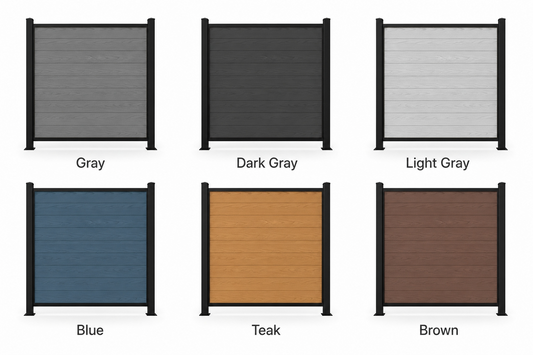
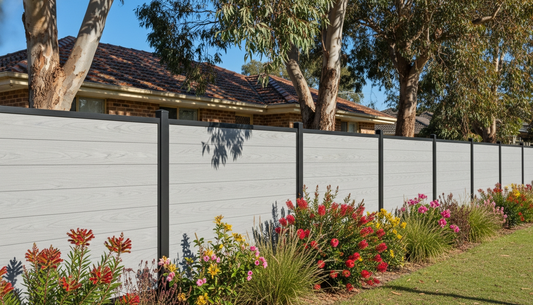
Our product range covers standard single-layer WPC panels and co-extrusion WPC panels with a 0.5mm–1.5mm HDPE protective shell. Available in six colours — Charcoal, Light Grey, Walnut, Teak, Blue Grey and White — across four panel heights: 0.9m, 1.2m, 1.5m and 1.8m, with 1800 × 1800 mm the standard set. The main privacy profile is 180 × 24 mm, which covers 172 mm once the boards lap — calculate materials from 172 mm, not from the overall width, or you will under-order by about 4.4%. Panels carry a 10-year warranty. Browse our composite fencing range for full product details.
We provide the certificates listed above as part of the standard pre-order process, with the gaps stated rather than papered over. Buyers are welcome to arrange third-party factory audits through SGS, Intertek or Bureau Veritas at any point in the relationship.
MOQ, Pricing and Payment Terms
Our minimum order quantity is 70 sets — not a full container. A 20GP takes 200 sets, so the MOQ is roughly a third of the smallest container: a first order, a single development phase or a trial run does not have to be sized to fill one. Full container quantities attract the strongest per-set pricing, but they are not the entry requirement.
Pricing is structured as follows. Ex-factory (EXW) pricing is confirmed on request, based on the specific product mix, volume and container size. FOB Nansha or Yantian pricing includes inland transport to port. CIF pricing covers cost, insurance and freight to a named UK port. Most UK buyers prefer CIF terms for the first order, which simplifies the freight management process; experienced importers often move to FOB terms to take control of freight selection.
Payment terms for first orders are typically 30% deposit on order confirmation and 70% balance against bill of lading or pre-shipment inspection report. Established buyers with a track record of orders may be offered extended terms. We accept payment by T/T (telegraphic transfer) and, for qualifying buyers, documentary credit (letter of credit).
Start Your Enquiry
For UK buyers who are ready to explore factory-direct supply, the process starts with a conversation. Send us your project details — product type, quantities, heights, colours and required delivery timing — and we will respond within 24 hours with indicative pricing, lead times and a recommended container configuration. If you would prefer to receive samples before committing to a price discussion, we can arrange that too.
Our UK-facing sales team is experienced in working with first-time importers and can walk you through every step from sample approval to port delivery. We can also recommend freight forwarders with established South China to UK lanes who we work with regularly and who are familiar with our documentation and packing formats.
Whether you are a builders merchant building out a composite fencing category, a landscaping contractor looking to reduce your supply costs, or a housing developer specifying fencing for a multi-plot scheme, factory-direct supply from Bohai Wood offers a straightforward route to better margins and consistent product quality.
FAQ
Q: Is it safe to buy composite fencing directly from China?
A: Yes, provided you follow a proper vetting process. Purchasing factory-direct from a certified, audited Chinese manufacturer is the standard procurement route for thousands of UK merchants and contractors. The key safeguards are: verifying certifications and asking which tests the factory has not done, approving samples before bulk production begins, using a freight forwarder experienced in China-to-UK imports, and working with a factory that provides full export documentation. Risks arise when buyers skip the verification stage or purchase from unverified trading companies rather than actual manufacturers.
Q: How much cheaper is factory-direct composite fencing?
A: Factory-direct composite fencing from a reputable Chinese manufacturer is typically 30–40% cheaper than equivalent products purchased through UK distribution channels. On a 40HQ container order of 400 sets, this translates to a saving of roughly £18,000–£24,000 compared with buying through a UK distributor at equivalent specification. After accounting for sea freight, import duty (approximately 3.7% under commodity code 3918.90), VAT (recoverable), and port handling costs, the net saving on landed UK cost is typically 25–35%.
Q: What certifications should a composite fencing supplier have?
A: Ask for CE marking with a supporting declaration of performance, REACH conformity, ISO 9001 quality management, and whatever fire and wind-load evidence your specification calls for. Bohai Wood holds CE / CPR (M.2024.206.C97619, valid to March 2029), ISO 9001 and ISO 14001 (both valid to April 2027), a REACH declaration of conformity, and Intertek wind-load report 250710027GZU-001 on a specific 1.8 × 1.8 m panel configuration. We do not hold a BS EN 13501-1 fire classification, a UKCA declaration, or an Environmental Product Declaration. If your project requires any of those, say so before specifying rather than after approval. Be cautious of any supplier who provides marketing materials instead of actual certificates, or who cannot name the issuing certification body and report number.
Q: How long does shipping from China to the UK take?
A: Our shipments leave from Nansha (Guangzhou) or Yantian (Shenzhen) and take roughly 55 days to a major UK port — Felixstowe, Southampton or Tilbury — in practice. Add 20 days of production before the goods reach the port, plus two to five days for UK customs clearance and inland delivery. Total lead time from order placed to goods available at your UK warehouse is around 11 weeks. Plan seasonal procurement against that figure, as production slots and freight capacity tighten significantly in the first and second quarters of each year.
Q: What is the minimum order for factory-direct composite fencing?
A: 70 sets. That is well under a container — a 20GP takes 200 sets — so a first order, a trial, or a single development phase does not have to fill one. Full container quantities attract the strongest per-set pricing, and below container volume the goods move as LCL consolidation where per-set freight is higher, but the order is accepted either way. One set is a 1800 × 1800 mm panel including one post; remember that a run of N bays needs N+1 posts and each gate needs two more.
Ready to Get Started?
Ready to source composite fencing factory-direct? Get a quote from Bohai Wood at /pages/contact — response within 24 hours.
Tags:
Previous
WPC Composite Fence Panels UK: Full Specs, Sizes and Wholesale Guide
Next
How Much Does Composite Fencing Cost in the UK? (2026 Price Guide)