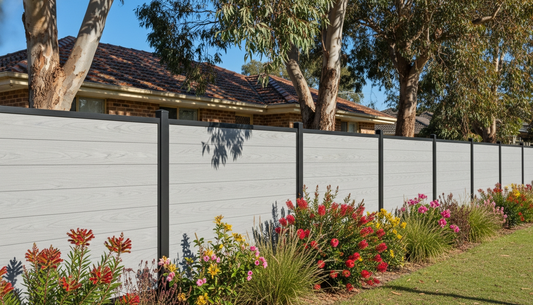
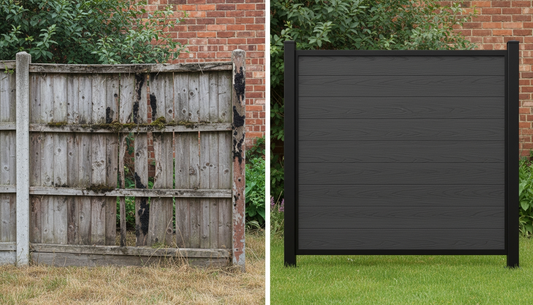
WPC Composite Fence Panels UK: Full Specs, Sizes and Wholesale Guide
If you are specifying, procuring, or distributing composite fence panels in the UK — whether as a contractor pricing a housing development, a builders merchant building a range, or an importer placing your first container order — the information you actually need is specific. Not vague promises about "long life" and "low maintenance", but real dimensions, density figures, the fire and slip evidence we actually hold, post-depth requirements, and MOQ numbers. This guide provides exactly that, drawing on Bohai Wood's factory specification data and UK market requirements for 2026.
Our composite fencing range covers standard WPC and premium co-extrusion panels across six colours and four heights. Everything below is taken from real product data, not marketing copy.
Standard Composite Fence Panel Sizes for the UK

UK fencing standards have largely converged on a set of practical dimensions derived from traditional timber panel sizing, garden design conventions, and planning rules. WPC composite panels follow the same conventions, which makes specifying them straightforward for any contractor who already works with timber.
Heights: 0.9m / 1.2m / 1.5m / 1.8m
The four height options available from Bohai Wood map directly to the most common UK applications. The 0.9m panel is typically used for boundary demarcation in front gardens, where permitted development rules cap fence height at 1m without planning permission — the 0.9m panel provides a clean margin of compliance. It is also widely used for low-level decorative screening, balcony infill, and as a visual boundary in open-plan commercial landscaping where full privacy is not the objective.
The 1.2m panel bridges residential and light commercial use. It is popular in situations where a clear boundary is needed without creating an enclosed or oppressive feel — school playgrounds, car park edges, and garden sections adjacent to seating areas are typical examples. At 1.2m it also works well as a lower-tier panel in tiered landscaping schemes.
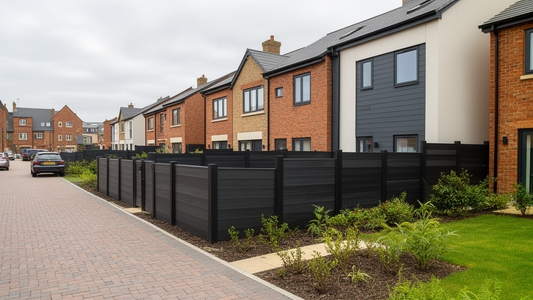
The 1.5m panel is a versatile mid-height option increasingly specified in residential developments where 1.8m feels excessive but 1.2m provides insufficient privacy. Many housing developers now use 1.5m composite panels on rear boundaries within open-plan housing layouts, pairing them with trellis toppers where additional height is desired without requiring planning consent.
The 1.8m panel is the most popular option in the UK market, delivering full privacy for back gardens and meeting the permitted development maximum of 2m for rear boundaries. At 1.8m it is the standard specification for residential garden enclosure, contractor builds, and commercial-perimeter fencing. Post-depth requirements increase with panel height — for a 1.8m panel, posts should be set a minimum of 600mm into the ground, increasing to 900mm in loose, sandy, or disturbed soil conditions.
Standard panel width in the UK market is 1.83m (6ft), maintaining compatibility with existing post-spacing infrastructure and the installed base of post supports already in the ground on replacement projects. Some profiles are produced in 1.5m widths for tighter site conditions or design requirements.
One ordering detail that is easy to miss: a run of N panels needs N+1 posts. Our fencing board is 180mm wide and covers 172mm once installed, so ordering strictly on the 180mm nominal figure under-orders by about 4.4% — always calculate on the covered width.
Material Specifications
Understanding the material science behind WPC composite panels is important for anyone specifying them for a commercial or development project. The figures below reflect Bohai Wood's standard and co-extrusion product lines.
Co-Extrusion vs Single-Layer WPC

Standard WPC consists of a homogeneous blend of approximately 60% recycled hardwood fibres and 40% recycled plastic polymers — typically HDPE — processed under heat and pressure into a uniform composite profile. The recycled-content composition gives the material its distinctive combination of rigidity, UV resistance, and dimensional stability. Standard WPC performs well in residential fencing applications and carries Bohai Wood's 10-year warranty, stepped by year rather than flat.
Co-extrusion WPC adds a permanently bonded outer shell of virgin HDPE, applied in the same extrusion run as the core composite. This shell — typically 0.5mm to 1.5mm thick — encapsulates the composite core on all exposed surfaces, providing a sealed barrier against moisture ingress, surface staining, and mechanical abrasion. The result is a panel that resists scratching, is easier to clean, shows lower colour fade over time, and is significantly more resistant to surface damage during installation and in high-traffic or exposed environments.
Density, Weight and Load Rating
WPC panels are denser than timber and lighter than concrete — a combination that gives them excellent structural performance while remaining manageable on site. A standard WPC fencing board (180mm wide, 24mm thick, hollow core) weighs approximately 3.5–4.5 kg per linear metre. A complete 1.8m × 1.83m panel comprising multiple boards, rails, and fixings will typically weigh between 22–32 kg depending on profile and grade. Co-extrusion panels run marginally heavier due to the additional shell material — the increase is generally 5–8% by mass.
In fence panel applications, the primary load on boards is lateral wind load rather than axial compression. UK wind loading for residential fencing is typically calculated at 0.75–1.0 kN/m², with exposed sites requiring values up to 1.5 kN/m². WPC panels with aluminium post systems at 1.83m centres comfortably exceed residential requirements; for high-exposure commercial sites, post spacing should be reduced to 1.5m and post embedment increased accordingly.
UV Stability and Fade Resistance
One of the most frequently asked questions about composite fencing in the UK concerns long-term colour stability. WPC is inherently more UV-stable than timber because the polymer matrix within the composite absorbs and dissipates UV radiation rather than undergoing the surface degradation that causes timber to grey and crack. However, not all WPC is equal in this regard, and the difference between standard WPC and co-extrusion WPC is significant over a 5–10 year period.
Standard WPC panels will show some colour lightening over the first 18–24 months as the surface pigments equilibrate, after which the rate of change slows substantially. Long-term colour shift on standard WPC over a 10-year period is typically in the range of 10–15 Delta E units under UK conditions. Co-extrusion panels, with their sealed HDPE shell, perform significantly better — long-term fade is typically below 5 Delta E units, which is largely imperceptible to the naked eye under standard viewing conditions.
Darker colours (Charcoal in particular) absorb more UV energy and can show slightly higher surface temperatures in direct sunlight. This accelerates thermal cycling rather than UV fade specifically, but the two effects are related. Co-extrusion panels are strongly recommended for dark-colour specifications in south-facing or exposed positions.
Fire: What UK Projects Ask For, and What We Hold

For commercial projects, housing developments, and any site where planning conditions or building regulation approval is required, the fire classification of fencing materials is an increasingly common specification requirement. The reference standard in the UK is BS EN 13501-1, the European reaction-to-fire classification for construction products, which runs from A1 (non-combustible) through to F.
We do not hold a BS EN 13501-1 classification for our fencing. What we hold is an Intertek flame-retardancy test report, reference 250710027GZU-001. Two caveats matter and we would rather state them here than at approval stage: a test report is not an EN class, and the report was issued on the tested profile rather than across the whole range. If your specification names an EN classification — Class B for a site near a building, for instance — raise it before you specify. Testing can be arranged, with the cost paid up front and credited against your order.
The general advice applies to every supplier including us: ask for the report number and the product reference it was issued against, and treat a bare classification claim with no report behind it as unevidenced. Bohai Wood holds current CE marking, REACH conformity and ISO 9001 certification, and can supply all of those documents on request.
Colour Options for the UK Market
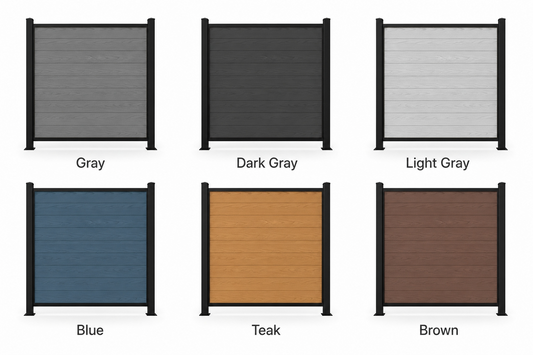
Walnut, Charcoal, Light Grey, Teak, Blue Grey, White
Bohai Wood composite fence panels are produced in six standard colours, selected to reflect the dominant trends in the UK residential and commercial landscaping market. All colours are available across both standard WPC and co-extrusion grades, and across all four panel heights.
Charcoal is currently the most popular colour in the UK market, driven by the dominance of dark, contemporary garden aesthetics. It pairs cleanly with grey porcelain paving, dark render, and aluminium framing that characterises modern new-build gardens and high-end residential refurbishments.
Light Grey offers a softer alternative to Charcoal and is widely used in schemes where the fence is intended to recede rather than make a statement — it works well as a backdrop to planting and in situations where a neighbouring property preference for a neutral tone needs to be respected.
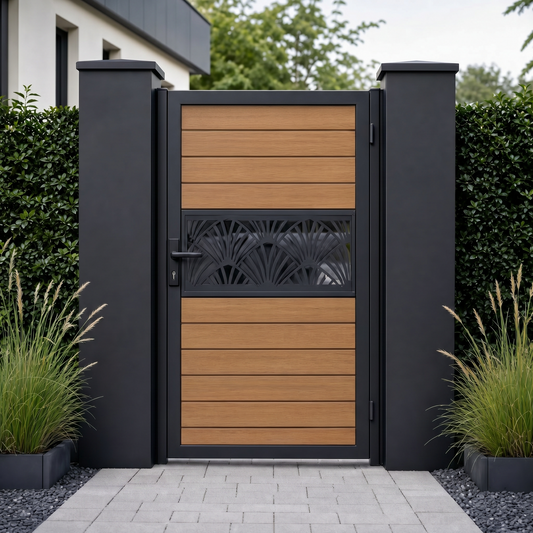
Walnut and Teak are the wood-tone options. Teak has a warmer, more golden-brown character suited to traditional and Mediterranean-influenced garden styles. Walnut sits in the mid-brown range and is the most natural-looking of the range, often specified by homeowners replacing timber fencing who want to retain a traditional aesthetic without the maintenance overhead.
Blue Grey is a distinctive cool-toned slate colour that has grown in popularity as garden design has moved towards naturalistic, Scandi-influenced palettes. It works particularly well against stone cladding, soft planting in silver and purple tones, and pale hardwood decking.
White is primarily used in commercial settings, contemporary residential schemes with a clean minimalist aesthetic, and pool enclosures. It shows soiling more readily than darker tones and is generally recommended with co-extrusion panels for ease of cleaning and stain resistance.
Compatible Post Systems
Composite fence panels are not self-supporting — they require a post system, and the choice of post type has a significant bearing on installation speed, long-term stability, and total project cost.
Aluminium Post Systems

Aluminium posts are the recommended system for WPC composite fence panels. The primary advantage is thermal compatibility: aluminium and WPC composite have similar coefficients of thermal expansion, so the joint between post and panel remains stable across the temperature range experienced in UK conditions — typically -10°C to +35°C. Timber posts, by contrast, expand and contract at a different rate to WPC panels, creating joint stress over time.
Aluminium posts for composite fencing are typically supplied in 80mm × 80mm or 100mm × 100mm square hollow section (SHS) with a wall thickness of 2–3mm. Posts are set into concrete at 600mm minimum depth for 1.8m panels. The post sleeve-and-cap system used with most composite fencing ranges simplifies installation — the panel rails slot into channels within the post rather than being fixed with exposed fasteners, giving a clean finish without visible hardware.
Bohai Wood supplies compatible aluminium post systems alongside our composite panels. Post spacing is 1.83m centres, aligned with standard panel width, and a run of N panels takes N+1 posts.
Concrete Post Compatibility
Existing concrete post infrastructure — common on replacement projects where timber panels are being swapped out — can be reused with composite panels in some circumstances. The key variables are whether the concrete posts have slots or channels that accept composite rail dimensions and whether post spacing matches 1.83m centres.
Traditional UK featheredge concrete posts with 50mm slots are generally compatible with composite panel rails, though an adaptor channel may be required depending on the rail profile. Concrete posts are heavier and harder to work with than aluminium, and their rigidity can cause cracking in freeze-thaw cycles in clay-heavy soils. For new installations, aluminium is strongly preferred.
Wholesale and MOQ Information
This section is directed at UK distributors, builders merchants, contractors placing supply-only orders for multiple projects, and importers enquiring about factory-direct purchasing. For residential single-project enquiries, see our product pages.
Minimum Order Quantities
Bohai Wood's minimum order quantity is 70 sets — roughly a third of a 20ft container. Factory-direct buying does not require you to fill a container, and a first order does not need to be consolidated with another buyer. For orders between the 70-set minimum and a full container, a part-container (LCL) arrangement allows a mixed selection across heights, colours and grades.
Per-unit economics do improve at container scale: a 20ft container holds 200 sets and a 40ft high-cube holds 400 sets. For buyers considering wholesale purchasing for the first time, our composite fencing supplier UK guide covers the commercial model in full detail, including pricing tiers and payment terms.
Lead Times from Factory to UK
Total lead time from confirmed order to UK delivery comprises three components: production lead time, sea freight transit, and UK customs clearance and delivery.
Production of standard catalogue profiles at Bohai Wood's Guangdong facility takes 20 days. Custom colour or profile orders require an additional 5–10 days.
Sea freight from Nansha (Guangzhou) or Yantian (Shenzhen) to UK ports (Felixstowe, Southampton, London Gateway) runs to roughly 55 days port to port in practice. That figure reflects what shipments actually take rather than a best-case main-lane schedule. UK customs clearance with a competent freight forwarder typically adds 3–7 days, after which haulage to a UK distribution point is typically same-day or next-day.
Total order-to-UK-delivery lead time is therefore approximately 11 weeks. Plan the full 11 weeks into your stock cycle and place reorders well in advance of projected depletion — anyone quoting four to five weeks door to door on a South China sea shipment is describing a best case, not a plan.
Container Load Volumes (20ft vs 40ft)

The choice between a 20ft and 40ft FCL involves a balance between capital outlay, storage capacity, and unit cost. Bohai Wood's container load volumes are as follows:
| Container | Sets | Linear Metres | Gross Weight |
|---|---|---|---|
| 20GP | 200 sets | ~360 m | ~11.5 tonnes |
| 40HQ | 400 sets | ~720 m | ~23 tonnes |
The 40HQ delivers a meaningfully lower cost per set due to fixed shipping and handling costs spread across a larger quantity of goods. For buyers with adequate storage and sufficient market demand, the 40HQ is the economically superior choice — but it is not the entry point, and the 70-set minimum exists precisely so that it does not have to be. Mixed loads combining composite fencing with decking or wall cladding products are available — contact us to discuss packing configurations.
UK import duty on WPC composite fencing under commodity code 3925.90 is approximately 3.7%. VAT at 20% is payable on import and is recoverable for VAT-registered businesses. A qualified freight forwarder can handle all UK customs documentation and CHIEF/CDS declarations.
Installation Overview
For buyers receiving composite fence panels for the first time, installation is more straightforward than many expect — particularly compared to the physical demands of handling heavy concrete panels or the skill requirements of working with featheredge timber. The system nature of composite fencing (post, bottom rail, boards, top rail, post cap) means that any competent groundworker or landscaper can achieve a clean result without specialist training.
Posts are set at 1.83m centres in concrete, to the depths described above. Bottom rails are levelled and fixed to the posts at the correct height off the ground to allow for drainage beneath the lowest board. Boards are inserted vertically into the rails, clicking or sliding into place with small expansion gaps at each end. Top rails and post caps complete the installation. The process for a standard 10-panel run typically takes one to two days for a competent two-person team.
For full installation guidance including tools list, step-by-step board fitting, and advice on sloped ground, see our detailed guide on how to install composite fence panels.
FAQ
Q: What are the standard composite fence panel sizes in the UK?
A: The standard composite fence panel heights in the UK are 0.9m, 1.2m, 1.5m, and 1.8m, with a standard width of 1.83m (6ft) — matching the post-spacing convention inherited from timber panel fencing. The 1.8m × 1.83m panel is by far the most common specification for residential back-garden privacy fencing. Some suppliers, including Bohai Wood, can produce non-standard heights to order for specific project requirements, though this typically adds to lead time and minimum order quantity.
Q: How heavy are composite fence panels?
A: The weight of a composite fence panel depends on the panel height, board profile, and whether it is standard or co-extrusion WPC. A typical 1.8m × 1.83m privacy panel will weigh between 22kg and 32kg complete. Individual fencing boards — 180mm wide, 24mm thick, hollow-core — weigh approximately 3.5–4.5 kg per linear metre. Co-extrusion panels are marginally heavier than standard WPC, typically by 5–8%. For import planning purposes, a 20GP of composite fence panels (200 sets) has a gross weight of approximately 11.5 tonnes, and a 40HQ (400 sets) approximately 23 tonnes.
Q: What is the difference between co-extrusion and standard WPC?
A: Standard WPC is a homogeneous blend of recycled wood fibres and recycled plastic processed into a single-layer composite profile. Co-extrusion WPC uses the same core composite but adds a co-extruded outer shell of virgin HDPE — 0.5mm to 1.5mm thick — on all exposed surfaces. This shell dramatically improves scratch resistance, stain resistance, UV colour stability, and resistance to moisture ingress. Co-extrusion panels cost approximately 20–40% more than standard WPC at supply price, but their superior long-term performance makes them the preferred specification for commercial projects, high-use environments, and any installation where appearance retention matters over the long term.
Q: Do you hold a BS EN 13501-1 fire classification?
A: No. We hold an Intertek flame-retardancy test report, reference 250710027GZU-001, which is a test report rather than an EN classification, and it was issued on the tested profile rather than across the whole range. We also do not hold a BS 7976 pendulum slip value. If your project specification names an EN reaction-to-fire class, raise it before specifying rather than at approval stage — testing can be arranged, with the cost paid up front and credited against your order. We do hold CE marking, REACH conformity and ISO 9001 certification, and can supply those documents on request.
Q: What post system should I use with composite panels?
A: Aluminium post systems are recommended for composite fence panels as the first choice for new installations. Aluminium and WPC composite have compatible thermal expansion characteristics, the system installs cleanly without exposed fixings, and aluminium posts will not rot, rust, or degrade over the life of the fence. Remember that a run of N panels needs N+1 posts. Existing concrete posts can be reused on replacement projects if post spacing and slot dimensions are compatible — an adaptor channel may be needed. Timber posts are not recommended for composite panels due to differential expansion rates and the risk of the post degrading before the composite panels.
Q: What is the minimum order for wholesale composite fence panels?
A: Bohai Wood's minimum order quantity is 70 sets, which is roughly a third of a 20ft container — you do not need to fill a container to buy factory-direct. For volume planning, a 20GP holds 200 sets and a 40HQ holds 400 sets. Pricing, payment terms (typically 30% deposit on order, 70% before shipment), and container planning are all covered in our composite fencing supplier UK guide.
Ready to Get Started?
Download our full product specification sheet or request a wholesale quote at /pages/contact. Our UK-facing sales team provides quotes within 24 hours, with full technical documentation including CE certificates, the Intertek flame-retardancy report and product datasheets available on request.
Tags:
Previous
Composite Fencing UK: The Complete Buyer's Guide (2026)
Next
Composite Fencing Supplier UK: Factory Direct Wholesale from China