


Capped vs Uncapped Composite Decking
The question buyers ask us most is composite decking capped vs uncapped. We make both, so here is the honest version: the cap layer buys you colour retention and stain resistance, not structural strength. Where the deck sees strong sun, pool chemicals or heavy public use, capped earns its premium. Where cost per square metre governs, uncapped is the sensible choice.
| Feature | Capped co-extrusion — BOHAI Premium | Uncapped classic — BOHAI | Solid timber |
|---|---|---|---|
| UV colour retention | ✓ Cap layer locks colour in | △ Slight weathering over the first 3–6 months | ✗ Greys and fades |
| Stain resistance | ✓ Wipes clean | △ Open-pore surface holds marks | ✗ Absorbs permanently |
| Scratch resistance | ✓ Cap layer takes the wear | △ Standard composite hardness | ✗ Scratches easily |
| Rot & mould | ✓ Resistant | ✓ Resistant | ✗ Prone to rot untreated |
| Maintenance | ✓ Wipe clean only | ✓ None required | ✗ Annual oiling and sealing |
| Board widths | 138 mm / 148 mm | 140 mm / 145 mm / 150 mm | Variable |
| Warranty | ✓ 15 years, stepped | ✓ 10 years, stepped | ✗ None typically |
| Price point | △ Mid-premium | ✓ Budget-friendly | △ Variable |
| Best for | High UV, poolside, commercial and long-life projects | Cost-led residential and light commercial | Traditional look where upkeep is accepted |
Capped Composite Decking Profiles
Four capped profiles, all four-sided co-extrusion over a WPC core. Width and core geometry are what separate them — the cap specification is the same across the range.
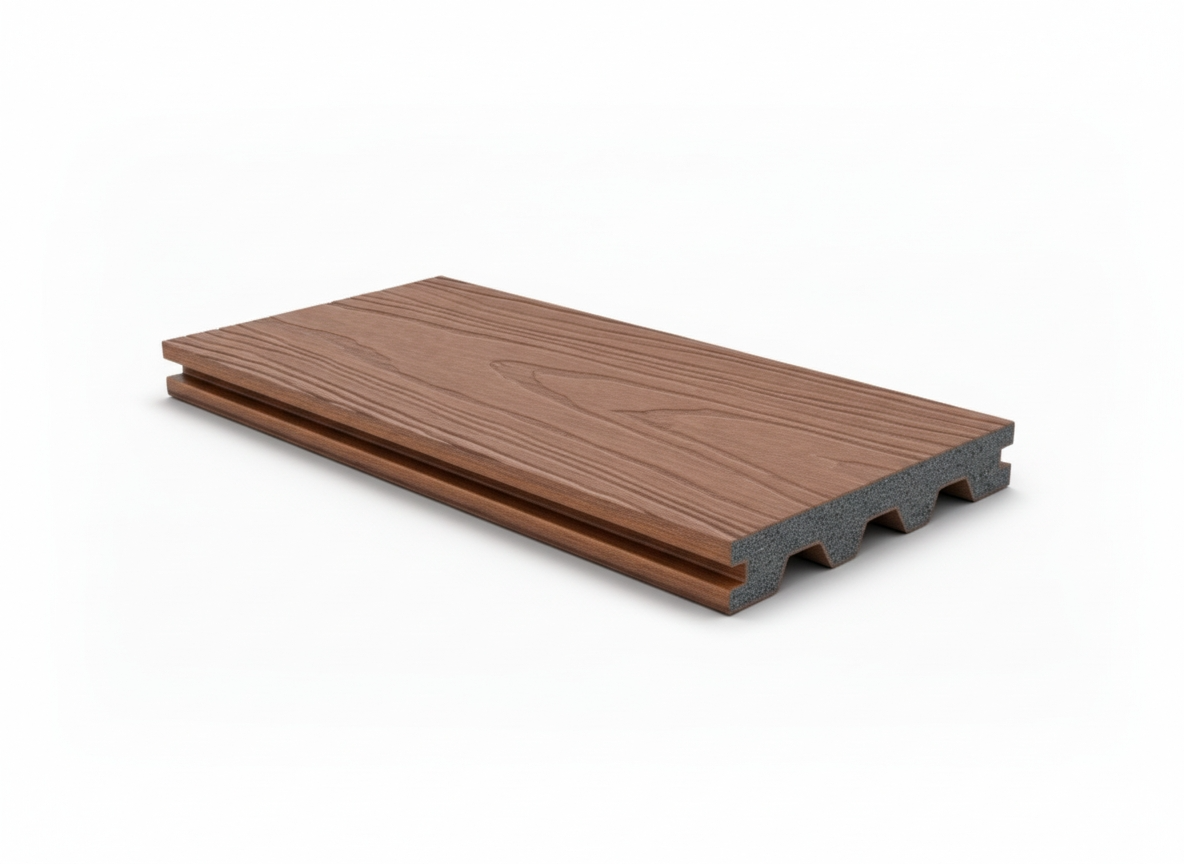
M-shape hollow
23 × 148 mm
M-shaped internal core, stiffer across longer spans and heavier footfall.
View product →

Round hole hollow
23 × 148 mm
Circular chambers, lighter than the M-shape at the same width.
View product →

Square pattern hollow
23 × 138 mm
Narrower plank line for a more traditional timber appearance.
View product →

Solid
20 × 140 mm
Full-density core with the cap layer. The highest specification here.
View product →
Capped or uncapped for your project?
Tell us the location, the exposure and the expected footfall. We will say which grade actually earns its cost on your job — including when uncapped is the right answer.
How Composite Deck Capping Works
Four-sided co-extrusion, bonded during manufacture
The cap layer
Composite deck capping is a polymer shell extruded onto the WPC core at the same moment the core is formed, so the two bond permanently. It is not a coating applied afterwards, and it covers all four faces.
UV resistant composite decking
The cap holds the colour pigments below a UV-stable surface, which is what slows the colour shift that an open-pore board goes through in its first months outdoors.
Stain and scratch
A capped surface resists oil, grease and pool chemicals far better than an open-pore board, and surface marks wipe off with water and mild detergent.
Where Capped Composite Decking Earns Its Premium

Luxury Pool Surround
Cap layer resists pool chemicals, chlorine splash and sunscreen oils.

Premium Residential Deck
Colour holds far longer than an open-pore board on a sun-facing garden deck.

Rooftop Terrace
Wide 148 mm boards mean fewer boards and less clip work on large areas.

Villa Garden Deck
The capped surface stays presentable under garden furniture and planters.

High-UV Regions
Specified for the Middle East, Australia and Southern Europe, where an uncapped board weathers fastest.

Hotel & Resort Decking
Hospitality-grade wear resistance with wipe-clean maintenance.

Commercial Boardwalk
Commercial composite decking for public boardwalks — the solid 20 × 140 mm profile carries the load.

Balcony & Outdoor Living
Hollow profiles keep dead load down on elevated balconies and terraces.
Specifying for a commercial or high-UV project?
Send us the location and the exposure. We will confirm the profile, the colour that holds up best in that climate, and what we can evidence with test reports.
Comparing Composite Deck Manufacturers on a Capped Board
Every supplier quoting you a capped board will call it co-extrusion. The word is not a specification, and the quotes in front of you are probably not comparing the same thing. Three questions make them comparable.
How many sides are capped?
This is the one that separates quotes fastest. A four-sided cap covers the face, both edges and the back. A three-sided cap leaves the underside open, which is cheaper to extrude and is where moisture reaches the core. Ours is capped on four sides. If a composite decking supplier will not state the number, assume three.
Which profile was tested?
A test result belongs to the profile that went on the rig, not to a catalogue. Our slip result is R10 under AS 4586-2013 Appendix D, Intertek report 230625005SHF-001, measured on profile ZSGJ138H23A. Ask any supplier for the same five things — laboratory, standard, date, profile and result. A composite decking company that quotes one report across its whole range is telling you about its paperwork, not its product.
Is the warranty flat or stepped?
A headline of 15 years means very little on its own. Ours is stepped — 100% of the value of the affected goods in years 1 to 3, tapering to 10% by years 13 to 15 — and it is published in full on the classic collection page. Ask any supplier for the year-by-year table rather than the headline number, and ask whether cover is issued per batch or per SKU.
Frequently Asked Questions
Product & Technology
What exactly is co-extrusion WPC decking and how does it differ from classic WPC?
Co-extrusion WPC decking is made by extruding a protective polymer cap layer onto the WPC core at the same time the core is formed, so the two bond permanently. The cap covers all four sides and gives better UV, stain and scratch resistance than classic WPC, which has an open-pore composite surface throughout.
What is the difference between the 23×148mm round hole and M-shape profiles?
Both share the same 148 mm width and 23 mm thickness but differ in the internal core. The round hole profile has circular chambers; the M-shape uses an M-shaped internal structure that is stiffer across longer spans and spreads load more evenly, which suits wider joist spacing or heavier footfall. The round hole board is slightly lighter and performs equivalently at standard residential joist spacings.
Why choose the 148mm wide board over the 138mm?
The 148 mm board covers more area per board, so fewer boards, fewer clips and less labour on a large deck. The 138 mm profile gives a finer plank line that reads closer to traditional timber, which some buyers prefer on residential projects.
Who should choose the 20×140mm solid co-extrusion board?
It is the highest specification in the range — a full-density solid core with the co-extrusion cap. Choose it where structural performance matters most: commercial boardwalks, high-footfall public areas, and residential projects where the deck is treated as long-term infrastructure.
Performance & Durability
Does composite decking fade?
An uncapped board goes through a natural weathering process over its first 3–6 months outdoors as surface pigments meet UV. A capped board reduces that shift substantially, because the pigments sit under a UV-stable polymer surface rather than in it. In high-UV locations — Australia, the Middle East, Southern Europe — capped is the grade we recommend.
Does composite decking expand and contract?
Yes. All composite decking moves with temperature, which is why the gap between boards is a working allowance rather than a tolerance. Leave 5–8 mm between boards, and use the upper end of that range in hot climates. Our hidden clip system sets the gap automatically during installation.
Does composite decking scratch easily?
An uncapped board has the composite exposed, so it marks more readily under furniture and grit. The cap layer on our co-extrusion range takes that wear instead of the core, and most surface marks wipe off. No composite decking is scratch-proof — dragging metal furniture will mark any board.
Is co-extrusion WPC decking suitable for pool surrounds?
Yes. The cap resists chlorine splash, pool chemicals and sunscreen oils that stain an open-pore surface, and marks clean off with water and mild detergent. Both hollow and solid profiles suit pool surrounds; choose solid for commercial pool facilities or very high foot traffic. Note that this is a staining and chemical-resistance answer, not a slip classification: we hold R10 under AS 4586-2013 Appendix D on profile ZSGJ138H23A, which is the shod-wet ramp test. We do not hold the DIN 51097 barefoot wet classification that pool surrounds are normally specified against.
What installation gap is required for co-extrusion WPC decking?
We recommend 5–8 mm between boards for thermal movement and rainwater drainage. The cap gives slightly better dimensional stability than an uncapped board, but the gap is still required. Our hidden clip system maintains it automatically; allow the upper end of the range in hot climates.
Ordering & Supply
Can BOHAI supply a complete co-extrusion decking system including accessories?
Yes. Boards in your chosen profile, hidden stainless steel or aluminium clips, joist and keel profiles, edge trims and end caps, all matched to the board profile and colour. Samples are available on request: we supply the board free of charge and the courier cost is invoiced to you, then credited against your first order.
Do you supply capped composite decking to distributors and contractors?
Yes — we sell business-to-business only, direct from our factory in Guangdong, FOB Nansha or Yantian. We do not sell to homeowners. Buyers comparing capped composite decking manufacturers are welcome to request our ISO certificates and third-party test reports before ordering.
Are you a composite decking company or a trading company?
We are the plant. Among composite deck manufacturers that is worth checking rather than assuming: ask which port the goods load from. Ours are Nansha or Yantian, and both appear on our commercial invoices. A composite decking supplier who answers with a city rather than a port is usually buying the containers from someone else and reselling them to you.
Ready to specify capped composite decking?
Factory-direct pricing · ISO 9001 & 14001 · 15-year stepped warranty · Slip rated R10, Intertek 230625005SHF-001 · Trade buyers only


