Composite Fencing UK: The Complete Buyer's Guide (2026)
Composite fencing has moved from niche novelty to mainstream specification across the UK in the space of a decade. Walk through any new housing development, visit any commercial landscaping project, or browse the pages of any garden trade publication, and you will find WPC (Wood Plastic Composite) panels front and centre. Yet for all its growing popularity, there is still an enormous amount of confusion among buyers — homeowners, contractors, and merchants alike — about what composite fencing actually is, how much it costs, what separates a good panel from a poor one, and whether sourcing factory-direct from China genuinely delivers the savings suppliers claim.
This guide answers all of those questions in full. By the time you finish reading, you will understand the material science behind WPC, know the real 2026 UK price landscape, and have a clear framework for choosing the right product for your project — whether that is a single garden boundary or a 200-unit housing development.
What Is Composite Fencing? (WPC Explained)
WPC stands for Wood Plastic Composite — a manufactured material that combines wood-derived fibres with thermoplastic polymers to create boards and panels that look like timber but behave nothing like it. The result is a product that can be milled into consistent profiles, coloured through the full depth of the material, and installed with standard woodworking tools, while offering the weather resistance, longevity, and low maintenance that timber simply cannot match.
Understanding WPC at a material level matters because not all composite fencing is made to the same standard. The composition, manufacturing process, and quality of raw materials all affect how the finished panel performs over its lifetime — particularly in the demanding conditions of the UK climate.
Material: 60% Recycled Wood Fibres + 40% Recycled Plastic
The core of any WPC product is a carefully calibrated blend of wood and plastic. In a well-manufactured composite fence board, you are typically looking at approximately 60% recycled hardwood fibres — sourced from post-industrial wood waste, sawdust, and timber off-cuts — bonded with approximately 40% recycled thermoplastic polymers, most commonly HDPE (High-Density Polyethylene) or PVC.
The wood fibres give the material its natural aesthetic: the surface texture, the grain-like appearance, and the warmth of tone that homeowners and designers find appealing. The plastic component provides structural stability, water resistance, and protection against the biological decay processes — rot, mould, insect damage — that make untreated timber so unsuitable for long-term outdoor use in the UK.
The specific ratio matters. Too high a wood content and the material becomes more susceptible to moisture absorption and surface checking over time. Too high a plastic content and the board loses its natural aesthetic and can exhibit excessive thermal expansion. Reputable manufacturers — including Bohai Wood — have refined this balance over years of production and testing to achieve consistent, stable results.
Stabilisers, UV inhibitors, and colourants are added to the blend before extrusion, ensuring that colour penetrates the full depth of the board rather than being a surface coating that can chip or peel.
Standard WPC vs Co-Extrusion WPC
There are two main manufacturing processes for WPC fence boards, and the difference between them is significant for buyers specifying products for UK conditions.
Standard WPC (single-layer extrusion) involves extruding the wood-plastic composite mixture through a die in a single pass. The resulting board is uniform in composition throughout. Standard WPC is a solid, capable product and represents good value for most residential applications, but it is somewhat more porous at the surface than co-extruded alternatives and can be more prone to surface staining and minor scratching over time.
Co-Extrusion WPC takes the process a step further. The core of the board is still standard WPC composite, but during manufacturing a separate protective layer — typically 0.5mm to 1.5mm of pure HDPE — is bonded to the outer surface of the board in a simultaneous co-extrusion process. This cap layer acts as a hard shell: it is non-porous, highly scratch-resistant, far more stain-resistant, and significantly better at resisting UV-induced fading.
For UK buyers, co-extrusion matters most in high-exposure applications: south-facing gardens with full sun exposure, coastal environments with salt air, commercial properties that will see heavy use, and any project where the fence will be difficult to access for maintenance. The premium over standard WPC is typically 20–40% on supply cost, but the uplift in durability and appearance retention over a 10–20 year lifespan makes it the specification of choice for premium projects.
Why UK Homeowners and Contractors Are Switching to Composite

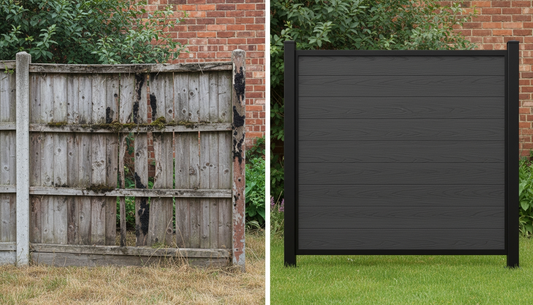
The shift towards composite fencing in the UK is not a marketing-driven trend — it is a practical response to the genuine failings of traditional timber in a British climate. The UK's combination of persistent damp, frost cycles, variable UV exposure, and high winds is genuinely harsh on untreated or poorly treated wood, and the annual cost of maintaining timber fencing has become increasingly difficult to justify.
Performance in UK Weather (Wind, Rain, Frost, UV)
The four main weathering threats to UK garden fencing are moisture, frost, wind loading, and UV radiation. Composite fencing addresses each of them in ways that timber cannot.
Moisture is timber's primary enemy in the UK. Annual average rainfall in England ranges from around 600mm in the east to over 1,500mm in the west, and the country experiences persistent damp for much of the autumn and winter. Untreated timber absorbs moisture, swells, distorts, and eventually rots. Even pressure-treated timber requires annual re-treatment to maintain its protective coating. WPC, by contrast, has water absorption rates typically below 2% in standardised testing — the material simply does not take on moisture in the way wood does, which means it does not swell, split, or rot.
Frost cycles cause physical damage to porous materials through ice formation within the material structure. As absorbed water freezes, it expands by approximately 9% in volume, progressively breaking down the cellular structure of timber. WPC's low water absorption means frost cycles have minimal impact on the material's physical integrity.
Wind loading is a practical consideration for fencing, particularly in exposed locations. Solid composite panels are dense and rigid, with good resistance to sustained wind loads when properly installed with correctly specified post systems. At 1.8m height, posts should be set to a minimum depth of 600mm in concrete, and 900mm in looser soils — the same principles as timber installation but with greater confidence in the panel's own structural consistency, which does not vary with grain direction or moisture content the way timber does.
UV radiation, while less intense in the UK than in southern Europe or Australia, still causes surface degradation and fading in exposed materials over time. Quality WPC incorporates UV stabilisers throughout the material (not just on the surface), and co-extrusion products with a dedicated cap layer perform particularly well in long-term UV testing.
Composite vs Timber vs Vinyl — Side-by-Side Comparison
| Feature | Composite WPC | Treated Timber | Vinyl (PVC) |
|---|---|---|---|
| Lifespan | 20–30+ years | 7–15 years | 20–25 years |
| Warranty (BOHAI fencing) | 10 years, stepped | None typically | Varies by brand |
| Annual maintenance | None required | Treatment, painting | Occasional clean |
| Moisture resistance | Excellent | Poor–Moderate | Excellent |
| UV resistance | Good–Excellent | Poor | Moderate |
| Natural appearance | Yes | Yes | No |
| Eco credentials | Good (recycled content) | Moderate | Poor |
| UK supply-only cost | £85–£240/panel | £30–£60/panel | £40–£90/panel |
| 10-year TCO | Lowest | Highest | Moderate |
The table makes the economics clear. Timber's lower upfront cost is offset within three to four years by treatment costs, and typically requires full or partial replacement within 10–15 years. When you factor in the cumulative cost of stain, treatment, repairs, and eventual replacement, composite fencing costs in the UK over a 10-year horizon are substantially lower than timber — despite the higher initial outlay.
Composite Fencing Styles Available in the UK
One of the practical advantages of WPC over timber is the consistency of the manufactured product. Every board comes out of the extrusion line to exactly the same profile, the same surface texture, and the same colour — there is no variation between boards from knots, grain direction, or inconsistent drying. This makes composite fencing well suited to the clean, geometric aesthetics that dominate contemporary UK garden design.
Privacy Panels

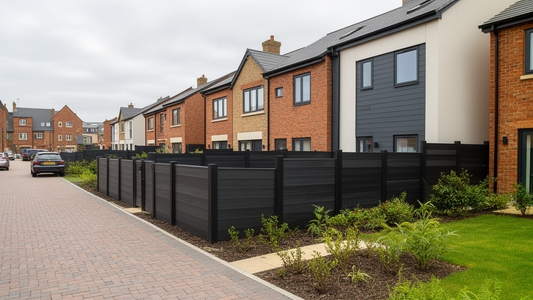
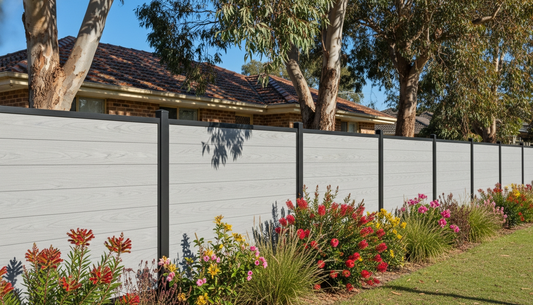
The most widely specified composite fencing style in the UK is the full privacy panel — solid boards set edge to edge with no gaps between them, typically at heights of 1.2m, 1.5m, or 1.8m. These panels provide complete visual screening, good wind reduction, and a clean, uniform appearance that suits both modern and traditional garden settings.
Solid privacy panels are available in board-to-board (no gap) profiles, tongue-and-groove profiles where boards slot together for a very tight join, and shadow gap profiles where a small, consistent reveal between boards adds a contemporary design detail without compromising privacy. For residential back garden boundaries, the 1.8m solid panel remains the most popular choice in the UK — it meets the 2m permitted development height limit with comfortable margin and provides full-height screening.
For commercial applications — housing development boundaries, school perimeters, commercial car parks — the solid panel is typically specified with a heavier post system (100x100mm aluminium or structural steel), and any fire classification named in the specification should be confirmed against an actual test report, with the product reference on it, before the product is approved.
Semi-Privacy and Trellis Panels

Not every garden needs or wants complete enclosure. Semi-privacy panels — typically featuring boards with a consistent 10–20mm gap between them — allow light and airflow through the fence line while still providing a clear boundary and partial screening. These panels are popular in smaller urban gardens where blocking all light can make the space feel oppressive, and in situations where good airflow is more important than total privacy.
Trellis panels, whether half-trellis (solid lower section with open trellis top) or full trellis, serve a different purpose: they mark the boundary, support climbing plants, and allow maximum light transmission. Composite trellis panels offer the same maintenance-free longevity as solid composite panels but with an entirely different aesthetic result — particularly popular with gardeners who want to grow roses, clematis, or other climbing plants without the rotting timber trellis problem.
Decorative and Wavy Profile Options

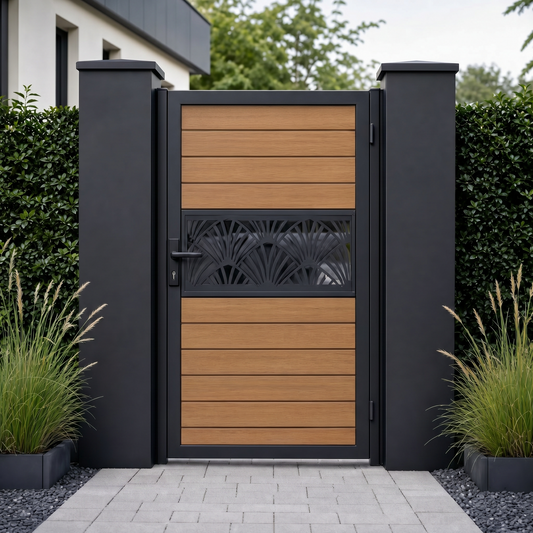
Beyond the standard flat board profile, WPC can be extruded into a range of decorative profiles. Wavy or scalloped top profiles give panels a more characterful appearance. Concave and convex board profiles create shadow and texture on the fence face. Lattice-cut decorative panels can be used as feature sections within a longer fence run. These options are particularly popular in landscaping projects where the fence is a deliberate design feature rather than simply a boundary marker, and they are available from factory-direct suppliers without the significant premium that UK retailers typically charge for decorative profiles.
Composite Fencing Costs in the UK (2026 Prices)
Price transparency is one of the areas where the composite fencing market has historically been poor — UK retailers have often been reluctant to publish clear supply-only prices, and the range between budget and premium products is wide enough to cause genuine confusion. The figures below reflect the actual UK market in 2026.
Supply-Only Price per Panel and per Metre
For standard single-layer WPC composite fence panels:
- 1.2m height panels: £70–£110 per panel supply-only
- 1.5m height panels: £80–£130 per panel supply-only
- 1.8m height panels: £85–£150 per panel supply-only
For co-extrusion (premium) WPC composite fence panels:
- 1.2m height panels: £120–£175 per panel supply-only
- 1.5m height panels: £135–£200 per panel supply-only
- 1.8m height panels: £150–£240 per panel supply-only
On a per-linear-metre basis (based on standard 1.83m-wide panels), supply-only costs range from approximately £45–£80/m for standard WPC and £80–£130/m for co-extrusion WPC.
Posts, rails, post caps, and fixing hardware typically add 15–25% to the supply cost, depending on the post system specified. Aluminium post systems — the recommended choice for composite panels — typically cost £40–£80 per post depending on height and gauge. Note that a run of N panels needs N+1 posts, not N — a detail that is easy to miss when pricing a long boundary.
Fully Installed Cost
Labour rates for composite fencing installation in the UK range from £300–£400 per day for an experienced fencing contractor. A typical residential boundary project — say 20 metres of 1.8m fencing — would typically take one to two days for a two-person team, giving a labour cost of £600–£1,600.
Adding supply costs, a fully installed 20-metre run of 1.8m standard WPC composite fencing typically comes to £2,200–£3,500 in total, or £110–£175 per linear metre installed. Premium co-extrusion products at the same length would typically run to £3,000–£5,000 installed, or £150–£250 per linear metre.
Factory Direct vs UK Retail — Price Comparison
This is where the numbers become particularly interesting for trade buyers. UK retail composite fencing brands — including well-known names such as Ecoscape, Cladco, TekBoard, and Alpha Decking — typically source their products from Chinese manufacturers and add their own margin before selling to UK customers. The factory-direct model, working directly with a factory-direct composite fencing supplier, removes this intermediary margin layer entirely.
In practice, UK merchants, contractors, and developers who source composite fencing directly from a reputable Chinese manufacturer typically achieve 30–40% lower supply costs compared to buying equivalent-quality products from UK retail brands. On a large project — say 500 linear metres for a housing development — that differential represents a very significant sum.
The trade-off is that factory-direct purchasing carries a minimum order quantity and the buyer takes on the logistics of importation. Our MOQ is 70 sets — well under a container — so the direct route is open to merchants and contractors long before they are filling containers. For reference on volume, a 20ft container holds 200 sets and a 40ft high-cube holds 400 sets.
How to Choose the Right Composite Fencing
The right composite fencing specification depends on three variables: who is buying, what the application is, and what budget is available.
For Residential Gardens
For the typical residential garden project — a homeowner replacing a tired timber fence or a contractor doing garden boundary work — the key decisions are height (almost always 1.8m for a back garden boundary), colour, and grade (standard vs co-extrusion). Standard WPC represents excellent value for sheltered gardens in most UK locations. Co-extrusion is worth the additional investment for coastal or fully exposed gardens, and for those who want the peace of mind of maximum durability over a long service life.
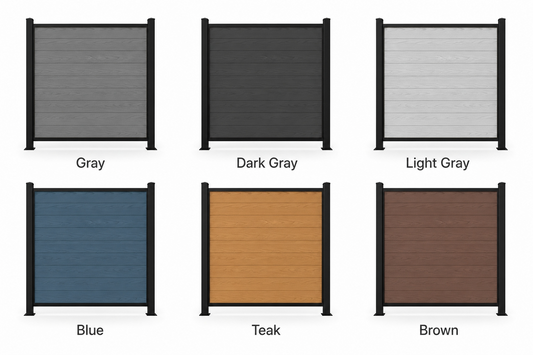
Colour choice is largely personal, but Charcoal and Light Grey dominate UK residential sales in 2026, reflecting the broader trend towards dark tones and contemporary minimalism in UK garden design. Walnut and Teak remain popular for buyers who want a warmer, more traditional timber-like appearance.
For Commercial and Development Projects
Commercial projects introduce additional considerations. Housing developers specifying composite fencing across an entire development need to be confident in supply chain consistency — every panel across hundreds of plots needs to match in colour and profile, which argues for working with a single factory-direct supplier with stable production capacity. Volume pricing at container-load scale dramatically improves project economics.
Schools and local authority projects will typically require formal reaction-to-fire documentation under BS EN 13501-1, and potentially REACH compliance certificates for materials used near playing areas. We do not hold a BS EN 13501-1 classification for our fencing. What we hold is an Intertek flame-retardancy test report, reference 250710027GZU-001 — a test report, not an EN class, and issued on the tested profile rather than the whole range. If your specification names an EN classification, raise it before you specify rather than at approval stage: testing can be arranged, paid up front and credited against the order. Commercial property managers should also ensure the specification includes co-extrusion WPC, given the higher intensity of use commercial fencing typically experiences.
UK Planning Rules and Height Restrictions
Planning permission for composite fencing in the UK is governed by the General Permitted Development Order (GPDO). The key rules are:
- Rear garden boundaries: Fencing up to 2m in height does not require planning permission under permitted development rights (providing the property is not subject to a restrictive planning condition).
- Front garden boundaries: Fencing adjacent to a highway or footpath is limited to 1m height without planning permission.
- Conservation areas and listed buildings: Permitted development rights may be restricted or removed entirely. A planning application is required for any new fencing above 1m in these designations.
- New-build estates: Some new developments have specific restrictive covenants regarding fence materials or heights — buyers should check their deeds.
The material choice — composite vs timber vs metal — has no bearing on the planning permission requirement. What matters is the height and location of the fence.
Why Source Composite Fencing Direct from the Factory?
For trade buyers — merchants, contractors, developers, and distributors — the factory-direct model represents a structural advantage that is reshaping the UK composite fencing supply chain. China manufactures the overwhelming majority of the world's WPC composite products. UK brands do not manufacture composite fencing in the UK; they import it from Chinese factories and resell it with a UK brand identity and margin added.
Working directly with a Chinese manufacturer like Bohai Wood gives UK buyers access to the same product — or better — at a significantly lower cost. Bohai Wood operates 50+ production lines at its facility in Sihui, Zhaoqing, Guangdong province, and supplies over 1,000 clients globally. On certification, the honest position is worth stating plainly: we hold CE marking, REACH compliance and ISO 9001 quality management certification. We do not hold a BS EN 13501-1 reaction-to-fire classification, and we do not hold a BS 7976 pendulum slip value. Ask any supplier — us included — for the report number and the product reference it was issued against, and treat a bare list of standard names as unevidenced.
The factory-direct process is well-established and manageable for UK buyers. Production of standard catalogue profiles takes 20 days, and sea freight from Nansha (Guangzhou) or Yantian (Shenzhen) to a UK port runs to roughly 55 days in practice — so plan on an order-to-UK-port window of around 11 weeks, plus 3–7 days for customs clearance and inland delivery. Anyone quoting you four to five weeks door to door on a sea shipment from South China is quoting a best case you should not build a programme around. Container volumes are 200 sets per 20ft and 400 sets per 40ft high-cube, with a minimum order of 70 sets. Bohai Wood's export team handles all shipping documentation and can recommend experienced UK freight forwarders familiar with WPC fencing imports.
For those new to factory-direct purchasing, the right starting point is a sample order — a small quantity of boards in selected profiles and colours, shipped by courier. Samples themselves are free; you cover the courier charge, and we credit it against your first order. Evaluating samples against current UK market products typically makes the quality and value case compellingly and clearly.
You can explore Bohai Wood's composite fence panels online, or review composite fencing vs timber in more detail if you are still weighing the material decision.
Frequently Asked Questions
Q: What is composite fencing made from?
A: Composite fencing is made from a blend of recycled wood fibres (typically 60% of the composition) and recycled thermoplastic polymers such as HDPE or PVC (typically 40%). UV stabilisers, colourants, and binding agents are added during manufacture. The mixture is extruded through a heated die to form consistent board profiles. Higher-grade co-extrusion products add a separate protective polymer cap layer to the outer surface during manufacture, which improves durability and surface performance.
Q: How long does composite fencing last in the UK?
A: Quality composite fencing from a reputable manufacturer typically lasts 20–30 years in UK conditions. Warranty is a different question from service life, and it is the one that carries commercial weight: Bohai Wood's fencing carries a 10-year warranty, stepped by year rather than flat, running from the date the goods are received at the destination port. Treat any supplier quoting 25 or 30 years as a headline number and ask to see the schedule — what it pays in year 12 is the figure that matters. The key factors affecting actual lifespan are the grade of material (standard vs co-extrusion), the quality of UV stabilisers used, installation quality (particularly post depth and concrete mix), and the degree of UV exposure. Compared to treated softwood timber, which typically requires full replacement within 10–15 years, composite fencing lasts substantially longer.
Q: Is composite fencing more expensive than wood?
A: Upfront supply costs for composite fencing are higher than treated timber — typically two to three times the cost on a per-panel basis. However, when you account for the ongoing costs of timber maintenance (annual treatment, painting or staining, periodic board replacement), the 10-year total cost of ownership for composite fencing is typically lower than timber. A 20-metre run of 1.8m timber fencing might cost £600–£1,200 to supply but require £150–£300 per year in treatment and upkeep, plus partial replacement costs. The equivalent composite fence requires virtually no ongoing expenditure once installed.
Q: Does composite fencing need planning permission in the UK?
A: Not in most cases. Under permitted development rights, rear garden fencing up to 2m in height and front garden fencing up to 1m in height can be installed without planning permission. However, if your property is in a conservation area, is a listed building, or is subject to specific planning conditions (common on some new-build estates), you may need to apply for planning permission before installation. If in doubt, contact your local planning authority — this is a free and quick process in most cases.
Q: What is the best composite fencing in the UK?
A: The best composite fencing depends on your application and budget. For residential projects, co-extrusion WPC from a manufacturer with ISO 9001 certification and a written, stepped warranty schedule represents the best long-term value — a schedule you can read beats a longer headline number you cannot. In the UK, well-known retail brands include Ecoscape, Cladco, and TekBoard. Factory-direct suppliers such as Bohai Wood offer equivalent or superior product at 30–40% lower cost for trade buyers, from a minimum order of 70 sets. Key quality indicators to check are: CE marking, co-extrusion vs standard WPC, UV stabiliser specification, post system compatibility, and named test report numbers for any performance claim.
Q: Can I install composite fencing myself?
A: Yes — composite fence panels are designed to be installed with standard tools and no specialist skills beyond basic woodworking competence. The process involves setting posts (typically 600–900mm deep in concrete depending on soil conditions and fence height), fitting the bottom rail, inserting boards from the bottom up, and fitting the top rail and post caps. Remember that a run of N panels needs N+1 posts. Most 1.8m composite fence panels weigh 15–25kg depending on the profile and length, which makes them manageable for a two-person team without mechanical assistance. Aluminium post systems are simpler to work with than concrete posts for composite panels. A comprehensive installation guide should be supplied or available from your panel supplier.
Ready to Get Started?
Browse Bohai Wood's full composite fencing range — factory-direct prices, shipped to the UK across all major port routes. Whether you are a contractor pricing a development project, a merchant building out your product range, or a distributor looking for a reliable long-term supply partner, our team responds to all UK enquiries within 24 hours.
Request a quote at bohaiwoods.com/pages/contact — include your volume requirements and preferred profile/colour specifications for an accurate factory-direct price.
Tags:
Previous
WPC vs PVC vs Aluminum Cladding: An Engineering Comparison for Commercial Projects (2026)
Next
WPC Composite Fence Panels UK: Full Specs, Sizes and Wholesale Guide