


Classic Composite Decking(anti-slip grain)


Classic composite decking (deep wood grain)


Classic vs Co-Extrusion vs Solid Timber — Full Comparison
| Feature | Classic WPC — BOHAI | Co-Extrusion WPC — BOHAI Premium | Solid Timber — Traditional |
|---|---|---|---|
| Price point | ✓ Budget-friendly | △ Mid-premium | △ Variable |
| UV resistance | △ Good | ✓ Excellent — polymer cap | ✗ Fades & greys |
| Stain resistance | △ Moderate | ✓ High — capped surface | ✗ Absorbs stains |
| Rot & mould | ✓ Resistant | ✓ Resistant | ✗ Prone to rot |
| Maintenance | ✓ None required | ✓ None required | ✗ Annual oiling/staining |
| Splinter-free | ✓ Yes | ✓ Yes | ✗ Splinters over time |
| Installation | ✓ Hidden clip system | ✓ Hidden clip system | △ Nails & screws visible |
| Eco-friendly | ✓ Recycled wood fibre & polymer | ✓ Recycled wood fibre & polymer | ✗ Virgin timber |
| Warranty | ✓ 10 years, stepped | ✓ 15 years, stepped | ✗ None typically |
| Slip classification held | ✗ None on this grade | ✓ R10 on profile ZSGJ138H23A (AS 4586 App. D, shod wet) | ✗ None typically |
| Best for | Residential & light commercial, cost-sensitive projects | High-UV, poolside, luxury residential & commercial | Traditional aesthetics where maintenance is acceptable |
The Warranty Schedule, Year by Year
Our cover is stepped, not flat. A headline number on its own tells you nothing about what is actually payable in year 9, so here is the whole schedule for both grades. Cover runs from the date the goods arrive and are signed for at the destination port, and it is expressed as a percentage of the value of the affected goods. Warranties are issued per batch rather than per SKU, so the schedule that applies to your order is the one printed on that batch's certificate — ask for it before you quote a figure to a client.
| Year | Classic — uncapped (10 yr) | Premium — capped co-extrusion (15 yr) |
|---|---|---|
| Years 1–3 | 100% | 100% |
| Year 4 | 80% | 80% |
| Year 5 | 70% | 70% |
| Year 6 | 50% | 50% |
| Year 7 | 40% | 40% |
| Year 8 | 30% | 30% |
| Year 9 | 20% | 30% |
| Year 10 | 10% | 20% |
| Years 11–12 | ✗ No cover | 20% |
| Years 13–15 | ✗ No cover | 10% |
| Year 16 onward | ✗ No cover | ✗ No cover |
Classic Composite Decking Thickness and Width
Classic profiles run from 21.5 mm to 25 mm in composite deck thickness, across face widths of 140–150 mm. Hollow chambered boards carry the load on a lighter section; solid boards are denser and stiffer at the same face width. Every board in this range is uncapped, so the thickness of composite decking you choose is what governs span — there is no cap layer adding stiffness.
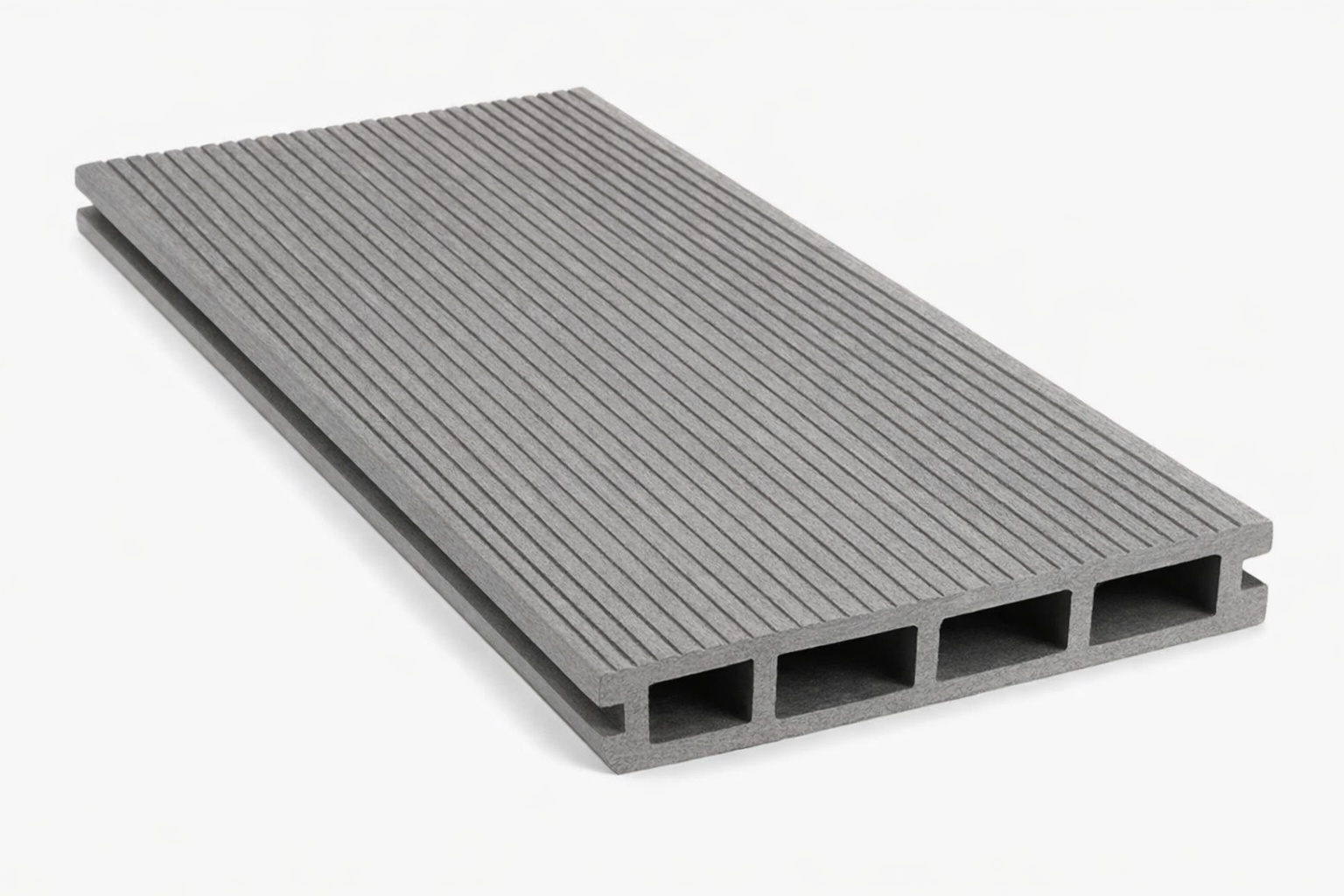
Square groove, hollow
140 × 25 mm
Residential decks and balconies. Chambered core keeps dead load down and drains freely.
View product →
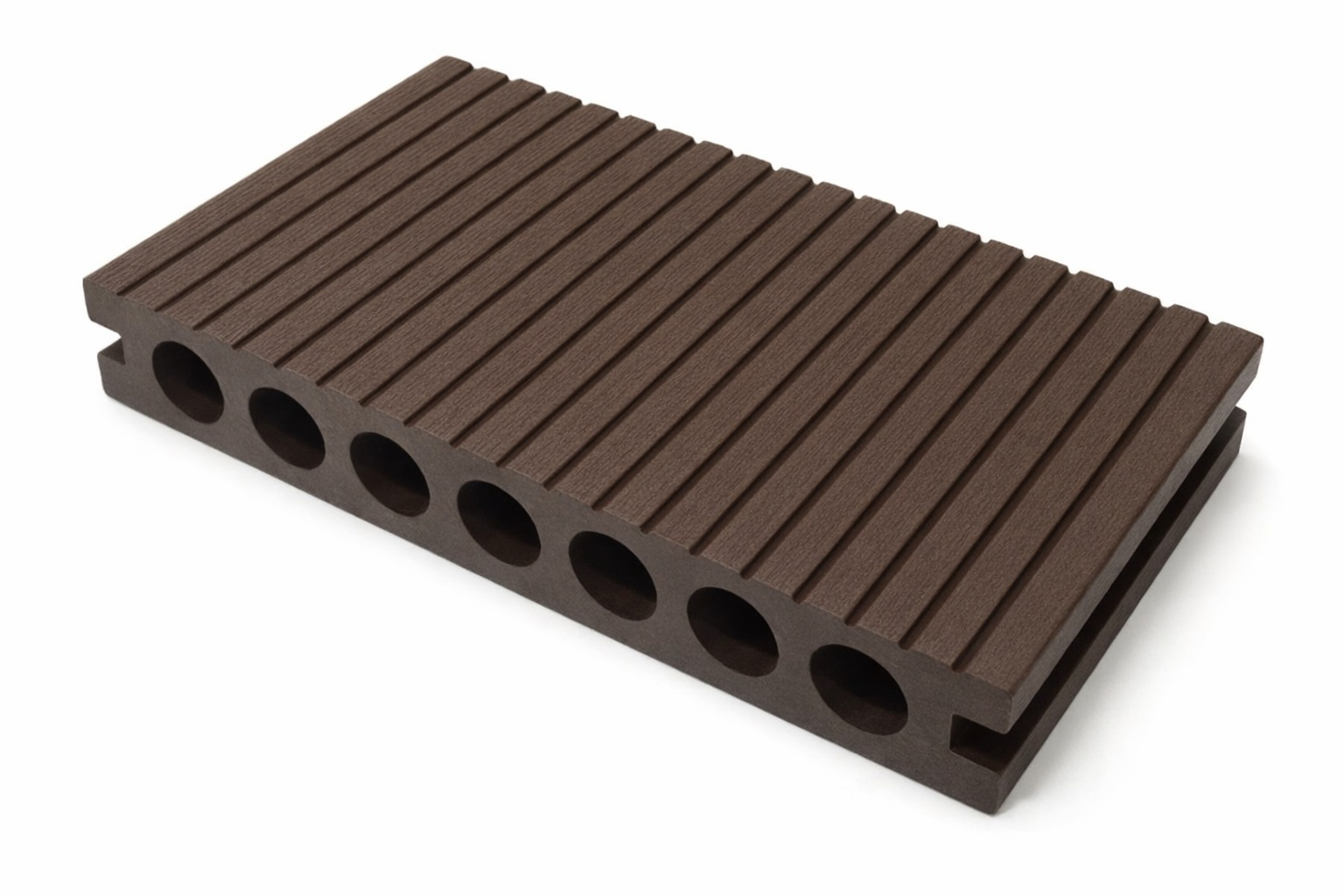
Round groove, hollow
140 × 25 mm
Same section as the square groove, with a rounded chamber profile.
View product →

Solid, straight grain
140 × 21.5 mm
Denser and stiffer. Commercial walkways and sustained foot traffic.
View product →
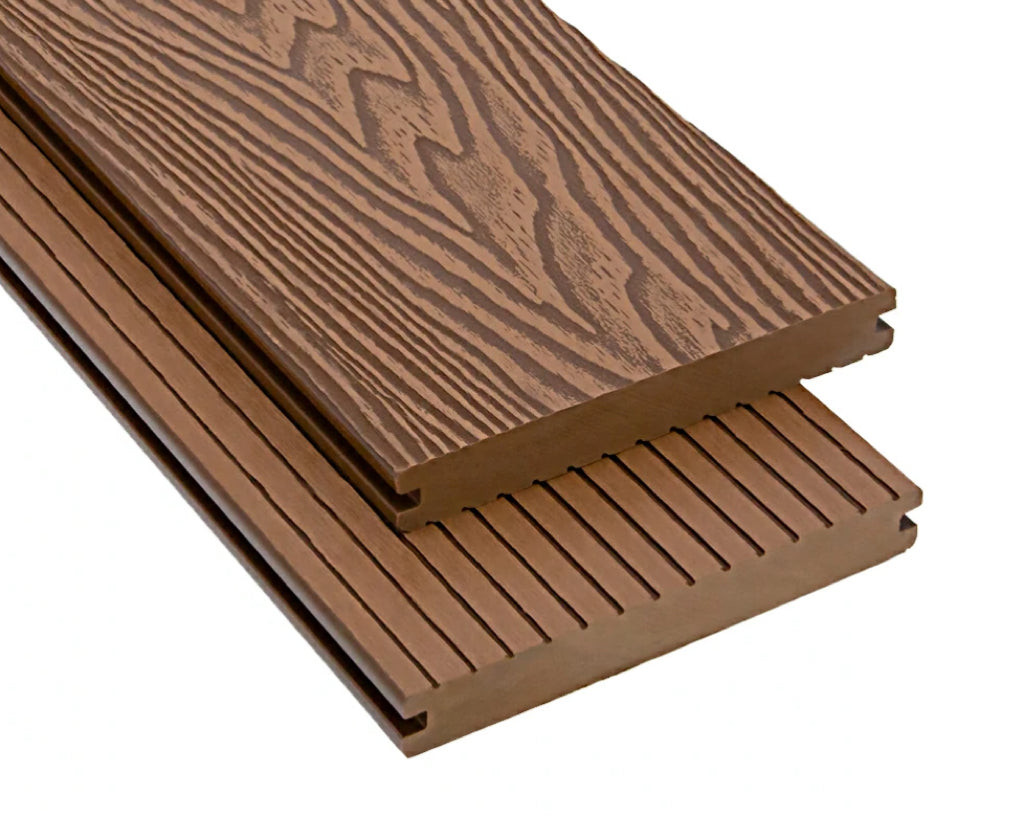
3D embossed, solid
140 × 23 mm
Deep wood grain on a solid section, for exposed weather-facing decks.
View product →
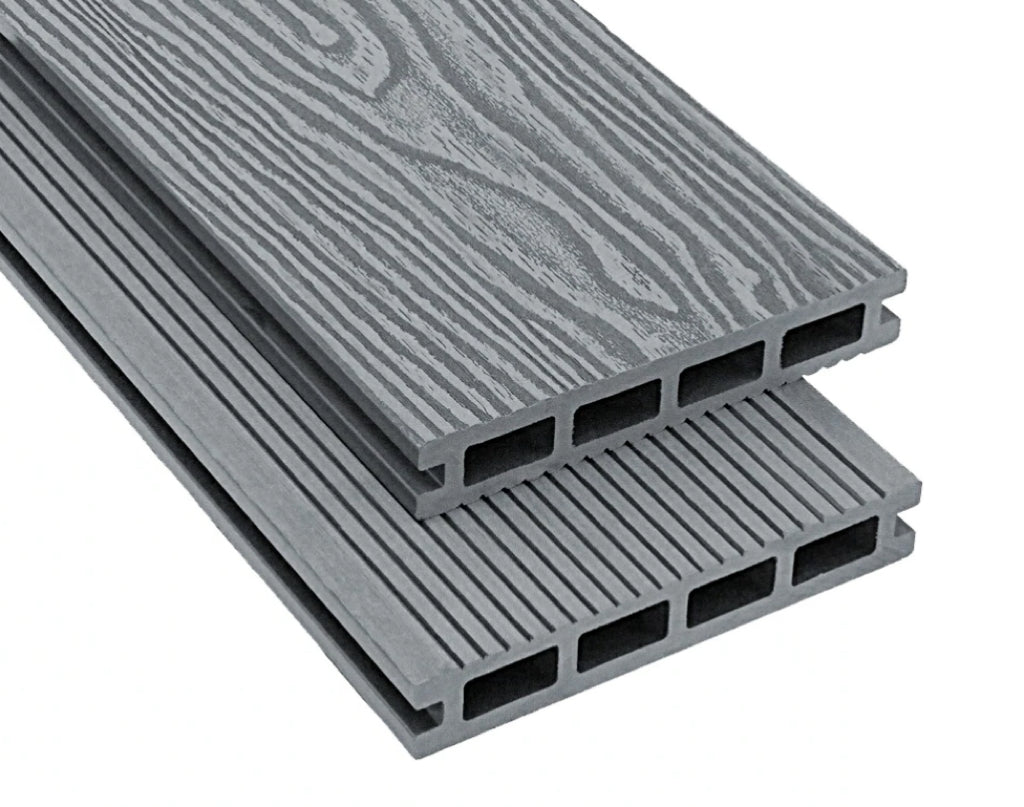
3D embossed, square
145 × 21.5 mm
Deep grain at the lowest cost per square metre in the range.
View product →

3D embossed, round
150 × 23 mm
Widest board here — fewer boards per square metre, faster to lay.
View product →
Not sure which profile fits your project?
Send us the deck area and the joist layout. We will confirm the profile, the board count and how it packs into a container before you commit to anything.
Installing Classic Decking: Spacing, Joists and Clips
Getting composite decking spacing right is the single thing that decides whether a deck stays flat. Boards expand and contract with temperature, so the gap between them is a working allowance, not a tolerance.
Board gap
Leave a 5–8 mm gap between boards for thermal movement and rainwater drainage. In hot climates use the upper end of that range. Our hidden clip system sets this composite deck spacing automatically during installation, so there is no need to measure between each board.
Composite decking joist spacing
Correct composite decking joist spacing depends on the profile and the lay direction — a hollow board spans less than a solid one of the same width, and any diagonal lay shortens the effective span between crossings. Confirm the joist centres for your chosen profile with us before the subframe is set out, and keep butt joints over a joist rather than between them.
Hidden fastener decking — the clip system
Classic boards are grooved on both long edges and fixed with composite decking clips that engage the groove at every joist crossing. The result is a surface with no visible screw heads, consistent gaps and free drainage — the standard approach for hidden fastener decking. Clips, starter clips, zinc-plated steel keel, fastening fittings and skirting trim are all listed on our composite decking accessories page. If your project is driven by the setting rather than the board grade, our guide to composite decking types and build-ups works through which profile each setting needs.
Need the joist centres for your profile?
Joist spacing depends on the board and the lay direction, so we confirm it per profile rather than publishing one number. Tell us what you are specifying and we will send the centres before the subframe is set out.
Where Classic WPC Decking Works Best

Garden Deck
Composite decking patio boards for residential gardens and outdoor living areas.

Pool Surround
A composite deck pool surround drains freely and will not swell, rot or splinter. Ask us about slip classification before specifying a barefoot wet area.

Balcony & Terrace
Composite balcony decking in the hollow profile keeps dead load down on elevated structures.

Commercial Walkway
The solid profile handles sustained foot traffic on public walkways and boardwalks.

Rooftop Terrace
Lightweight hollow boards suit rooftop loading limits and podium decks over garages.

Poolside Decking
Pool deck boards that resist water without warping, swelling or splintering underfoot.

Outdoor Dining
Composite outdoor decking for restaurant terraces and hospitality seating areas.

Garden Path
Durable composite decking for garden paths and low-level walkways over soft ground.

Pontoon & Dock
Waterside installations, pontoons and docks in permanently damp marine environments.
Buying From Composite Deck Manufacturers: How to Tell the Plant From the Middleman
Most of the composite deck companies you will find in a search are distributors, importers or brands that buy from plants like ours and resell. There is nothing wrong with that — but you are paying for it, and it changes what you can ask for. Four questions separate the two.
Ask which port they load from
A plant names its port without hesitating. Ours are Nansha and Yantian, and both appear on our commercial invoices. Composite deck suppliers who cannot answer this, or who answer with a city rather than a port, are almost always buying from someone else.
Ask for the certificate number, not the logo
Any composite deck company can put an ISO badge on a web page. Ask for the certificate number and the expiry date and check them. Ours are ISO 9001 and ISO 14001, both valid to April 2027, issued to Guangdong Bangying New Material Co., Ltd. — the legal entity behind the BOHAI brand, and the name that appears on the invoice.
Ask what they will not claim
This is the most useful question and almost nobody asks it. Composite deck material manufacturers who know their own product will tell you which tests they hold and which they do not. We publish one slip result — R10 under AS 4586-2013 Appendix D on profile ZSGJ138H23A — and we say plainly that the classic range in this collection has no slip classification at all. A supplier who claims everything has usually tested nothing.
Ask whether you can visit
The address on our documents is the plant, in Sihui, Zhaoqing, Guangdong — not an office. Buyers and third-party inspection firms are welcome. An offer of a factory video instead of a factory visit tells you what you need to know.
Frequently Asked Questions
Product & Specifications
What is the difference between hollow and solid WPC decking boards?
Hollow WPC decking boards (square groove and round groove, 140×25mm) have internal chambers that reduce overall weight and material cost while maintaining excellent surface strength for residential and light commercial use. Solid WPC boards (140×21.5mm) are fully dense throughout, offering higher load-bearing capacity and greater rigidity — making them the preferred choice for high-traffic commercial walkways, public boardwalks, and areas subject to sustained heavy foot traffic.
What installation gap should I leave between classic WPC decking boards?
We recommend leaving a 5–8mm gap between boards to allow for thermal expansion and contraction and to provide drainage for rainwater. In high-temperature climates (Middle East, Australia), err towards the larger end of this range. Our hidden clip system maintains consistent spacing automatically during installation, removing the need for manual measurement between each board.
Are classic WPC decking boards anti-slip?
We do not hold a slip classification for the classic uncapped range, and we will not imply one. The surface groove pattern adds texture underfoot, but texture is not a rating. The only slip result we hold is R10 under AS 4586-2013 Appendix D — the oil-wet ramp test, walked in shoes — measured on the co-extruded profile ZSGJ138H23A, which is not a board in this collection. We do not hold the DIN 51097 barefoot wet classification that pool surrounds and changing areas are normally specified against. If your project needs a classification, tell us at design stage: testing can be arranged, with the cost paid up front and credited in full against your order.
What colours are available for classic WPC decking?
Our classic WPC decking boards are available in a range of standard colours including Teak, Walnut, Light Grey, Charcoal, and Dark Brown, with additional colours available for project orders above minimum quantity. All colours are integrated throughout the board material — not surface-painted — ensuring the colour remains consistent even if the board surface is lightly scratched during installation or use.
What is uncapped composite decking?
Uncapped composite decking has the wood-polymer composite exposed on all four faces, with no bonded polymer cap. It still resists rot and needs no annual treatment, but the open surface marks more easily than a capped board. It is the cost-led choice for residential and light commercial decks.
How thick is composite decking?
Our classic profiles run from 21.5 mm to 25 mm thick across face widths of 140–150 mm. The most specified is the 140 × 25 mm hollow board; solid boards are 140 × 21.5 mm. Thickness is what governs how far a board can span between joists, so it drives the subframe design more than any other dimension.
What is the cheapest composite decking for a pool deck?
Within our range the hollow 140 × 25 mm classic profile is the lowest cost per square metre and is widely used around pools, because it drains freely and does not swell. If the surround takes heavy year-round footfall, the solid profile costs more per metre but holds up better. Note that we hold no slip classification on the classic range — if the surround is a barefoot wet area assessed under DIN 51097, raise it with us before specifying.
Durability & Performance
How long will classic WPC composite decking last?
BOHAI classic WPC decking carries a 10-year limited warranty with stepped cover, running from the date the goods are received at the destination port. The full year-by-year schedule is published in the warranty table above: 100% of the value of the affected goods in years 1–3, 80% in year 4, 70% in year 5, 50% in year 6, 40% in year 7, then 30%, 20% and 10% in years 8, 9 and 10, with no cover from year 11. Our co-extruded range carries 15 years on the same stepped basis. The composite material is inherently resistant to rot, mould, insect damage, and UV degradation — the primary failure modes of timber decking. Unlike timber, WPC does not require periodic retreatment to maintain its service life, making the total lifecycle cost significantly lower than wood alternatives.
Will classic WPC decking fade in strong sunlight?
Classic WPC decking will undergo a natural weathering process during the first 3–6 months of outdoor exposure, during which the surface colour will settle slightly from its original shade. After this initial period, the colour stabilises and remains consistent for the life of the product. For maximum long-term colour retention in high-UV environments such as Australia, the Middle East, and Southern Europe, we recommend our co-extrusion WPC decking range, which features a UV-stable polymer cap layer for enhanced colour stability.
What does the warranty actually pay, and what is excluded?
Cover is a percentage of the value of the affected goods, stepped by year — see the schedule table above. It covers three naturally occurring inherent defects: peeling, cracking, and overall uneven fading. Excluded are improper installation, physical or accidental damage, natural disasters, chemical corrosion, improper use, and after-sales service costs. Cover is conditional on the boards having been installed to our official guidelines and normally maintained, and warranties are issued per batch rather than per SKU, so the governing schedule is the one on that batch's certificate.
Ordering & Supply
What is the minimum order quantity for classic WPC decking?
Our minimum order quantity is 70 m². That is well below a full container, so a first order or a single project does not have to fill one. We supply distributors, contractors and project buyers, and full container quantities attract the strongest per-square-metre pricing. Samples are available on request: we supply the board free of charge and the courier cost is invoiced to you, then credited against your first order.
Can BOHAI supply classic WPC decking with accessories and fixings?
Yes. We supply a complete classic decking system including boards, hidden stainless steel or aluminium clips, starter clips, joist/keel profiles, edge trim boards, and end caps. A complete accessory package means your project can be supplied from a single source, simplifying procurement and ensuring all components are matched to the board profile and colour. Contact us for a full system quote including accessories.
Do you supply composite decking to distributors and contractors?
Yes — we sell business-to-business only. As composite decking manufacturers we ship direct from our factory in Guangdong to distributors, contractors and project buyers, FOB Nansha or Yantian. We do not sell to homeowners. Buyers comparing composite decking suppliers are welcome to request our certificates and test reports before ordering.
Are you one of the composite deck companies that resells, or the factory?
The factory. We are composite deck material manufacturers, not a trading company — the boards in this collection are extruded on our own lines in Sihui, Zhaoqing, Guangdong, and shipped FOB Nansha or Yantian. Many composite deck suppliers you will find online are importers reselling containers they bought from plants like ours. If you are comparing quotes, ask each composite deck company which port they load from and who the legal entity on the invoice is; the answers separate the two very quickly.
Ready to order uncapped composite decking?
Factory-direct pricing · ISO 9001 & 14001 · 10-year stepped warranty · MOQ 70 m² · Trade buyers only


