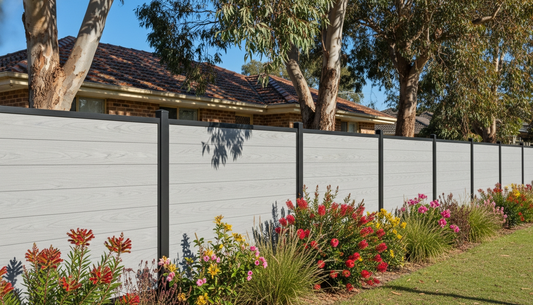
Composite Fencing vs Wood Fencing: Which Is Better for US Homeowners?
For most of the last century, wood was the default fencing material for American homeowners — cheap, familiar, and easy to install. Composite fencing has spent the last two decades chipping away at that default, and by 2026 it has become the material of choice for a large share of privacy fence, backyard, and HOA-community projects. But "better" depends heavily on what a buyer is optimizing for: lowest possible upfront cost, lowest cost over 15–20 years, minimal upkeep, or a specific aesthetic. This guide walks through the comparison the way a contractor or procurement buyer would — cost first, then the maintenance and durability data that determines whether that initial cost estimate holds up over the life of the fence.
If you're earlier in the research process and still weighing composite against other materials generally, the composite fencing & gates buyer's guide is a useful starting point before diving into this wood-specific comparison.
Upfront Cost: Composite vs Wood Fencing
On a pure materials-and-labor basis, wood fencing is cheaper to install than composite fencing in nearly every US market. Pressure-treated pine, the most common wood fencing material, typically installs for $12–$25 per linear foot, including posts and labor, for a standard 6-foot privacy fence. Cedar, a step up in appearance and rot resistance, runs $18–$35 per linear foot installed. Composite fencing, by comparison, spans a much wider range — from $20–$30 per linear foot for entry-level uncapped WPC panels up to $40–$80 per linear foot for premium capped, co-extruded systems, as detailed in the composite fencing cost guide.
The gap is real and it matters for buyers working with a fixed project budget and no flexibility to spread cost over time. For a typical 150-linear-foot backyard fence, pressure-treated pine might run $1,800–$3,750 installed, while a comparable composite installation could run $3,000–$12,000 depending on tier. Homeowners financing a fence out of pocket, or contractors bidding competitively on a price-sensitive job, often find wood's lower entry point decisive in the moment — even when it isn't the better long-term value.
Where the comparison gets more nuanced is at the premium end of both categories. High-grade cedar or redwood, dimensional lumber with clear (knot-free) grades, and craftsman-style wood fence designs can cost as much as or more than mid-tier composite. At that price point, buyers are no longer choosing wood purely for savings — they're choosing it for a specific traditional aesthetic, and the cost comparison with composite becomes much closer, sometimes favoring composite once installation quality is held constant.
Factory-direct sourcing changes this calculation further. Buyers purchasing capped WPC composite fencing directly from a manufacturer rather than through a US retail or distributor channel can access factory-direct composite fencing pricing that narrows or, at scale, closes the upfront cost gap with wood — while retaining composite's durability and maintenance advantages described below.
Lifetime Cost: Maintenance, Repairs and Replacement
Upfront cost tells only part of the story, and it is frequently the wrong number to anchor a fencing decision on. Wood fencing requires ongoing maintenance that composite does not: staining or sealing every 1–3 years at $2–$5 per linear foot in materials and labor, plus periodic board replacement as individual boards rot, warp, split, or are damaged by insects. Over a 15–20 year ownership period, a wood fence typically requires 5–8 maintenance cycles and at least one partial board replacement, pushing cumulative maintenance spend to $3,000–$8,000 or more for a 150-linear-foot fence — on top of the original installation cost.
Composite fencing, particularly capped WPC product, requires essentially no staining or sealing. Occasional washing with soap and water is the extent of routine upkeep, a difference explored fully in the composite fencing maintenance guide. There is no recurring $2–$5 per linear foot maintenance cost every few years, and no labor line item for a homeowner or a facilities team to plan around annually.
When these figures are modeled over a realistic ownership horizon, the total cost of ownership comparison shifts substantially. A wood fence with a $2,500 upfront cost and $400–$600 in maintenance spend every 2 years can accumulate $5,500–$8,000 in total cost by year 15 — without accounting for full replacement, which pressure-treated wood typically requires once within that window. A composite fence with a $6,000 upfront cost and near-zero maintenance spend may cost $6,500–$7,000 by year 15, and it still has 5–10+ years of useful life remaining given typical 20–25 year warranties on capped boards. The full math, including breakeven timelines for different starting price points, is worked through in the cost-benefit analysis — a resource worth reviewing before committing budget to either material.
Repair costs also diverge. A damaged or rotted wood board is inexpensive to replace individually but happens often enough that the cumulative labor cost adds up. Composite boards are far less prone to warping, splitting, or insect damage, so unplanned repair frequency is meaningfully lower across the fence's service life.
Appearance and Color Options Over Time

New wood fencing has an appearance that's hard to replicate synthetically — natural grain variation, a warm tone, and a material authenticity that many homeowners specifically want. The tradeoff is that this appearance is temporary without maintenance. Untreated or unsealed wood grays and weathers within 6–18 months of installation, depending on climate and sun exposure. Even sealed wood requires reapplication on a 1–3 year cycle to maintain its original color; skip a cycle and the fence begins visibly graying, splitting at the surface, and showing UV damage.
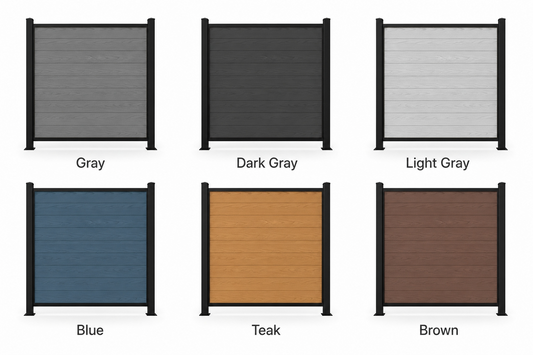
Composite fencing, especially capped co-extruded product, is engineered specifically to resist this kind of appearance degradation. The capping layer contains UV stabilizers that resist fading far more effectively than raw wood or even stained wood, and manufacturers commonly back this performance with 20–25 year warranties covering color retention as well as structural integrity. Color options have also expanded significantly — composite fencing in 2026 is available in black, brown/walnut, gray, and cedar-toned finishes, with black leading current design trends for its clean, modern look against a wide range of home exteriors, as covered in more detail in a dedicated colors guide.
The practical difference for a buyer comparing the two materials side by side after five years of ownership is stark: a well-maintained (stained/sealed on schedule) wood fence will look reasonably close to new, but an unmaintained one will look substantially aged, grayed, and possibly warped. A composite fence, maintained or not, will look nearly identical to its installation-day appearance, because there's no staining schedule to fall behind on in the first place. For buyers who know realistically they won't keep up a strict staining schedule — which describes most homeowners — composite's appearance stability over time is one of its most concrete advantages.
Durability in Different US Climates

Climate exposure is where the practical performance gap between the two materials becomes most visible, and it varies meaningfully by region. In humid Southeast and Gulf Coast climates, wood fencing faces persistent moisture exposure that accelerates rot, mold growth, and termite activity — pressure treatment slows but does not eliminate these risks, and untreated cut edges (at posts, joints) are common failure points. Composite fencing's polymer content is inherently moisture- and insect-resistant, making it a strong performer in exactly the climates where wood struggles most.
In the arid Southwest, UV exposure rather than moisture is the dominant stress factor. Wood dries out, cracks, and splits under intense, sustained sun exposure unless very diligently maintained. Capped composite fencing, engineered with UV-stabilized outer layers, resists this kind of sun damage far more effectively — a meaningful advantage in states like Arizona, Nevada, and inland California.
In freeze-thaw regions across the Midwest and Northeast, both materials face stress from expansion and contraction cycles, but the failure modes differ. Wood posts set in concrete can heave with frost, and moisture trapped in wood grain that then freezes accelerates splitting. Composite posts — particularly aluminum-reinforced or steel-core composite post systems — handle freeze-thaw cycling with less material fatigue, though proper footing depth below the frost line remains essential regardless of fence material.
Coastal and high-wind regions favor composite's structural consistency: composite boards don't develop the localized weak points from rot or insect damage that make wood fencing vulnerable to storm damage over time. For a full breakdown of how long each material realistically lasts under these conditions, the composite fencing lifespan guide covers expected service life by climate zone and product tier in more depth.
Environmental Considerations: Recycled Content vs Treated Lumber
Environmental impact is a genuinely mixed comparison rather than a clean win for either material, and buyers should weigh the specific factors that matter most to them. Wood is a renewable resource, and fencing sourced from certified sustainable forestry operations has a reasonable environmental case, particularly compared to virgin-plastic products. The counterpoint is that most economical wood fencing is pressure-treated with chemical preservatives (commonly copper-based compounds) to resist rot and insects — these treatments raise disposal considerations, since treated lumber generally cannot be safely burned or composted and requires landfill disposal at end of life.
WPC composite fencing is manufactured from a blend of roughly 60% recycled wood fiber and 40% recycled HDPE polymer — meaning the majority of the material by weight is diverted from waste streams rather than newly harvested or newly refined. This recycled-content profile gives composite a strong circular-economy argument: it repurposes wood processing byproducts and post-consumer plastic that would otherwise go to landfill. The tradeoff is that composite fencing, being polymer-inclusive, does not biodegrade at end of life the way untreated wood does, and recycling infrastructure for WPC composite products specifically is still developing in most US regions.
For buyers prioritizing minimal chemical treatment, untreated cedar or redwood (naturally rot-resistant species that don't require chemical preservation) is arguably the more environmentally straightforward choice, at a cost premium. For buyers prioritizing reduced virgin material consumption and diversion of waste plastic from landfill, composite's recycled-content composition is the stronger argument. Neither material is environmentally "free," and buyers with strict sustainability requirements — HOA communities with green building mandates, for example — should request specific recycled-content percentages and certification documentation from any composite supplier rather than taking general marketing claims at face value.
Which Option Is Right for Your Project?
The right material depends on which variables matter most for a specific project, and being explicit about priorities makes the decision considerably easier. Wood fencing tends to be the better fit for buyers with a tight upfront budget who are willing to commit to a genuine maintenance routine, for temporary or shorter-horizon installations where 20-year durability isn't relevant, and for buyers who specifically want the traditional, natural aesthetic that only real wood grain provides — accepting that it will require active upkeep to preserve that look.
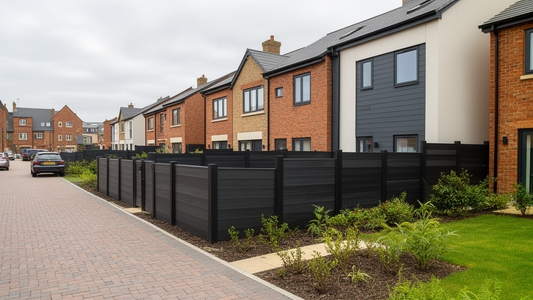
Composite fencing tends to be the better fit for buyers planning to own the property long-term and wanting to avoid a recurring maintenance obligation, for humid, high-UV, or freeze-thaw climates where wood's weaknesses are most pronounced, for HOA communities and commercial properties where consistent long-term appearance across dozens or hundreds of linear feet is a priority, and for buyers who've run the lifetime-cost numbers and found that composite's higher entry price is offset within a reasonable ownership horizon.
A practical way to test which category fits your project: if you can honestly commit to staining or sealing a wood fence every 1–2 years without fail, and you plan to own the property for under 10 years, wood is a defensible and cost-effective choice. If either of those conditions doesn't hold — a common reality for most homeowners — composite fencing's higher upfront cost is very likely to be recovered in avoided maintenance spend and improved longevity well before the fence needs replacing.
Frequently Asked Questions
Q: Is composite fencing more expensive than wood upfront?
A: Yes, in most cases. Pressure-treated wood fencing typically installs for $12–$25 per linear foot, while composite fencing ranges from $20–$30 per linear foot for entry-level uncapped panels up to $40–$80 per linear foot for premium capped WPC systems. Factory-direct sourcing can narrow this gap significantly at equivalent specification, particularly for larger projects where container-quantity purchasing becomes viable and retail distribution markups are removed from the price.
Q: Does composite fencing save money over time compared to wood?
A: Often, yes, once maintenance is factored in. Wood requires staining or sealing every 1–3 years at $2–$5 per linear foot, plus periodic board replacement, which can add $3,000–$8,000 in cumulative costs over 15–20 years for a typical residential fence. Composite requires minimal maintenance beyond occasional washing, so its higher upfront cost is frequently offset within 8–15 years depending on the specific price points and maintenance discipline involved.
Q: Which lasts longer, composite or wood fencing?
A: Composite fencing generally lasts longer. Capped WPC composite fencing commonly carries 20–25 year warranties on color and structural integrity, and well-maintained installations often exceed that. Wood fencing, even pressure-treated, typically requires significant repair or full replacement within 15–20 years, and sooner in humid or high-insect-pressure climates without diligent maintenance.
Q: Does composite fencing fade less than wood?
A: Yes. Capped, co-extruded composite fencing includes UV-stabilized outer layers specifically engineered to resist color fading, and manufacturers typically warranty this performance for 20–25 years. Unsealed or under-maintained wood fencing grays and fades within 6–18 months of installation, and even properly stained wood requires reapplication every 1–3 years to maintain its original color.
Q: Is composite fencing more environmentally friendly than wood?
A: It depends on the specific comparison. Composite fencing is typically made from roughly 60% recycled wood fiber and 40% recycled HDPE polymer, giving it a strong recycled-content and waste-diversion profile, but it does not biodegrade at end of life. Untreated, sustainably-sourced wood is renewable and biodegradable, but most economical wood fencing is chemically treated for rot resistance, which complicates its disposal profile. Neither material has an unambiguous environmental advantage across every criterion.
Ready to Get Started?
Considering the switch from wood to composite? Get factory-direct composite fencing pricing from Bohai Woods to compare real numbers.
Tags:
Previous
Pool Fence Codes USA: Composite Fencing and Gate Compliance Guide (2026)
Next
WPC Fencing Certifications USA: A 2026 Verification Checklist