How Much Does Composite Fencing Cost in the UK? (2026 Price Guide)
Composite fencing is a significant investment, and one of the first questions any UK buyer asks is: what will it actually cost? This guide gives you real 2026 prices — supply-only, fully installed, and over a 10-year period — so you can budget accurately and understand exactly where your money goes.
UK Composite Fencing Cost Calculator
Enter the number of 1.8 m bays, choose the panel construction and decide whether to include a rough post-and-labour allowance. The estimate updates as you type.
£1,725–£3,405
10 bays · approximately 18.3 m11 posts included
Panels £850–£1,500 · posts £275–£605 · labour allowance £600–£1,300
Indicative budget, not a quotation. It excludes gates, removal, disposal, concrete, gravel boards, caps, difficult access and unusual ground conditions. The labour allowance follows the broad day-rate assumptions in this guide; obtain an itemised local installer quote before committing.
Composite Fencing Price Summary 2026
The table below gives a quick overview of what you can expect to pay across the main cost categories. All figures are for supply to the UK and reflect current market pricing.
| Cost Category | Price Range |
|---|---|
| Standard WPC panels (supply only) | £85 – £150 per panel |
| Co-extrusion WPC panels (supply only) | £150 – £240 per panel |
| Aluminium post system (per post) | £25 – £55 |
| Installation labour | £300 – £400 per day |
| Typical full installation (10 panels) | £1,200 – £2,200 all-in |
| Minimum order (factory-direct) | 70 sets |
These figures cover a standard residential or commercial installation using 1.8m-high solid privacy panels, which represent the most common specification across the UK market. If you are working with shorter panels or simpler profiles, costs reduce accordingly. For a deeper explanation of the product specifications behind these prices, the composite fencing UK buyer's guide covers material grades, panel heights, and styles in detail.
Supply-Only Costs: Per Panel and Per Metre
Supply-only pricing refers to the cost of the composite fence panels themselves, delivered to site, before any installation labour or groundworks. This is the relevant figure for contractors who install their own, builders merchants buying to resell, or developers pricing up a specification.
Standard WPC — approx £85–150 per panel
Our standard WPC formulation is approximately 60% wood powder, 30% HDPE and 10% additives. At the lower end of the range — around £85 per panel — you are typically buying a 1.2m-high or 1.5m-high panel in a standard colour such as charcoal or light grey, direct from a factory-direct supplier. The upper end of the standard WPC range, at around £150 per panel, reflects a full 1.8m-high privacy panel purchased at retail from a UK distributor.
On a per-metre basis, standard WPC panels typically work out at approximately £50–£95 per linear metre, depending on height and sourcing. Posts, rails, and fixings are additional.
Co-Extrusion (Premium) WPC — approx £150–240 per panel

Co-extrusion WPC panels add a protective outer shell around the composite core during manufacturing. The shell is designed to improve surface resistance to stains, scratching, moisture and colour change compared with an uncapped surface. The price premium varies by profile, cap coverage and finish, so compare like-for-like panel dimensions and accessories.
At factory-direct prices, co-extrusion 1.8m panels typically start at around £150–£175 per panel. Through a UK distributor or retail brand, the same specification will commonly be priced at £190–£240 or above. For projects where long-term appearance is important — housing developments, commercial sites, high-visibility garden fencing — the extra cost is generally worth it, and the 10-year maths support the upgrade (see the total cost of ownership section below).
Fully Installed Composite Fencing Costs
Supply-only pricing tells only part of the story. For most buyers, the more relevant figure is the all-in installed cost, which includes labour, posts, concrete, and fixings.
Labour Costs (£300–400 per day, 1–3 days typical)
Fencing installation labour in the UK typically runs between £300 and £400 per day for a competent fencing contractor, or a similar rate for a general builder or landscaper. The time required depends primarily on the number of panels and the ground conditions:
- 1–5 panels (small garden boundary): usually a half to one day
- 6–12 panels (typical residential project): one to two days
- 13–25 panels (larger property or commercial run): two to three days
Ground conditions significantly affect labour time. Rocky or tree-root-laden ground, or sites where old fence posts must be removed first, can add half a day or more to a job. Soft or waterlogged ground requires deeper post setting (minimum 900mm rather than 600mm) and additional concrete, which adds both time and material cost.
Post and Fixing Costs
Posts are a meaningful additional line item. The recommended system for composite fence panels is an aluminium post with an inset channel that accepts the board ends. Aluminium posts:
- Typically cost £25–£55 per post, depending on height and wall thickness
- Are set at 1.83m centres, so a 20-metre run needs 12 posts — remember a run of N panels always needs N+1 posts
- Are set in concrete: one 25kg bag of postcrete per post is standard for solid ground; two bags may be needed in loose or made-up ground
For the same 20-metre run (approximately 11 panels at 1.83m), expect to spend approximately £350–£650 on posts and fixings. Concrete, gravel boards, post caps, and fixing screws add a further £100–£200.
Worked example — 10 panels of 1.8m co-extrusion WPC, fully installed:

| Item | Cost |
|---|---|
| 10 co-extrusion panels at £175 each (factory-direct) | £1,750 |
| 11 aluminium posts at £40 each | £440 |
| Concrete and fixings | £150 |
| Labour (1.5 days at £350/day) | £525 |
| Total | £2,865 |
The same job priced with UK retail panels at £220 each would push the materials total to £2,200 for panels alone, bringing the all-in cost to approximately £3,315 — a difference of £450, or roughly 16% more.
What Affects the Price?
Not all composite fencing jobs cost the same. Several factors move the price up or down significantly.
Panel Style, Height, Colour, Post System
Panel height is the single biggest cost lever. A 0.9m panel may cost half as much as a 1.8m panel of the same profile, simply because it uses half the material. If full privacy is not required — for a front garden boundary, for instance — specifying a shorter panel saves money both on materials and on post and labour costs (shallower post setting, faster installation).
Panel profile also matters. Solid privacy boards (the standard rectangular hollow-core profile) are the most economical. Decorative or wavy profiles, or board-on-board designs, use more material per panel and typically cost 15–25% more than an equivalent solid panel of the same height.
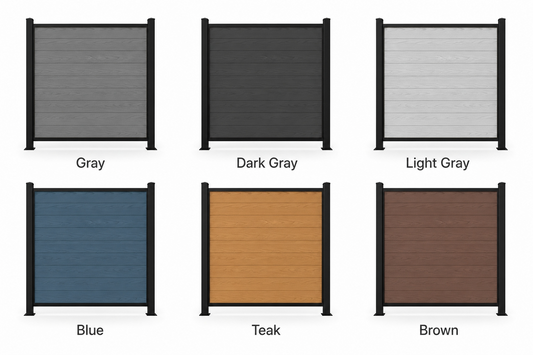
Colour has a modest effect on price. Standard colours — charcoal, light grey, and walnut — are the most economical because they are produced in the highest volumes. Less common colours such as blue grey or white may carry a small premium (typically 5–10%) due to lower production run volumes. UV fade resistance can also vary by colour, with darker tones sometimes showing slightly less visible fading over time, though co-extrusion construction largely equalises this difference across all colours.
Post system is an area where buyers sometimes make false economies. Concrete posts are cheaper upfront than aluminium — approximately £15–£30 each — but they require more labour to position accurately and are more difficult to adjust once set. They also add significant weight to a shipping order for importers. For composite panels specifically, aluminium posts with the proprietary channel system give a cleaner finish, faster installation, and easier board replacement if individual boards need changing in future.
Factory Direct vs UK Retail: Real Price Comparison
One of the most significant cost variables in the UK market is whether you buy through a UK distributor or brand, or source factory-direct from the Chinese manufacturer.
A UK retail price includes local stock, smaller order quantities, domestic delivery, sales support and the distributor's commercial margin. A factory-direct quotation is built around the named profile, colour, order volume, packing, port and freight basis. Those are different services, so a percentage saving cannot be promised before both quotations are compared on the same delivered scope.
For a contractor or builder's merchant, factory-direct wholesale pricing becomes relevant when the order can support international freight and stock planning. Compare panel dimensions, posts, rails, fixings, warranty schedule, VAT, customs and delivery—not just the panel headline.
The trade-off is lead time. Production of standard catalogue profiles takes 20 days, and sea freight from Nansha (Guangzhou) or Yantian (Shenzhen) to a UK port runs to roughly 55 days port to port in practice — so plan on around 11 weeks from order to UK port, plus 3–7 days for customs clearance and inland delivery. Buyers who maintain a UK stock float effectively eliminate this disadvantage. Becoming a composite fencing supplier UK account holder means you lock in factory pricing while retaining the flexibility of local stock.
10-Year Total Cost of Ownership: Composite vs Timber

Upfront price comparisons between composite and timber fencing often mislead buyers, because they ignore the ongoing cost of maintaining timber. A proper comparison requires a 10-year total cost of ownership (TCO) calculation.
Timber fencing (pressure-treated lap panels):
| Year | Cost |
|---|---|
| Year 0: Supply and install (10 panels) | £600 – £900 |
| Years 1–9: Annual treatment (stain/paint + labour) | £80 – £150/year |
| Year 7–10: Partial replacement (50% panels) | £350 – £500 |
| 10-year total | £1,680 – £2,750 |
Composite fencing (factory-direct, standard WPC, 10 panels):
| Year | Cost |
|---|---|
| Year 0: Supply and install (10 panels, factory-direct) | £1,900 – £2,400 |
| Years 1–10: Maintenance (annual clean, no treatment) | £0 – £30/year |
| Replacement: None required within warranty period | £0 |
| 10-year total | £1,900 – £2,700 |
The numbers tell a clear story: over 10 years, composite fencing and maintained timber come to roughly the same total cost. But timber requires your time and effort every year; composite requires almost none. And by years 10–15, when timber typically needs complete replacement, composite is still in service. On warranty specifically, Bohai Wood's fencing carries a 10-year warranty, stepped by year rather than flat, running from the date the goods are received at the destination port — service life and warranty are different questions, and it is the stepped schedule, not a headline number, that tells you what is actually payable in a given year.
How to Get the Best Price on Composite Fencing
Several practical steps help UK buyers get the most competitive price on composite fencing.
Buy at the right scale. Our minimum order is 70 sets, which is well under a full container, so factory-direct buying does not require you to fill one. Per-unit costs do improve at container volumes: a 20ft container holds 200 sets and a 40ft high-cube holds 400 sets. Contractors or merchants who aggregate demand from multiple projects can reach those thresholds with planning, but they are not the entry point.
Order ahead. Production takes 20 days and sea freight from South China to the UK runs to roughly 55 days port to port, so the realistic order-to-UK-port window is about 11 weeks. Buyers who plan three months ahead avoid premium air freight costs and the price volatility of last-minute UK stock purchases. Treat any four-to-five-week door-to-door quote as a best case, not a plan.
Specify standard products. Custom profiles, non-standard lengths, or bespoke colour matches all carry production setup costs that push the price up. For most residential and commercial projects, standard panel heights (1.2m, 1.5m, 1.8m) and standard colours cover the vast majority of requirements at the most competitive prices.
Ask about trial orders. Many buyers assume they need a full container for a first order. They do not — the 70-set minimum sits well below one, and a mixed LCL shipment lets a buyer test quality and customer demand before committing to larger volumes.
FAQ
Q: How much does composite fencing cost per metre in the UK?
A: Supply-only composite fencing typically costs £50–£95 per linear metre for standard WPC, and £85–£145 per linear metre for co-extrusion WPC, depending on panel height and sourcing channel. These figures are for panels only and exclude posts, concrete, and installation labour. If you are budgeting for a fully installed job, add £150–£300 per metre to account for posts, fixings, and labour, depending on ground conditions and local contractor rates.
Q: Is composite fencing cheaper than wood in the long run?
A: Yes, when you account for the 10-year total cost of ownership. Timber fencing needs annual treatment costing £80–£150 per year and partial replacement at around year 7–10. Composite fencing has near-zero maintenance costs and, in our case, a 10-year stepped warranty with no replacement expected in that period. Over a 10-year window, composite and properly maintained timber come out at a similar total cost — but composite requires substantially less time and effort. Beyond 10 years, composite continues to deliver value while timber typically needs full replacement.
Q: How long does delivery take from China to the UK?
A: Production of standard catalogue profiles takes 20 days, and sea freight from Nansha (Guangzhou) or Yantian (Shenzhen) to a UK port runs to roughly 55 days port to port in practice. Plan on around 11 weeks from order confirmation to UK port arrival, plus 3–7 days for customs clearance and inland delivery. Quotes of four to five weeks door to door on a South China sea shipment describe a best case, not something to build a programme around.
Q: Why is composite fencing more expensive than timber upfront?
A: The higher upfront cost of composite fencing reflects the material complexity and manufacturing process. Our WPC formulation combines approximately 60% wood powder, 30% HDPE and 10% additives before extrusion through a profile die. Co-extrusion panels add a further production step applying an HDPE protective shell. Capped and classic BOHAI products carry different stepped warranty schedules—15 years and 10 years respectively—and service life still depends on installation, exposure and maintenance. Compare the written warranty schedule, not an unsupported lifetime headline.
Q: How much does it cost to install 10 composite fence panels?
A: Installing 10 composite fence panels in the UK typically costs £2,500–£3,500 all-in, depending on material grade and sourcing. A realistic breakdown: 10 standard WPC panels at factory-direct prices (£100–£150 each) = £1,000–£1,500; 11 aluminium posts at £35–£50 each = £385–£550 (a run of 10 panels needs 11 posts); concrete and fixings = £120–£180; labour for 1.5 days at £350/day = £525. That totals approximately £2,030–£2,755. Using co-extrusion panels, or sourcing from a UK retailer rather than factory-direct, pushes the total higher.
Ready to Get Started?
Get a factory-direct quotation against the exact profile, quantity, packing and delivery basis. Request your quote at /pages/contact
Tags:
Previous
Composite Fencing Supplier UK: Factory Direct Wholesale from China
Next
How to Install WPC Fence UK: Complete Step-by-Step Guide