Composite Gate Cost USA: 2026 Price Guide (Pedestrian & Driveway)
Gates are often the afterthought in a composite fencing budget — until the quote comes in and the numbers raise eyebrows. A composite pedestrian gate and a composite driveway gate can differ in price by a factor of three or more, and adding automation, premium hardware, or a color-matched frame to a wide opening can push costs further than most buyers anticipate. This guide breaks down real 2026 price ranges for composite gates across all three main categories — pedestrian walk gates, double gates, and driveway gates — explains what drives those numbers, and shows where factory-direct sourcing can meaningfully change the math. For broader context on how these gate costs fit into a full fence project, see the composite fencing & gates buyer's guide before requesting any quotes.
Composite Gate Price Ranges: Pedestrian, Double and Driveway
Price ranges for composite gates in the USA vary significantly by gate type, width, frame construction, and board tier. The following figures reflect 2026 market pricing for WPC composite gates, covering both supply-only (gate unit cost) and installed pricing through a local fence contractor.
| Gate Type | Typical Width | Gate Unit Cost | Installed Cost (Est.) |
|---|---|---|---|
| Pedestrian (single) | 3–4 ft | $200–$400 | $400–$700 |
| Double / garden gate | 6–8 ft | $400–$800 | $700–$1,200 |
| Driveway gate (manual) | 10–14 ft | $600–$1,200 | $1,000–$2,000 |
| Driveway gate (automated) | 10–16 ft | $1,200–$2,500+ | $2,000–$4,500+ |
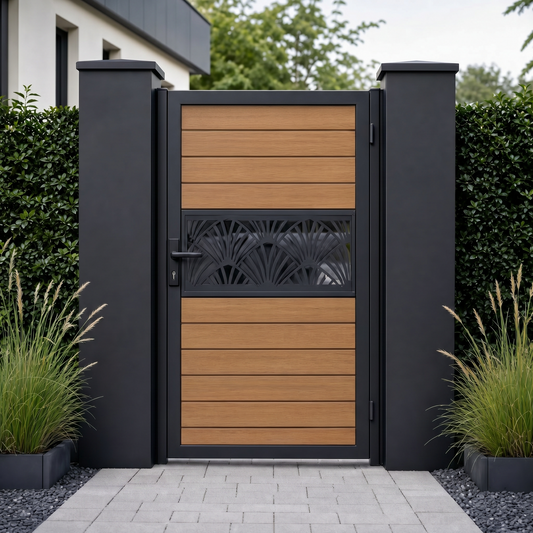
Pedestrian walk gates — the most common residential upgrade — are the most straightforward to price. A standard single gate sized 3 to 4 feet wide in a 6-foot privacy height, built from capped WPC boards on an aluminum-reinforced frame, typically runs $250 to $375 for the unit from a factory-direct source. Add local contractor installation charges, which usually include post-setting labor, hardware fitting, and alignment, and the installed price lands in the $400 to $700 range depending on your region.

Double gates — often used for garden access or side-yard utility clearance — span 6 to 8 feet across and require two gate leaves hung on a shared center post or independent posts. Because the structure carries more board weight and demands heavier hinges, the unit cost jumps to the $400–$800 range, with installation adding $300–$500 on top.
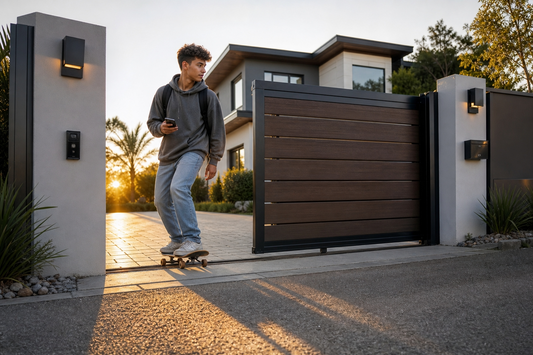
Driveway gates represent a separate category entirely. A manual swing driveway gate sized 10 to 14 feet wide requires heavy-duty steel-core framing, reinforced post footings, and substantial hinge hardware. Manual driveway gate units from a factory source typically run $600 to $1,200 depending on width and board tier; add installation and you are in the $1,000 to $2,000 range. Automated driveway gates with electric operators push the total project cost to $2,000–$4,500 or more, with the operator hardware accounting for a significant share of that premium.
What Affects Gate Pricing: Frame Material, Width, Hardware
No two gate quotes are identical, because four variables interact to set the final number: frame material, gate width, board tier, and included hardware.
Frame material is the single biggest structural cost driver. Composite gates in the entry-level tier use a basic hollow composite or steel strap frame, which is adequate for pedestrian gates up to about 4 feet wide. Step up to an aluminum-reinforced composite frame and you get better rigidity with less weight — the right choice for most residential double gates. For driveway openings of 10 feet or wider, a steel-core frame is the standard specification; steel handles the cantilever loads that would cause a lighter frame to sag within a few seasons. Expect to pay a premium of $80 to $200 or more for a steel-core frame versus a basic composite one on comparable gate sizes.
Gate width scales cost almost linearly: wider gates use more boards, heavier frames, and larger hinges. A 3-foot pedestrian gate and a 4-foot pedestrian gate may differ by only $40 to $60, but jumping from a 4-foot walk gate to a 10-foot driveway gate roughly triples the material cost before hardware is factored in.
Board tier — capped co-extruded versus uncapped standard WPC — affects both the unit cost and the long-term value of the gate. Capped boards carry a protective polymer shell that resists UV fading, surface scratching, and moisture absorption far better than uncapped boards. For a gate that is frequently touched, swung, and exposed to poolside splashing or driveway runoff, the capped tier is worth the 15–30% premium in most climates.
Hardware inclusions vary widely between suppliers. Some factory quotes include basic hinges and a simple latch; others price hardware separately. Always confirm what is bundled before comparing quotes side by side.
Matching a Gate to Your Existing Composite Fence Color and Profile
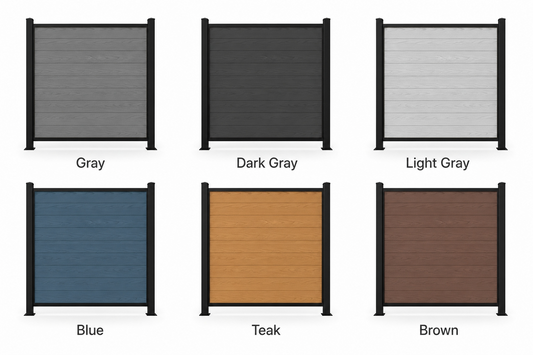
Color and profile matching between a gate and the surrounding fence panels is one of the most underestimated cost considerations in a gate project. If you are adding a gate to an existing composite fence — or replacing a gate without replacing the full fence — the cost of mismatching can exceed the cost of the gate itself, because a visibly different board tone or profile texture undermines the entire fence's appearance.

When the fence and gate are ordered together from the same factory in the same production batch, color matching is straightforward. The composite boards are drawn from identical stock, the co-extrusion shell is the same formulation, and the grain pattern is consistent. This is the lowest-risk approach and often the most cost-effective, because factories typically offer a discount when fencing and gate boards are ordered in a single container or pallet shipment.
The challenge arises when a gate is ordered separately — whether to replace a damaged original gate or to upgrade from a basic gate to a heavier driveway unit. WPC board colors shift slightly between production runs due to raw material variation in the wood fiber content, pigment batching, and HDPE sourcing. Even within the same color name — say, "charcoal black" or "walnut brown" — a gate produced six months after the fence panels will show a visible tone difference under natural light.
For this reason, experienced buyers always request physical samples before placing a gate order that must match existing panels. A factory that holds its color formulations under documented ISO 9001 production controls will typically be able to match much more closely than one that does not. If you are building a full fence-and-gate system from scratch, ordering everything together and consulting the composite fencing cost guide for total budget planning is the cleanest approach.
Automation and Self-Closing Hardware Costs
Gate hardware costs fall into two distinct categories in 2026: compliance-grade self-closing and self-latching hardware required for pool barriers, and optional automation systems for driveway gates.
Pool compliance hardware is non-negotiable if the gate is part of a pool barrier under the International Swimming Pool and Spa Code (ISPSC) or equivalent state code. The standard requirements include a self-closing hinge mechanism that returns the gate to the closed position without assistance, a self-latching latch positioned at least 54 inches above grade (or on the pool side of the gate), and a gate that opens outward — away from the pool. Self-closing hinge kits designed for composite gates typically cost $60 to $150 per pair, depending on load rating and adjustment range. Spring-loaded or hydraulic self-closing mechanisms are both available; hydraulic adjustable closers are preferred for heavier gates because the closing speed can be tuned without disassembly. Pool compliance hardware adds $100 to $300 to a pedestrian gate's total cost when not included in the base gate price.
Automated gate operators for driveway gates are a separate and larger investment. A single-arm swing gate operator for a standard residential driveway gate — typically rated for gates up to 500 lbs and 16 feet per leaf — runs $500 to $1,200 for the operator hardware alone from reputable brands. Add remote control receivers, safety sensors, power supply wiring, and installation labor, and a full automated driveway gate system costs $1,500 to $3,000 on top of the gate unit itself. Solar-powered operators are available and are worth considering for remote installations without convenient AC power access.
For projects that include automated driveway gates, the composite driveway gate styles guide covers frame construction requirements, post sizing for motor loads, and style options that are compatible with common automation hardware.
Factory-Direct Gate Pricing vs Local Fence Contractor Markups

The gap between factory-direct composite gate pricing and the price a homeowner or builder sees from a local fence contractor reflects three layers of margin: the US distributor margin (if applicable), the contractor's material markup, and the contractor's labor rate. Understanding each layer helps buyers make better sourcing decisions.
A local fence contractor in 2026 typically marks up the material cost of a composite gate by 30 to 60 percent before quoting a customer. On a gate that costs $350 from a factory-direct source, that markup adds $105 to $210 to the material line before labor is even calculated. For a single residential gate, this markup is often accepted as a convenience cost. For a multi-gate commercial project — an HOA community installing 40 pedestrian gates, or a builder fitting out a 200-unit development — that markup compounds into significant money.
Factory-direct composite gate sourcing bypasses the distributor and contractor material margin entirely. A US buyer purchasing directly from a WPC factory in China, using an FOB or CIF term, is effectively buying at the price tier normally reserved for distributors. On a pedestrian gate priced at $280 direct, the landed cost after freight, duties, and US port handling might reach $380 to $420 depending on volume and shipping terms — still materially below the $490 to $560 that a US contractor would charge for the same specification gate at retail markup, before installation labor.
For buyers evaluating factory-direct sourcing, factory-direct composite gate pricing from Bohai Woods is a starting point for understanding what direct-from-factory pricing looks like on gates and matched fence panels at scale.
Budgeting Tips for Multi-Gate Projects (HOAs, Builders)
HOA communities, subdivision builders, and commercial property managers face a different budgeting challenge than a single homeowner replacing one gate. At scale, gate cost per unit is only part of the picture; procurement logistics, color consistency across production runs, and installation sequencing all affect the total project cost.
The most reliable cost-control lever for multi-gate projects is to order all gates — and the fence panels they connect to — from a single factory in a single production batch. This guarantees color consistency, eliminates re-ordering delays, and typically qualifies the order for volume pricing. Most WPC factories offer meaningful per-unit discounts at 20 or more gates; some Bohai Woods B2B programs extend additional terms for HOA and developer accounts at even lower thresholds.
When budgeting a multi-gate project, build in a contingency of 8 to 12 percent on the gate line specifically. Gate openings are more likely to require rework than straight fence sections — posts occasionally need reseating after first-season soil settlement, hardware may need adjustment as the structure settles into alignment, and any damage during installation affects a functional access point rather than an inert fence panel.
For HOA communities procuring fence and gate systems with design-review requirements, factor in a 2 to 4 week HOA approval cycle before installation can begin. Submit color samples and product spec sheets — including the factory's ISO 9001 certification and any ASTM-aligned test reports — alongside the architectural review application. Approval rates are significantly higher when technical documentation accompanies the color and style submission.
Frequently Asked Questions
Q: How much does a composite pedestrian gate cost?
A: A standard composite pedestrian gate — single leaf, 3 to 4 feet wide, 6-foot privacy height — typically costs $200 to $400 as a unit from a factory-direct or wholesale source in 2026. Installed cost through a local fence contractor adds $200 to $350 in labor and hardware fitting, bringing the typical installed total to $400 to $700. Capped co-extruded board construction sits at the top of that range; uncapped WPC gates occupy the lower tier. Pool compliance hardware (self-closing hinges, elevated latch) adds another $100 to $300 if not included.
Q: How much more does a driveway gate cost than a walk gate?
A: A composite driveway gate typically costs two to four times more than a pedestrian gate when comparing equivalent quality tiers. A pedestrian gate might run $280 to $350 in unit cost; a manual driveway gate of similar board specification but spanning 12 feet will run $700 to $1,200 or more, due to the steel-core frame required to prevent sagging, heavier hinge hardware, and the additional board area. Add an automated operator and the driveway gate system cost reaches $2,000 to $4,500 installed — roughly five to ten times a basic pedestrian gate.
Q: Can I get a composite gate that matches my fence color exactly?
A: Yes, but the most reliable way to achieve an exact color match is to order the gate and the fence panels from the same factory in the same production batch. WPC composite boards are subject to minor color variation between production runs due to raw material differences in wood fiber and pigment batching. If you are ordering a gate to match an existing fence, request a physical sample from the factory and compare it in natural daylight against your installed panels before committing. A factory with ISO 9001 production controls and documented color formulations will achieve a much closer match than one without that oversight.
Q: What hardware is included in a typical composite gate price?
A: Standard gate pricing from a composite factory typically includes a pair of standard load-rated hinges and a basic adjustable latch. What is usually not included, and must be specified or purchased separately, is self-closing hardware for pool barrier compliance, lockable deadbolts, decorative hardware finishes (e.g., powder-coated black fittings to match a black fence), drop rods for double gates, and automated gate operators. Always confirm hardware inclusions in writing before comparing quotes. The difference between a "gate with basic hardware" and a "gate with full pool-compliance hardware" can be $150 to $300 per gate.
Q: Is it cheaper to buy a gate and fence as a matched set?
A: In most cases, yes — ordering fence panels and gates together from the same factory is cheaper per unit than ordering them separately, for three reasons. First, factories often apply volume discounts when total board quantities are higher. Second, shipping a combined fence-and-gate order in a single container spreads fixed freight costs across a larger material volume. Third, matched-set ordering eliminates the risk of color mismatch and the potential re-order cost that comes with it. For projects where the gate and fence budget is being finalized at the same time, requesting a combined quote almost always produces a better landed cost than sourcing gate and fence panels separately.
Ready to Get Started?
Get a matched fence-and-gate quote, factory-direct, from Bohai Woods. Whether you need a single pedestrian gate or a multi-gate HOA program, our USA team can provide unit pricing, color samples, and full technical specifications. Contact Bohai Woods through our USA factory-direct program page to get started.
Tags:
Previous
Composite Fencing Cost USA: 2026 Price Guide
Next
Composite Fencing Wholesale USA: How to Buy Factory-Direct from China