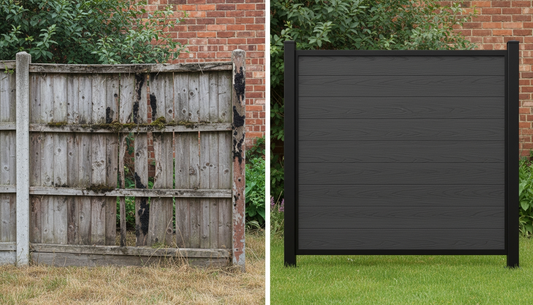
Composite Fence Panel Sizes USA: Standard Dimensions and How to Measure
Most composite fence panels shipped to the US are made to metric dimensions and sold against imperial expectations. The gap between the two is small enough to miss on a quote and large enough to fail an inspection. Start there.
The 1800 mm Problem: A "6-Foot" Panel Is Not Six Feet
The standard panel size across most Chinese WPC fencing production is 1800 × 1800 mm. It gets described in US conversations as a 6 ft × 6 ft panel. It is not.
| Metric size | Actual imperial | US nominal it gets called | Difference |
|---|---|---|---|
| 1800 mm | 70.87 in / 5.906 ft | 6 ft (1829 mm) | 29 mm / 1.14 in short |
| 1200 mm | 47.24 in / 3.937 ft | 4 ft (1219 mm) | 19 mm / 0.76 in short |
| 2400 mm | 94.49 in / 7.874 ft | 8 ft (2438 mm) | 38 mm / 1.5 in short |
An inch does not matter for a garden screen. It matters in three specific places:
Pool barriers. US pool codes generally require a minimum barrier height of 48 inches measured from the finished grade on the outside of the barrier. A 1200 mm panel is 47.24 inches — three-quarters of an inch below the minimum. Set on a post base that raises it, it may pass; set at grade, it does not. This single conversion has failed more pool inspections than any material defect. The pool fence code guide covers the full barrier rule set.
HOA and zoning height maximums. These cut the other way. A jurisdiction capping fences at 6 ft gives you 29 mm of headroom with an 1800 mm panel — useful when your post caps and a raised post base would otherwise push you over.
Run length arithmetic. Over a 200-foot fence line, the difference between counting 1800 mm and 6 ft per bay compounds to roughly 3.2 feet — most of an extra bay. Estimate in millimetres, convert once at the end.
The practical rule: do your arithmetic in millimetres, and convert only for the permit drawing. Mixing units mid-calculation is where the errors enter.
Standard Sizes You Will Actually Be Quoted
Two different things get called a "size," and quotes move between them without warning.
Assembled panel systems ship as a kit — boards, rails, posts and trim for one bay:
| Panel type | Standard size | Screening |
|---|---|---|
| Privacy (close board) | 1800 × 1800 mm | Full — no visibility |
| Half trellis | 1800 × 1800 mm | Solid lower section, open upper |
| Full trellis | 1800 × 1800 mm | Open — decorative or planting support |
| Decorative / laser-cut pattern | 1800 × 1800 mm | Partial, pattern-dependent |
Loose board profiles ship by the linear metre and are cut to whatever bay width you frame:
| Profile | Section | Weight | Typical use |
|---|---|---|---|
| T180H24 | 180 × 24 mm (172 mm coverage) | 2.69 kg/m | Main privacy fence board |
| T90H24B | 90 × 24 mm | 1.47 kg/m | Narrow board, mixed-width designs |
| 95 × 21 | 95 × 21 × 4000 mm/pc | — | Courtyard, farm and garden fencing |
| 188 × 20 | Wavy profile | — | Decorative fence board |
Weight per metre is the number to write down. It drives container loading, pallet counts and whether your installer needs two people per panel — and it is the figure most quotes omit. A 1800 × 1800 mm privacy bay takes 11 boards of T180H24 (1800 ÷ 172 = 10.47, rounded up), and since each board spans the full 1800 mm bay width that is roughly 20 running metres of board per bay — about 53 kg of board alone, before rails and posts. That is why panel weight climbs quickly on tall runs, and why two people per bay is the realistic assumption.
Board Width, Panel Width, and Effective Coverage
These are three different numbers and confusing them is the most common source of short deliveries.
Overall board width is the physical width of the extruded profile — the 180 in T180H24.
Effective coverage width is how much fence line one board actually covers once it is interlocked with the next. Tongue-and-groove and clip-fixed boards overlap, so coverage is always less than the overall width.
Panel dimension is the finished bay: 1800 × 1800 mm including the frame.
The gap between overall and effective is small per board and significant per order. If you calculate a 30-metre run using overall board width and the boards actually interlock at a smaller effective width, you will be short — and short by enough to need a second shipment for a few boards, at a freight cost that dwarfs the material.
Take the T180H24 privacy board as a worked example. Its overall width is 180 mm; its effective coverage width is 172 mm. The interlock consumes 8 mm.
That 8 mm is 4.4% of the board width, and 4.4% is exactly how much material you under-order if you calculate with the overall figure:
| Calculation basis | Boards needed for a 1800 mm panel height | Result |
|---|---|---|
| Overall width (180 mm) | 1800 ÷ 180 = 10.0 | Under-ordered |
| Effective coverage (172 mm) | 1800 ÷ 172 = 10.47 | Correct |
Two consequences worth planning for. First, a 1800 mm height does not divide into a whole number of boards — the remainder is taken up by the top and bottom rails or by a cut board, so confirm with your supplier which it is before you assume the panel arrives complete. Second, on a container order, a 4.4% shortfall is not a rounding error. On 5,000 m² of board it is 220 m² missing, and the freight cost of shipping that separately will exceed its material value several times over.
Always ask for effective coverage width in writing, not overall width. A factory that cannot answer that question immediately has not thought about your run length.
How to Read a Chinese Factory Model Code
Once you see the pattern, a model code tells you the profile without opening a catalogue.
The number before H is width in millimetres. The number after H is thickness. So T180H24 is a board 180 mm wide and 24 mm thick, and T90H24B is 90 mm wide and 24 mm thick. H denotes a hollow profile; S in the same position denotes solid — TS140S23 is a 140 × 23 mm solid board. Solid boards weigh substantially more per metre and cost more per square metre, but resist impact and edge damage better.
Note that the code gives you overall width, not coverage width. The two differ by the interlock, so a model code alone is not enough to calculate quantities — you still need the coverage figure from the supplier.
Two practical uses. First, you can sanity-check a quote against a spec sheet without asking. Second, when a supplier offers a "similar" alternative because your model is out of stock, the code tells you immediately whether the substitute changes width, thickness or core structure — all three affect fit with the rails and posts you have already ordered.
The Component List Behind a Panel Size
A panel dimension is meaningless without the system around it. A complete bay needs:
- Aluminium post — the tested privacy assembly used an 80 × 80 mm post in 6063-T5 alloy
- Top and bottom aluminium rails — these conceal the tongue-and-groove seam at the panel edge and stiffen the bay
- Post cap and post base
- Angle bracket connector — panel-to-post fixing
- Side cover — closes the exposed post channel
- Spacer clips — maintain consistent board gaps and allow for thermal movement
- Expansion bolts and screws — post base to concrete or masonry
Two things follow from this list.
Post spacing is set by panel width, not by preference. With an 1800 mm panel, post centres land at 1800 mm plus the post section. Change the panel and every post hole moves.
The alloy matters. 6063-T5 is a structural aluminium temper; a post described only as "aluminium" tells you nothing about wall thickness or temper. On an exposed run this is the component that fails first if it is under-specified, and the fence boards get blamed for it.
Converting a Fence Run Into a Panel Count
Five steps. Do them in millimetres.
- Measure the total run along the actual fence line, following slopes and returns rather than measuring across them. Record it in millimetres.
- Subtract gate openings. A pedestrian gate typically needs 900–1000 mm of clear opening plus post allowance; a double or driveway gate needs its own dimension. Gates are not panels and are priced separately — see the gate cost guide.
- Divide by the bay module — panel width plus one post section. Round up, never down.
- Add the end post. A run of n bays needs n + 1 posts. This is the single most common ordering error, and it strands a job for the two weeks it takes to ship one post.
- Add cut allowance for corners, returns and the final partial bay. A straight run needs little; a fence line with several corners and step-downs on a slope needs meaningfully more.
Sloped ground changes the answer. Stepped installation keeps each panel level and creates triangular gaps at the base that need infill or a raised plinth. Raked installation follows the slope but requires panels that can be cut to a parallelogram — not all systems allow it, and a close-board panel with a fixed frame usually cannot. Establish which method your system supports before you count bays, because a stepped run on a slope consumes more panel height than a flat run of the same length.
Ordering at Container Quantities
At volume, panel dimensions stop being a measuring question and become a loading question.
Weight per metre drives the container split. WPC is dense. A 40 ft container fills to its weight limit before its volume limit on solid profiles, and to volume before weight on hollow ones. Mixing hollow and solid profiles in one container is how you use both. Ask for the loading plan, not just the quantity.
Confirm the profile, not just the description. "1800 × 1800 privacy panel" is not a specification. The specification is the board model, the effective coverage width, the post section and alloy, and the rail profile. Two suppliers quoting the same panel size can be quoting different systems, and the cheaper one is often cheaper because the post is thinner.
Order spares in the first container. Boards, post caps and clips are cheap as part of a container and ruinous as an air freight top-up. A small percentage of spare boards and a handful of extra posts and caps costs little against the freight cost of one urgent replacement.
You do not have to start at container volume, incidentally — our minimum is 70 sets, which is well below the full-container minimum most factories quote. For how panel specification feeds into landed cost, see the composite fencing cost guide; for the shipping process itself, the China import guide.
Frequently Asked Questions
Q: What is the standard composite fence panel size?
A: 1800 × 1800 mm is the standard across most Chinese WPC fencing production, covering privacy, half-trellis, full-trellis and decorative panel types. In imperial that is 70.87 × 70.87 inches — 5.906 feet, not 6 feet. Loose board profiles are also sold by the linear metre and cut to whatever bay width you frame.
Q: Is a 1800 mm fence panel the same as a 6 ft panel?
A: No. 1800 mm is 70.87 inches and 6 ft is 1829 mm, so an 1800 mm panel is about 1.14 inches short of six feet. The difference is usually irrelevant aesthetically but matters where a code sets a minimum height, and it compounds across a long run — roughly 3.2 feet over a 200-foot fence line.
Q: Will a 1200 mm panel meet a 48-inch pool barrier requirement?
A: Not on its own. 1200 mm is 47.24 inches, which is below a 48-inch minimum measured from finished grade on the outside of the barrier. Whether the installed assembly complies depends on the post base and mounting height, so confirm the finished dimension against your local code before ordering rather than assuming the panel size is sufficient.
Q: What does H mean in a model code like T180H24?
A: H denotes a hollow profile. The number before it is the board width in millimetres and the number after it is the thickness — so T180H24 is a hollow board 180 mm wide and 24 mm thick. An S in the same position denotes a solid profile, which is heavier per metre and more resistant to impact and edge damage.
Q: What is the effective coverage width of a T180H24 fence board?
A: 172 mm. The board is 180 mm wide overall and the tongue-and-groove interlock consumes 8 mm, so each board covers 172 mm of fence line. Quantity calculations must use 172 mm — calculating with the 180 mm overall figure under-orders by 4.4%.
Q: How many boards are in a standard 1800 × 1800 mm panel?
A: Eleven. 1800 mm of height divided by 172 mm of effective coverage is 10.47, rounded up to 11, with the remainder taken up by the rails or a cut board. Since each board spans the full 1800 mm bay width, that is about 20 running metres of board per bay and roughly 53 kg before rails and posts.
Q: How many posts do I need for a fence run?
A: One more than the number of bays. A ten-bay run needs eleven posts. Forgetting the end post is the most common ordering error in this category and it holds up a job for as long as it takes to ship a single component.
Q: Can composite fence panels be cut down to size on site?
A: Loose boards can be cut to length with a fine-tooth blade. Assembled panels with a fixed frame usually cannot be cut down without compromising the frame, which is why sloped ground normally requires stepped installation rather than raking the panel. Confirm which method your system supports before finalising the panel count.
Getting the Dimensions Right
Measure in millimetres, ask for effective coverage width in writing, and count one more post than you think you need. Request a spec sheet with board profile, coverage width and post section before you price a run.
Tags:
Previous
WPC Fencing Certifications USA: A 2026 Verification Checklist
Next
Composite Gate Hardware Guide: Hinges, Latches, Locks and Self-Closing Kits