Pool Fence Codes USA: Composite Fencing and Gate Compliance Guide (2026)
A pool fence is not a decorative boundary — it's a life-safety barrier governed by building code, and inspectors treat it that way. Drowning is a leading cause of accidental death for young children in the United States, and the pool barrier requirements written into US model codes exist specifically to keep unsupervised toddlers out of the water. For homeowners, builders, HOA boards and fence contractors, getting the barrier right is the difference between a passed inspection and an expensive tear-out — or worse, a tragedy.
This guide explains how US pool barrier codes work under the International Swimming Pool and Spa Code (ISPSC) and the broader ICC framework, the specific numbers inspectors measure, and how composite (WPC) fencing and matching gates can be configured to meet them. Codes vary by state and local jurisdiction, so treat everything here as the model-code baseline and always confirm the exact rules with your local building department before you build. If you're new to the category, our composite fencing & gates buyer's guide covers the product fundamentals this article builds on.
Overview of US Pool Barrier Codes (ISPSC / ICC Framework)
Most US pool barrier requirements trace back to a single source: the International Code Council (ICC), which publishes the model codes that states and municipalities adopt and amend. The dedicated document is the International Swimming Pool and Spa Code (ISPSC), whose Section 305 lays out barrier requirements for residential pools and spas. Closely related language also appears in the International Residential Code (IRC) Appendix and, historically, in standards like ASTM F1908 for fence and gate safety. Many jurisdictions further reference the federal Virginia Graeme Baker Pool and Spa Safety Act for entrapment, though that act focuses on drains rather than fences.
The core idea is consistency. A compliant barrier must completely surround the pool, be hard to climb, have no gaps a small child could slip through, and have gates that close and latch themselves so a barrier left ajar is the exception, not the rule. The ISPSC sets the model thresholds — a minimum height, a maximum ground clearance, a maximum opening size, and gate self-closing and self-latching rules — and then states adopt those thresholds with local modifications.
Because adoption is local, two houses 20 miles apart can face different numbers. Arizona, Florida, California and Texas — the highest pool-density states — each layer their own amendments on top of the ICC baseline. That's why the practical first step in any pool project is a call or counter visit to the authority having jurisdiction (AHJ). The sections below give you the model-code numbers to walk in with, so you can have an informed conversation and specify fencing that will pass.
Minimum Fence Height Requirements by State

The single most-asked question is height, and the model-code answer is clear: a residential pool barrier must be at least 48 inches (4 feet) high, measured from the finished ground level on the side of the barrier facing away from the pool. That measurement detail matters — if your yard slopes, the height is taken from the outside grade, and a berm or retaining wall on the outside can effectively shorten a barrier below code.
State and local variation almost always pushes the number up, never down. California is the most cited example: under its Swimming Pool Safety Act, many jurisdictions require a minimum enclosure height of 60 inches (5 feet), and California also requires that a new pool include at least two approved drowning-prevention safety features, of which an enclosure is one. Other states and individual cities set their own floors — some counties in Florida and Arizona require 5 feet, and gated-community or HOA rules frequently demand more height or a specific style on top of code.
For composite fencing this is straightforward to accommodate. WPC privacy systems are commonly produced in finished heights of 4 ft, 5 ft and 6 ft, so a 48-inch or 60-inch barrier is a stock configuration rather than a custom order. A taller 6 ft privacy panel also doubles as a code-compliant pool barrier while delivering full screening — useful where a homeowner wants both child safety and privacy from neighbors. Just remember that height is measured to the top of the barrier with the gate and panels installed, so confirm the finished dimension against the panel sizes and measuring guide before ordering.
Gap Size and Ground Clearance Rules
Height alone doesn't make a barrier safe — a 6-foot fence with a 6-inch gap at the bottom fails its purpose. The ISPSC therefore controls every opening in the barrier with a set of precise dimensions, and this is where solid composite panels have a real advantage over spaced pickets or chain link.

The model rules break down as follows:
- Ground clearance: the gap between the bottom of the barrier and the finished grade (measured on the non-pool side) must not exceed 2 inches. On a solid surface like a pool deck, the maximum drops to 4 inches at the top of the barrier in certain configurations, but the 2-inch figure is the one most inspectors apply at the bottom.
- The 4-inch sphere rule: no opening anywhere in the barrier may allow a 4-inch-diameter sphere to pass through. This is the universal "no gap a small child's head or body can fit through" test, and it governs picket spacing, lattice openings and any decorative cut-outs.
- Climbability and horizontal members: where horizontal rails are less than 45 inches apart, they must be on the pool side of the barrier (so they can't be used as a ladder from outside), and the spacing of vertical members between them must not exceed 1¾ inches. Where horizontal members are 45 inches or more apart, vertical spacing up to 4 inches is allowed. Solid barriers must have no protrusions, indentations or toeholds that create a foothold for climbing.
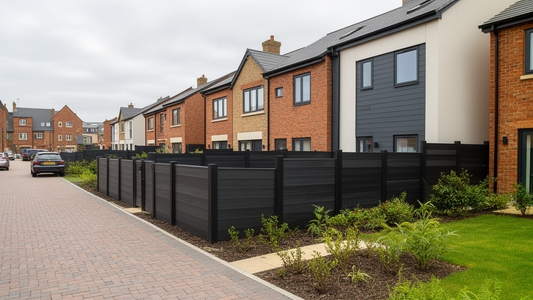
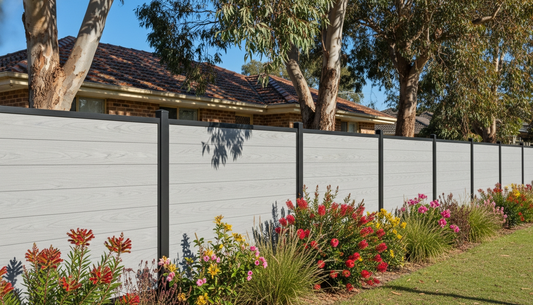
Solid tongue-and-groove composite privacy panels satisfy most of this almost by design: there are no through-gaps, no climbable horizontal rails on the exterior face, and no 4-inch openings to measure. The board run can be set so the bottom clearance stays under 2 inches, and because composite boards cut cleanly, an installer can trim the bottom course to follow grade. The smooth, capped exterior also offers no toeholds — a meaningful safety point that spaced metal and wood picket fences struggle to match.
Self-Closing and Self-Latching Gate Requirements

Gates are where most pool barriers fail inspection, because a gate is the one part designed to open. The ISPSC is strict and specific about how a pool gate must behave, and every requirement is aimed at ensuring the gate returns to a latched position on its own.
The model-code requirements for a residential pool gate are:
- It must be self-closing — released from any position, it swings shut on its own.
- It must be self-latching — it latches automatically when it closes, with no manual step.
- It must open outward, away from the pool, so a child pushing against it cannot force it open toward the water.
- The latch release mechanism must be at least 54 inches above the finished ground. If the release is lower than 54 inches, it must be located on the pool side of the gate at least 3 inches below the top, and there must be no opening greater than ½ inch within an 18-inch radius of the release (so a child can't reach through a gap to operate it).
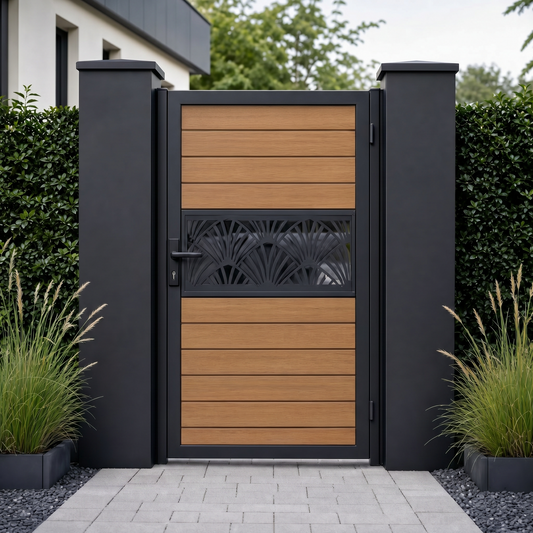
Composite gates meet these rules when paired with the right hardware: a heavy-duty self-closing hinge with adjustable spring tension, a magnetic or gravity self-latching mechanism mounted at the code height, and a frame stiff enough to keep the gate from sagging out of latch alignment over time. This is one reason a properly built composite gate uses an aluminum-reinforced frame rather than relying on board stiffness alone — sag is the enemy of reliable self-latching. For the specific latches, hinges and magnetic kits that satisfy pool-gate rules, see our composite gate hardware guide.
Choosing Composite Fencing and Gates That Meet Pool Codes
Beyond the dimensional rules, a pool barrier has to survive a wet, sunny, chemically harsh environment for decades — and this is where the material specification matters as much as the geometry. A barrier that warps, fades or loosens at the footings is a barrier that drifts out of compliance.
Capped (co-extruded) WPC is well suited to poolside duty. The protective outer shell resists the UV, chlorine and salt exposure that degrade lesser materials, and because the boards don't rot, splinter or corrode, the barrier holds its shape and clearances over time. Independent testing backs this up: Bohai Woods' co-extruded fence system was tested by Intertek for wind-pressure resistance and held a maximum horizontal uniform load of 372.1 N/m² (roughly a Beaufort 9 gale) with no disengagement or cracking, which matters for an open poolside run that catches wind. Xenon-arc UV aging testing to ISO 4892-2 documents the fade resistance that keeps a dark or natural-tone barrier looking consistent for years.
On slip resistance, the testing we hold is specific and worth quoting precisely, because pool decks are where it matters most: R10 under AS 4586-2013 Appendix D — the oil-wet ramp test, walked in shoes, measured at 15° — issued by Intertek, report 230625005SHF-001, on the co-extruded decking profile ZSGJ138H23A. That is a shod-wet result on a decking board. The barefoot wet method (DIN 51097) and the UK pendulum method (BS 7976) are different tests and are not yet run on our profiles; both can be arranged on the profile you intend to specify, with the cost paid up front and credited against your order. Raise it at design stage rather than at inspection.
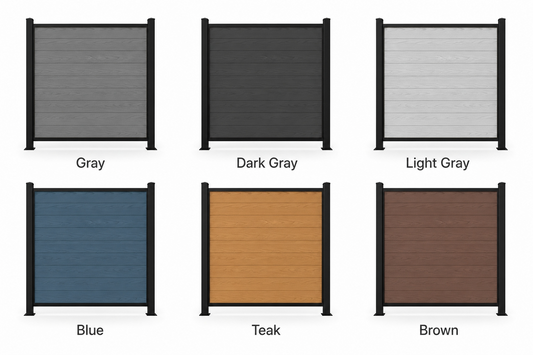
When specifying a pool-code barrier, prioritize: solid tongue-and-groove privacy panels (no 4-inch gaps), a finished height matching your local minimum (48 in or 60 in), aluminum-reinforced posts set in concrete footings for stability, an aluminum-framed self-closing gate, and corrosion-resistant stainless or coated hardware. Confirm the bottom clearance and post spacing on your specific layout. If you want a configuration reviewed against common pool requirements, you can ask Bohai Woods about pool-code-ready fencing and gates — though final sign-off always rests with your local inspector.
Working with Local Inspectors and HOAs on Pool Enclosures
Passing inspection is a process, not a gamble, if you engage the right people early. Start at the building department (the AHJ) before you buy fencing. Ask which code edition they enforce (ISPSC, IRC appendix, or a state amendment), confirm the exact minimum height, the bottom-clearance figure, the gate latch-height rule, and whether your jurisdiction requires a permit and a final barrier inspection before the pool can be filled or used. Get the answers in writing or by reference to the adopted code section, and design to those numbers.
In HOA communities there's a second layer. The HOA's architectural guidelines are often stricter than code and govern things code doesn't — approved colors (commonly black, brown and natural tones), permitted styles, and a design-review approval process that typically takes two to four weeks. The trap is that an HOA-approved style and a code-compliant barrier are two separate approvals; you need both. Submit your fence color, height and gate design to the HOA for written approval before installation, and align that submission with code requirements so you don't get caught between a board that wants a certain look and an inspector who needs a certain latch height.
Finally, document the finished installation: keep the product spec sheets, the gate hardware data, and any test reports together so that if a question arises at final inspection — or when you sell the home and a new survey is done — you can show the barrier was built to spec. A little paperwork up front turns a stressful inspection into a formality.
Frequently Asked Questions
Q: What is the minimum height for a pool fence in the USA?
A: Under the model International Swimming Pool and Spa Code (ISPSC), a residential pool barrier must be at least 48 inches (4 feet) high, measured from the finished ground on the side facing away from the pool. Many states and cities require more — California commonly mandates 60 inches (5 feet), and some Florida and Arizona jurisdictions also require 5 feet. HOAs may add their own height rules. Always confirm the exact minimum with your local building department before ordering fencing.
Q: Do pool gates need to be self-closing and self-latching by law?
A: Yes. Under the ISPSC model code, a residential pool gate must be self-closing and self-latching, and it must open outward away from the pool. The latch release must sit at least 54 inches above the ground; if it's lower, it must be on the pool side with no opening over ½ inch within 18 inches of the release. These rules ensure the gate returns to a latched position on its own. Local amendments can be stricter, so verify with your AHJ.
Q: How big can gaps be in a pool fence?
A: The governing rule is that no opening in the barrier may allow a 4-inch-diameter sphere to pass through, and the gap between the bottom of the fence and the ground must not exceed 2 inches on the non-pool side. Where horizontal rails are less than 45 inches apart, vertical spacing between members drops to 1¾ inches. Solid tongue-and-groove composite privacy panels easily satisfy these limits because they have no through-gaps and no climbable rails on the exterior.
Q: Does composite fencing meet pool barrier code requirements?
A: Yes, when configured correctly. Solid composite privacy panels have no 4-inch gaps and no exterior toeholds, are made in 48-inch and 60-inch heights, and pair with aluminum-framed self-closing, self-latching gates. Capped WPC also resists the UV, chlorine and salt of a pool environment, holding its shape and clearances over time. Compliance depends on installation — correct height, under-2-inch ground clearance and code-height latches — and final approval always rests with your local inspector.
Q: Do pool fence codes vary by state?
A: Significantly. The ISPSC and ICC provide a model baseline, but each state and municipality adopts and amends it, so height, clearance and gate rules differ by location. California's 60-inch minimum and two-safety-feature requirement is the best-known example, and high pool-density states like Florida, Arizona and Texas each add local rules. HOAs layer further style and approval requirements on top. Never assume the model numbers apply unchanged — confirm the adopted code with your authority having jurisdiction.
Ready to Get Started?
Bohai Woods can advise on configurations that help meet common pool barrier requirements — always confirm with your local building department. Explore pool-code-ready fencing and matching gates through the Bohai Woods factory-direct composite fencing program for the USA.
Tags:
Previous
How to Import Composite Fencing from China to the USA
Next
Composite Fencing vs Wood Fencing: Which Is Better for US Homeowners?