Composite Fencing Distributorship in the USA: Margins and Business Model
The composite fencing and gates category is growing steadily in the United States, driven by homeowner demand for low-maintenance privacy fencing, an active residential construction market, and the accelerating shift away from wood among HOA communities and custom builders. For entrepreneurs, lumberyards, building materials dealers, and regional importers, that growth creates a meaningful distribution opportunity — one that becomes significantly more attractive when you source factory-direct from a Chinese manufacturer rather than through a layered US supply chain.
This guide walks through how the composite fencing distribution business actually works, what margins look like at each pricing tier, the key operational choices every new distributor faces, and how to build and market a range that generates repeat business from local contractors. Whether you are evaluating this as a standalone venture or as a new category addition for an existing building materials business, the information below will give you a realistic picture of the opportunity. For broader context on the product category itself, the composite fencing & gates buyer's guide is a useful starting point.
How the Composite Fencing Distribution Business Works

Composite fencing distribution in the USA sits inside a three-tier channel: manufacturer or factory at the top, distributor in the middle, and trade buyers — fence contractors, landscapers, general contractors, and dealers — at the point of sale. End consumers (homeowners and HOA communities) typically buy from or through those trade accounts, although some distributors also sell directly to homeowners on larger projects.
The distributor's value-add in this channel is straightforward: you absorb the friction and cost of international sourcing, hold local inventory or manage order flow, extend trade credit, and provide the local relationships and service that a Chinese factory cannot replicate from abroad. In exchange, you capture the margin spread between your landed cost and your trade selling price.
What makes composite fencing distribution commercially interesting in 2026 is that the category still has significant headroom in most US regions. The major branded players — Trex, Fiberon, TimberTech/AZEK — have solid brand recognition but carry premium pricing that locks out a meaningful portion of the market. Regional distributors working with factory-direct WPC products can position themselves to serve contractors and dealers who want comparable specification at a lower price point, or who want more flexibility on panel sizes, colors, and gate matching than the big brands offer.
The business model scales reasonably well, because composite fencing is a recurring, project-based purchase. A fence contractor who tries your product on one job and has a positive experience will typically return for every subsequent job — making early customer acquisition the critical investment. Distributors who combine stocked inventory with responsive service tend to build strong contractor loyalty within 12–18 months of launch.
Typical Margins: Wholesale, Trade and Retail Pricing Tiers
Understanding the margin structure requires tracking pricing through the channel. The numbers below reflect the 2026 US market for WPC composite fencing sourced factory-direct from China.
Factory/landed cost (FOB + freight + duties): For capped co-extruded WPC fence panels and posts, a well-negotiated factory-direct program typically delivers landed cost at a US port in the range of $8–$16 per linear foot equivalent, depending on panel height, board profile (capped vs uncapped), order volume, and freight routing. The wholesale buying guide covers landed cost components in detail, including current freight and duty estimates.
Wholesale/trade selling price: Most US distributors selling composite fencing to fence contractors and landscape companies price in the $18–$32 per linear foot range for standard 6-foot privacy panels, depending on board profile and region. This implies a gross margin of roughly 40–55% on direct material cost before freight, warehousing, and sales overhead.
Retail/end-customer installed price: The all-in installed price that a homeowner pays typically runs $40–$80 per linear foot for premium WPC. The contractor captures labor and markup on top of the material cost they paid the distributor, so the distributor's trade price does not need to compete with the installed retail price — it only needs to be competitive against what the contractor's next-best alternative costs them.
Multi-tier margin compression: Distributors who sell through a second layer — e.g., selling to a regional building materials dealer who then sells to contractors — give up margin to support that extra tier. In practice, most composite fencing distributors find it more profitable to sell direct to trade accounts rather than through another reseller, keeping the full spread. A good rule of thumb is to plan for 40–45% gross margin on direct material cost as your baseline, with operating margin of 12–22% after warehousing, freight, credit, and sales costs.
Gates and accessories (post caps, brackets, trim) generally carry higher gross margins than panel products, because the per-unit comparison against branded alternatives is less transparent to buyers. Building gates and accessories into your range from day one improves blended margin substantially.
Stocking Inventory vs Drop-Ship and Made-to-Order Models

Every new composite fencing distributor faces a critical operational decision: how much inventory to hold domestically, and how much to run on a back-order or made-to-order basis against the factory.
Stocking inventory is the highest-service, highest-capital model. You hold a selection of core SKUs — typically 6-foot privacy panels in two or three colors, a matching post system, and pedestrian gate kits — in a local or regional warehouse, and fulfill contractor orders within days. This model is essential for building loyalty with fence contractors, who typically cannot afford to wait 8–10 weeks for materials on a job that is already scheduled. The trade-off is the carrying cost and obsolescence risk, which is manageable for a focused SKU set but grows quickly if you try to stock too broad a range.
Drop-ship from factory is viable for non-stock items — custom colors, oversized panels, driveway gate kits — where the customer accepts a 6–10 week lead time. It requires strong coordination with your factory on production scheduling and container loading. Some distributors run a hybrid model: stock the three or four highest-velocity SKUs domestically, and drop-ship everything else directly from the factory on a made-to-order basis.
Made-to-order / back-order only works for distributors who are primarily selling large projects (HOA communities, subdivision developers) where the buyer has a long enough planning horizon to accommodate production and shipping lead time. This model requires almost no domestic inventory capital but limits your ability to serve the time-sensitive contractor market.
For most new entrants, a practical starting point is a focused stocked range of 3–5 SKUs covering your best-selling height (typically 6 ft privacy), two or three colors (black, gray, and a natural brown/cedar tone), a matched post system, and pedestrian gate kits — and then running a drop-ship program for everything outside that core. See the guide to building a product range for dealers for specific SKU-selection guidance.
Regional Exclusivity and Territory Considerations
One of the most commercially significant questions to resolve early in a factory-direct distributor relationship is whether you can secure regional or territorial exclusivity for your factory's product line. Exclusivity is not standard in the industry — most Chinese manufacturers will sell to multiple US buyers — but it is negotiable, particularly if you are prepared to commit to minimum purchase volumes.
The case for pursuing exclusivity is strong. If a competing distributor in your region sources the same product from the same factory at the same price, the only differentiator is your service level and relationships — and those are hard to protect. Exclusivity by state, metro area, or defined sales territory gives you pricing discipline and prevents your own supplier from undercutting your margin structure by selling directly to your customers.
Factories will generally consider exclusivity arrangements when they are confident in the distributor's commitment, which typically means a minimum annual purchase commitment (often $150,000–$500,000+ depending on factory scale and the value of the territory), a marketing investment, and sometimes a non-compete that prevents you from carrying directly competing product from another Chinese WPC factory.
When evaluating territory scope, think in terms of where your logistics infrastructure and sales reach are competitive. A distributor operating from a single warehouse in the Midwest can realistically serve a multi-state territory; a distributor in a major coastal metro might find that a tighter, densely populated territory is just as commercially valuable with lower freight complexity.
Building a Range: Fencing, Matching Gates and Accessories

A composite fencing distributor's product range defines their commercial identity with trade buyers. The common mistake new distributors make is launching with either too few SKUs (limiting their ability to win a variety of projects) or too many (inflating inventory costs before demand is proven). A deliberately structured range avoids both problems.
The core principle is good-better-best applied across two dimensions: board construction (uncapped standard WPC as the entry tier, co-extruded/capped as the premium tier) and panel height (4 ft, 5 ft, 6 ft, and 8 ft privacy). In practice, most US residential demand concentrates in 6-foot privacy panels, with 4-foot semi-privacy panels a distant second for front yards and HOA applications. Launch with 6-foot privacy first, and add 4-foot only when your core range has proven velocity.
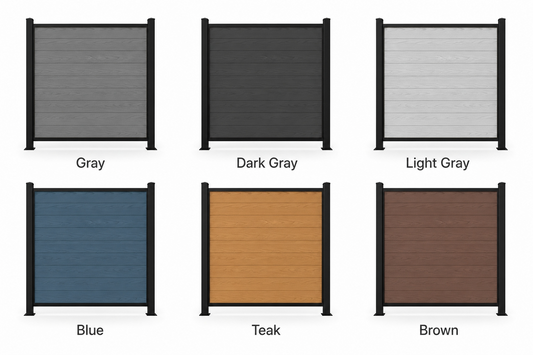
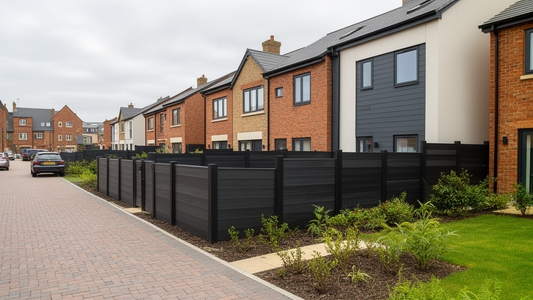
Color selection matters more than most new distributors realize. In 2026, black and charcoal are the fastest-growing colors for composite fencing in the US market, driven by the modern and minimalist home exterior trend. Natural brown/walnut and gray are volume workhorses — broadly HOA-acceptable and easy to sell against wood. Cedar tones appeal to buyers who want the wood look without the maintenance. A launch range of black, gray, and natural brown/walnut covers the large majority of residential demand.
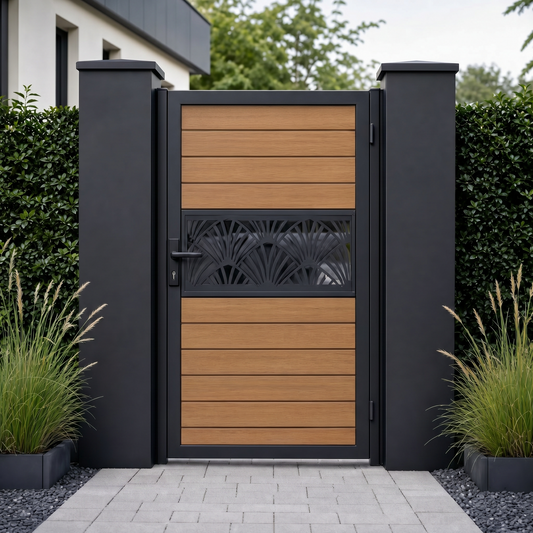
Matching gates are not optional accessories — they are a requirement for a credible range. A fence contractor who cannot buy a matched pedestrian gate from the same distributor will source the whole job elsewhere. Stock pedestrian walk gate kits in your core colors alongside panel inventory. Double gates and driveway gates can initially run as made-to-order, given their lower frequency and higher per-unit cost.
Accessories — post caps, intermediate brackets, trim boards, and decorative top rails — are compact, high-margin add-ons that improve job profitability for the contractor while building your average order value. They are relatively inexpensive to stock and rarely expire.
Marketing a New Composite Fencing Line to Local Contractors
The most effective marketing channel for a new composite fencing distributor is direct outreach to fence contractors, landscapers, and general contractors who are already installing fencing in your territory. These buyers are accustomed to receiving samples and will evaluate a new product on its merits if approached professionally.
A physical sample kit is your most important sales asset: a short board section in each stocked color, a post cross-section showing the reinforcement core, and a gate hardware component. When a contractor can hold a capped co-extruded board and compare it to what they are currently installing, the material quality argument usually makes itself. Samples themselves are free — the courier charge is invoiced and then credited against the first order — so the cost of putting one in a contractor's hands is negligible relative to the value of a recurring trade account.
Beyond samples, the channels that consistently drive contractor acquisition for building materials distributors include: trade association membership and local fencing contractor network events, Google My Business presence optimized for "composite fencing supplier [city/state]" searches, a straightforward trade account application with Net-30 terms for qualified contractors, and referrals from architects, landscape designers, and HOA management companies. Digital advertising works but is most efficient once you have testimonials and project photos from your first wave of installed projects.
Positioning your range against the branded alternatives is not about attacking Trex or Fiberon — it is about giving contractors a transparent cost and specification comparison they can present to their clients. A contractor who can show a homeowner a co-extruded composite board and a materially lower material cost than the comparable branded option is equipped to win more jobs. Your job as a distributor is to give them that argument.
Frequently Asked Questions
Q: What margins can a composite fencing distributor expect?
A: A well-run composite fencing distributor sourcing factory-direct from China should expect gross margins of 40–55% on direct material cost (landed cost to trade selling price). After warehousing, freight, credit, and sales overhead, operating margins typically land in the 12–22% range depending on volume, SKU mix, and whether you stock inventory or operate on a made-to-order basis. Gates and accessories generally carry higher gross margins than panel products, so blended margin improves as you build out the range. Larger purchase volumes also reduce landed cost and expand the margin spread.
Q: Do I need to hold inventory to become a distributor?
A: Not necessarily, but inventory capability significantly expands your addressable market. Fence contractors who need materials for a scheduled job typically cannot wait 8–10 weeks for a production and shipping cycle — if you cannot fulfill from local stock, you will lose that segment of business. A practical middle ground is to stock your top 3–5 SKUs domestically and run a drop-ship or back-order program for everything else. Distributors focused exclusively on large-scale HOA or developer projects can often operate without domestic stock, since those buyers plan far enough ahead to accommodate factory lead times.
Q: Can I get regional exclusivity from a factory-direct supplier?
A: Yes, but it requires negotiation and a commitment. Most Chinese WPC fencing factories will consider territorial exclusivity arrangements in exchange for minimum annual purchase commitments, typically in the $150,000–$500,000+ range depending on territory value and factory size. Exclusivity protects your pricing discipline by preventing the factory from selling the same product to competing distributors in your region. Define the territory clearly in the agreement — by state, metro area, or ZIP code clusters — and ensure the contract specifies how exclusivity is maintained if purchase minimums are not met.
Q: What products should a starter composite fencing range include?
A: A practical launch range covers: 6-foot privacy fence panels in capped (premium) and uncapped (entry) construction in at least three colors (black, gray, natural brown/walnut); a matched composite post system with the same color options; and pedestrian walk gate kits in matching colors. Post caps and intermediate brackets round out the accessory side. This covers the majority of US residential demand without overextending inventory. Add 4-foot semi-privacy panels, double gate kits, and additional colors once you have proven demand velocity in your territory.
Q: How do established brands like Trex and Fiberon affect distributor opportunities?
A: The major brands define the upper end of the market's price expectations, which actually creates opportunity for a factory-direct distributor positioned one tier below them on price. Trex fencing retail pricing runs roughly $22–$38 per linear foot (material only), with some premium lines higher. A factory-direct distributor supplying comparable WPC specification — capped boards, aluminum-reinforced posts — at a materially lower price point can win contractors and dealers who want to compete against the brands rather than sell through them. The brands also do limited customization on panel sizes, colors, and gate matching; factory-direct sourcing gives distributors flexibility the brands cannot match.
Ready to Get Started?
Explore distributor terms, sample kits and starter range options with Bohai Woods. Visit the Bohai Woods distributor program for the USA to request factory pricing, review certifications, and discuss territory availability.
Tags:
Previous
Composite Fencing Wholesale USA: How to Buy Factory-Direct from China
Next
How to Import Composite Fencing from China to the USA