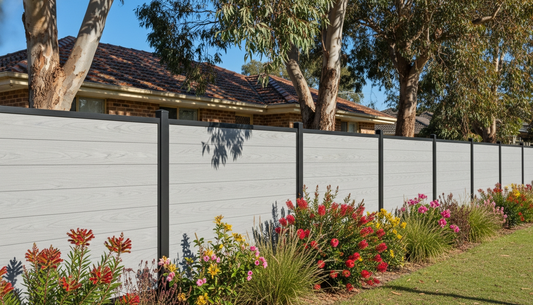
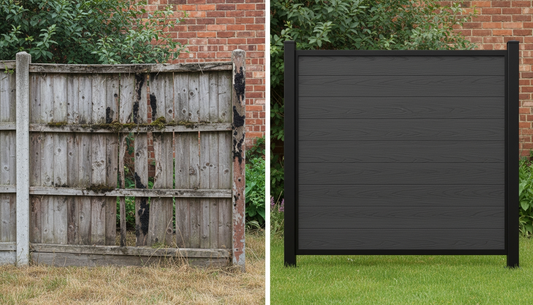
Fencing Solutions Under the California Sun: How WPC Fencing Resists UV Damage and Fading
California’s high-UV suburbs can turn a handsome fence shabby in just a few seasons. If your HOA expects uniform color year after year, the smart move is to evaluate wood–plastic composite (WPC) products using verifiable UV tests and measurable color-change limits—not marketing adjectives. This guide explains the standards (ASTM/ISO/QUV), how to read lab results with ΔE color metrics, and what to specify for real-world results in HOA neighborhoods.
Why UV beats up fencing—and why WPC handles it differently
Sunlight drives photo-oxidation in polymers and breaks down pigments and binders at the surface. That shows up as fading, chalking, and a rougher feel. Natural wood also fades and weathers unevenly unless you re-coat frequently. Vinyl can discolor or embrittle where heat and UV are severe. WPC fencing combats this with:
- UV-stabilized capstocks (co-extruded outer layers)
- High-performance pigments designed for outdoor exposure
- Additives that slow oxidation and surface chalking
The result, when engineered and tested well, is steadier color and lower maintenance in high-UV suburbs.
The standards that matter for WPC fencing UV resistance
When someone claims “great fade resistance,” your first question should be: Tested how?
-
ASTM G154 (fluorescent UV/condensation) and its international analog ISO 4892-3 are widely used to screen polymer composites for color change and chalking under UVA-340 lamps. Atlas Material Testing summarizes how these fluorescent-UV methods simulate short-wavelength sunlight and include moisture cycles while noting correlation limits to the outdoors. See Atlas’s paints and coatings durability overview and ISO 4892-3 update for context: Atlas applications overview on fluorescent-UV methods and Atlas ISO 4892-3 update (2024).
-
ASTM G155 (xenon-arc) uses full-spectrum light (UV–visible–NIR) and often correlates better with outdoor performance when correlation is critical. Atlas’s technical guides explain irradiance control and spectrum considerations; a good primer is Atlas TG101 on irradiance basics.
-
Color change is calculated as ΔE using ASTM D2244. You’ll want lab reports to state instrument settings (e.g., D65/10°), aperture, and geometry so results are comparable.
A note on hours-to-years conversions: there is no universal conversion from QUV/xenon hours to outdoor years. Use accelerated tests for ranking and minimum performance screens, then validate with field references.
How to read a UV lab report like a pro
Vendor reports can be dense. Focus on a few items that predict visible outcomes in California suburbs:
-
Apparatus and cycle
- For fluorescent-UV (ASTM G154/ISO 4892-3), a common screen uses UVA-340 lamps, ~0.89 W/m² at 340 nm, 8 h UV at ~60°C black panel followed by 4 h condensation at ~50°C.
- For xenon-arc (ASTM G155), look for filter type (daylight or window), irradiance setpoint, black panel or chamber temperature, and wet cycles.
-
Exposure duration
- State total hours (e.g., 1,000, 2,000, 3,000 h). Don’t assume a direct “years” equivalence; ask for outdoor correlation or field references.
-
Color measurement and ΔE threshold
- Confirm ΔE method (CIEDE2000 recommended), illuminant/observer (D65/10°), and baseline vs post-exposure readings.
- Practical rubric for perception under consistent viewing:
- ΔE < 1.0: Typically imperceptible
- ΔE 1–3: Slight; often acceptable to HOAs
- ΔE > 3: Noticeable to most observers
- As a precedent for quantified warranties, Trex’s Limited Fade & Stain Warranty specifies numerical ΔE limits over set periods, providing a benchmark for quantified fade commitments. See the PDF: Trex Limited Fade & Stain Warranty (2023).
Best-practice specification for high-UV California HOAs
Write performance into the spec so everyone bids apples-to-apples.
-
Require recognized standards and data
- UV exposure per ASTM G154 or ISO 4892-3 (fluorescent UV, UVA-340) and/or ASTM G155 (xenon arc).
- Report cycle, irradiance, black panel temperature, and moisture step.
- Provide ΔE results (CIEDE2000) measured per ASTM D2244.
-
Prefer construction that’s built for sun
- Co-extruded capstock with UV stabilizers
- Outdoor-rated pigments with proven lightfastness
-
Ask for validation
- Third-party lab reports, plus local references with dated photos when available.
Example spec clause (adapt with legal review)
Color Stability: Composite fencing profiles shall be tested per ASTM G154 or ISO 4892-3 using UVA‑340 lamps at 0.89 W/m² (340 nm) with an 8 h UV/4 h condensation cycle at 60°C/50°C. After 2,000 hours exposure, color change shall be ΔE (CIEDE2000) ≤ 5.0 measured per ASTM D2244, D65/10° observer. Submit third‑party lab report with pre/post instrument files.
Illustrative mapping of hours to expectations (not a conversion)
The table below is a qualitative screen only; real correlation depends on formulation and climate. Use it to set minimums, not to predict exact years.
| Accelerated exposure (UVA‑340, example cycle) | Typical ΔE target | What an HOA might see |
|---|---|---|
| 1,000 h | ≤ 3.0 | Slight shift; most won’t notice across a run |
| 2,000 h | ≤ 5.0 | Mild fade; still uniform for typical suburban sightlines |
| 3,000 h | ≤ 6.0–7.0 | Noticeable on close inspection; still acceptable if uniform |
Hypothetical California HOA micro‑case (for illustration)
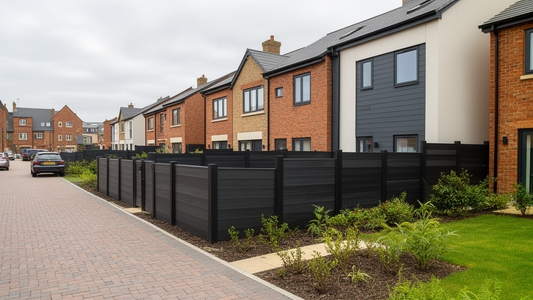
Scenario: A south‑facing, 220‑linear‑foot privacy fence in a high‑UV East Bay suburb. The HOA approves a WPC system with a ΔE ≤ 5.0 requirement after 2,000 h UVA‑340 per ASTM G154. Baseline color readings are captured at install.
- Year 1: After a dry summer, annual wash restores surface sheen. Measured ΔE averages 1.6; no visible mismatch between sun‑exposed and shaded sections.
- Year 2: ΔE averages 2.7 after a hotter season; uniform across panels. Minor dusting rinses off.
- Year 3: ΔE averages 3.9; color remains consistent fence‑to‑fence. HOA notes no patchy panels.
Label: Hypothetical example only. Your results depend on product formulation, orientation, landscaping, and maintenance. Use it to design your documentation workflow—not as a performance guarantee.
Neutral example: mapping a datasheet to an HOA spec and submittal
Think of this workflow as a checklist you can apply to any vendor, including Bohai Wood.
-
Start with the vendor’s published test summary and product page. For instance, Bohai provides a composite fencing collection and product details that help frame specs: Bohai composite fencing collection and Composite Fencing 188‑20.
-
Translate claims into requirements:
- If the datasheet references fluorescent‑UV testing (ASTM G154/ISO 4892‑3) and lists ΔE after a stated number of hours, copy those exact parameters into your spec clause (like the example above).
- Require a third‑party lab report with instrument files to verify ΔE (ASTM D2244, CIEDE2000).
- Define submittals and acceptance:
- Submittal: Warranty text, test report, and 3 local references (photos within 36 months).
- Acceptance: Field color checks at install and year‑3 must not exceed your ΔE threshold for representative panels; if a panel exceeds, review shading and maintenance before remediation.
Maintenance and inspection that actually preserve color
-
Homeowner maintenance card
- Annual hose rinse with mild soap; soft brush only.
- Avoid solvent cleaners and harsh abrasives that alter sheen.
- Keep sprinklers from constantly wetting one area; standing moisture encourages deposits and uneven appearance.
-
Post‑install and year‑3 inspection checklist
- Capture baseline spectrophotometer readings (D65/10°, consistent geometry) on representative panels.
- Photograph in diffuse daylight with a color checker; repeat annually in similar light.
- Log cleaning dates and products used.
- If ΔE exceeds the threshold, check orientation, shade patterns, irrigation, and cleaning routine before deciding on replacement.
Lifecycle perspective: WPC vs wood vs vinyl in suburban California
The goal isn’t perfection; it’s uniform appearance with minimal upkeep.
| Factor | WPC fencing (with capstock) | Wood (stained/painted) | Vinyl |
|---|---|---|---|
| UV/color stability | Strong when tested to ASTM G154/G155; uniform fade | Prone to rapid fade; frequent re‑coats | Can discolor; heat movement visible |
| Maintenance over 10 years | Low: washing; no re‑coats | High: sand/re‑stain every 2–3 years | Low–moderate: cleaning; chalk removal |
| Aesthetics in HOAs | Consistent color and texture | Can look patchy between boards | Uniform but can appear glossy |
| Quantified fade warranties | Increasingly common (ΔE‑based) | Rare | Sometimes offered; details vary |
Questions to ask vendors and installers before you approve
- Which standard did you use—ASTM G154/ISO 4892‑3 or ASTM G155—and what were the exact cycles and irradiance?
- What are the ΔE results after 1,000–3,000 hours using CIEDE2000 per ASTM D2244?
- Do you have third‑party lab reports and recent California references with dated photos?
- Is the product co‑extruded with a UV‑stabilized capstock, and which pigments are used for outdoor lightfastness?
- How should we document baseline color and annual checks for HOA records?
Wrap‑up
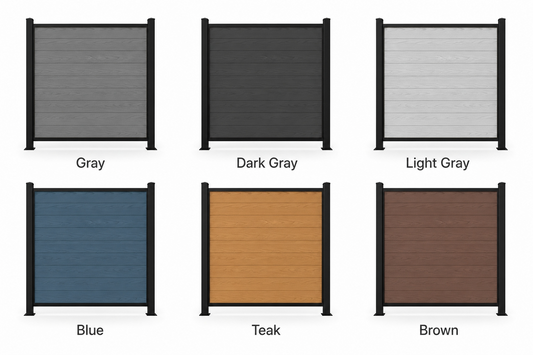
If your HOA needs fences that stay visually uniform under intense sun, anchor decisions in standards and numbers. Specify ASTM/ISO methods, set a realistic ΔE limit, and require verifiable reports and field documentation. Want to see configurations and profiles that fit HOA aesthetics? Browse the Bohai composite fencing collection to explore options without the sales fluff.
Explore our composite fence panels — available in privacy, trellis and decorative styles.
Tags:
Previous
Desert Wind and Sand Abrasion on Exterior Walls: Why Composite Cladding Is the Best Choice
Next
Low‑maintenance WPC security fencing for public housing projects: modular, vandal‑resistant, spec‑ready