Composite Gate Hardware Guide: Hinges, Latches, Locks and Self-Closing Kits
Most composite gate problems are hardware problems. The gate does not warp — it sags, drops out of latch alignment, and stops closing. Almost always the cause is hardware sized for a wood gate carrying a composite one.
Why Composite Gates Need Different Hardware
Three differences matter, and only the first is obvious.
Weight. WPC is denser than softwood. A composite gate leaf can weigh two to three times what a comparable cedar or pine gate weighs, and hinge failure is a function of load, not appearance.
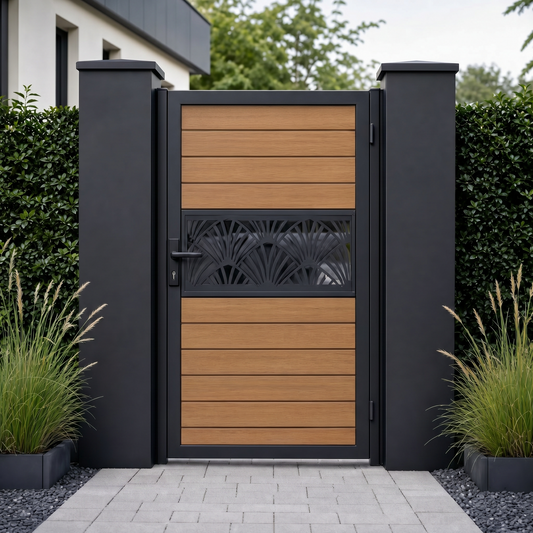
Where the load goes. A composite gate is normally an aluminium frame with WPC infill boards. The frame carries the load; the boards do not. This means hardware must fix to the frame — a hinge lagged into the face of a composite board has nothing structural behind it and will pull out.
No forgiveness. Wood gates absorb small misalignments; the timber compresses, the latch still catches. An aluminium-framed composite gate is rigid. A few millimetres of hinge drop translates directly into a latch that no longer engages, which is why composite gates fail closed-loop tests that wood gates pass.
Sizing Hinges: Do the Weight Math First
Hinge selection starts with the actual leaf weight, and most buyers never calculate it. You can, from two numbers your supplier should give you: the board weight per metre and the effective coverage width.
Worked example using a standard privacy board at 2.69 kg/m with 172 mm coverage:
| Gate leaf | Boards | Infill weight | |
|---|---|---|---|
| Pedestrian 1000 × 1800 mm | 11 | 29.6 kg | 65 lb |
| Pedestrian 1200 × 1800 mm | 11 | 35.5 kg | 78 lb |
| Driveway leaf 2000 × 1800 mm | 11 | 59.2 kg | 130 lb |
| Driveway leaf 2500 × 1800 mm | 11 | 74.0 kg | 163 lb |
The arithmetic is: gate height ÷ coverage width = board count (round up), then board count × leaf width × weight per metre.
These figures are infill only. The aluminium frame, fixings and any lock body add meaningfully on top — a frame perimeter on a driveway leaf runs seven metres or more of extrusion. So treat the table as a floor, not a total, and ask your supplier for the complete leaf weight in writing before selecting hinges. A supplier who cannot produce that number has not weighed the product.
Then specify hinges with margin. Hinge ratings are usually quoted per pair at a stated gate width. Size to the complete leaf weight with headroom rather than to the rating that just barely covers it — the rating is a static figure and a gate in service sees wind load, slamming and people leaning on it.
For driveway leaves in the 130 lb and up range, use three hinges rather than two, or a heavy-duty pair with an adjustable centre. The third hinge is not about static load; it is about distributing the moment that causes the far corner to drop.
Adjustability is not optional. Choose hinges with adjustment in at least two axes. Composite gates need re-alignment after the first season as posts settle, and a non-adjustable hinge turns a five-minute correction into a re-hang.
Latches and Locks: Pedestrian vs Driveway
Pedestrian gates in ordinary use take a gravity latch or a lockable latch with a thumb-turn or key. The decision that matters is which side the release sits on and whether the gate is in a security or a safety role — those pull in opposite directions.
Driveway gates need a drop rod or cane bolt on the passive leaf plus a latch or lock on the active leaf. Without the drop rod, the passive leaf moves in wind and destroys latch alignment. This is the single most commonly omitted component on double gates, and it is inexpensive.
Automated gates change the logic entirely. A motorised sliding or swing gate uses the operator to hold position, and the hardware set becomes a different list: safety edges, photo eyes, manual release. Do not specify a self-closing hinge on a gate that has an operator — the two fight each other.
Match hardware to the gate type at quotation stage. A composite gate ordered without its hardware list is an incomplete order, and hardware is the item most often shipped separately and late.
Pool-Code Hardware: The Rules That Actually Bind
If the gate forms part of a pool barrier, hardware stops being a preference and becomes a compliance item. Under the ISPSC framework the gate must:
- Be self-closing — released from any position, it swings shut on its own
- Be self-latching — it latches automatically, with no manual step
- Open outward, away from the pool
- Have the latch release at least 54 inches above finished ground — and if the release sits lower, it must be on the pool side of the gate with specific shielding
That 54-inch rule is what most hardware sets fail. A standard lockable latch mounted at a comfortable adult height sits well below it. You need either a latch designed for high mounting or a magnetic latch with a keyed release positioned to the code height.
Two practical consequences:
Self-closing hinges must be matched to the leaf weight, not just present. A spring hinge that closes a 65 lb pedestrian gate will not reliably close a 130 lb driveway leaf against a latch, and a gate that closes but does not latch fails the inspection exactly the same as one that stays open.
Test the closed loop, not the components. Release the gate from several positions — fully open, half open, barely ajar — and confirm it latches every time. Inspectors do this. The full barrier rule set is in the pool fence code compliance guide.
Finishes and Corrosion
Hardware finish is usually chosen to match the fence colour. That is fine as far as it goes, but the substrate matters more than the coating.
Stainless grade. 304 stainless is adequate inland. Within roughly a mile of salt water, or on a pool gate exposed to chlorine, 316 is the grade to specify — 304 will show surface rust and eventually seize in those conditions.
Galvanic pairing. An aluminium gate frame with plain steel fixings in a wet environment sets up galvanic corrosion at every fixing point. Use stainless or coated fixings specified for aluminium contact.
Powder-coated aluminium hardware matches composite fence colour ranges well and avoids the galvanic issue, but check the load rating — decorative powder-coated hinges are often rated for far lighter gates than a composite leaf.
The finish that matches your fence colour and the hardware that carries your gate weight are two separate decisions. Make the structural one first.
Why Gate Hardware Fails
Five causes account for most of it, and none is a manufacturing defect.
- Hinge undersized for the real weight. The gate was priced as a wood gate and hardwared as one. It sags within a season.
- Two hinges on a leaf that needed three. The load is within rating but the moment is not.
- Hardware fixed to the boards instead of the frame. Nothing structural behind the fixing; it pulls out.
- Post not set for gate load. A gate post carries an eccentric load that a line post never sees. If the gate post is the same section and depth as the fence posts, it will lean, and every latch problem downstream traces back to it.
- Over-tightened fixings. Crushing the composite at the fixing point creates a stress riser that cracks later.
Note that three of the five are specification errors made before anything was installed. Hardware failures are mostly ordering failures.
Retrofitting Hardware to an Existing Gate
Upgrading hardware on a gate already hung is realistic, with two checks first.
Check the post before the hinge. If the gate post moves when you push the gate, replacing the hinge fixes nothing. Correct the post first.
Check the frame. Confirm there is frame material where the new hardware will fix. Moving a hinge 100 mm to reach frame is normal; fixing into board because the frame is not there is not.
When adding self-closing hardware to a gate that was not designed for it, expect to adjust the latch position as well. A self-closing hinge changes the speed and angle at which the gate arrives at the latch, and a latch that worked with a manual push often needs repositioning.
What to Specify When You Order
For a single gate this is a checklist. For a dealer stocking gates or a contractor buying a project quantity, it is the difference between a clean install and a truck roll.
Specify, in writing, on the order:
- Complete leaf weight — not board weight, the finished leaf
- Hinge type, quantity per leaf, rating, and adjustment axes
- Latch type and mounting height, with pool-code role stated if applicable
- Drop rod or cane bolt for every double gate
- Fixing type and stainless grade, specified for aluminium contact
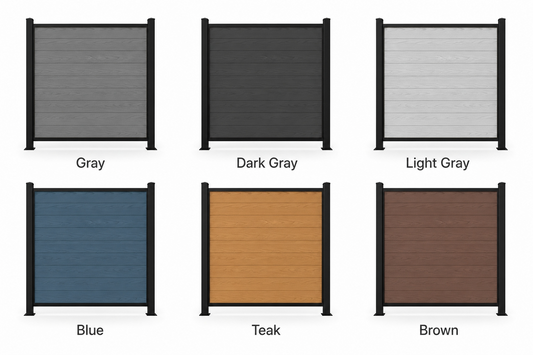
- Finish and colour reference matched to the fence
- Whether hardware ships fitted or loose, and in which container
That last point causes more delay than any other. Hardware that ships loose in a separate carton arrives with the container but gets separated on site; hardware that ships in a later shipment strands finished gates. Agree it at the quote, not at the packing list. For how gate hardware feeds into total gate pricing, see the composite gate cost guide, and for panel and post dimensions that determine gate opening sizes, the composite fence panel sizes guide.
Frequently Asked Questions
Q: What hinges are best for heavy composite gates?
A: Adjustable heavy-duty hinges sized to the complete leaf weight with headroom, not to the minimum rating that covers it. Use three hinges rather than two on driveway leaves — the third distributes the moment that drops the far corner. Adjustability in at least two axes matters because composite gates need re-alignment after posts settle.
Q: How much does a composite gate leaf weigh?
A: The infill alone is calculable: gate height ÷ board coverage width gives the board count, then board count × leaf width × board weight per metre. Using a 2.69 kg/m board with 172 mm coverage, a 1000 × 1800 mm pedestrian leaf carries about 29.6 kg (65 lb) of infill and a 2000 × 1800 mm driveway leaf about 59.2 kg (130 lb). The aluminium frame and fixings add on top, so ask your supplier for the complete leaf weight before selecting hinges.
Q: What hardware is required for pool code compliance?
A: Self-closing hinges, a self-latching mechanism, outward opening away from the pool, and a latch release at least 54 inches above finished ground — or lower only if positioned on the pool side with the required shielding. The self-closing hinge must be matched to the leaf weight: a gate that closes but does not latch fails inspection the same as one that stays open.
Q: Why does my composite gate sag?
A: Usually the hinge is undersized for the actual weight, there are two hinges where three were needed, or the gate post is moving under an eccentric load the fence posts never see. Check the post first — if it moves when you push the gate, no hinge change will fix the symptom.
Q: Can hardware be fixed directly to composite boards?
A: No. On an aluminium-framed composite gate the frame carries the load and the boards do not. Hardware must fix to the frame; a hinge fixed into the face of a board has nothing structural behind it and will pull out.
Q: What stainless grade should gate hardware be?
A: 304 is adequate inland. Specify 316 within about a mile of salt water and on pool gates exposed to chlorine, where 304 will show surface rust and can eventually seize. Also check fixings are specified for contact with aluminium, or galvanic corrosion starts at every fixing point.
Q: Can I add self-closing hardware to an existing gate?
A: Usually yes, provided the post is sound and there is frame material where the new hardware fixes. Expect to reposition the latch as well — a self-closing hinge changes the speed and angle at which the gate meets the latch, so a latch that worked with a manual push often needs moving.
Before You Order
Get the complete leaf weight in writing, size the hinges to it with margin, and confirm whether hardware ships fitted or loose. Those three answers prevent most gate problems. Request a gate specification sheet with frame section, leaf weight and hardware list.
Tags:
Previous
Composite Fence Panel Sizes USA: Standard Dimensions and How to Measure
Next
Composite Driveway Gates USA: Styles, Sizes and Automation Options