Composite Decking Boards UK: Specs, Sizes & Wholesale 2026
For contractors pricing jobs, merchants building a composite range, or developers specifying materials for a housing scheme, knowing the precise board dimensions, construction grades, and ordering minimums matters far more than marketing language. This guide covers everything a UK trade buyer needs to know about WPC composite decking boards in 2026 — from raw dimensions and fixing systems through to subframe requirements and wholesale container volumes. If you are new to composite as a material category, our composite decking UK guide covers the broader buying decision including cost comparisons with timber and PVC.
Standard Composite Decking Board Dimensions for the UK
WPC composite decking boards are manufactured to a narrower range of standard dimensions than traditional timber, which is one of their practical advantages. Because boards are extruded rather than sawn, dimensional consistency is high — typically ±0.5mm on width and thickness across a production run.
Board Width Options (135mm, 140mm, 150mm)
Bohai Wood produces composite decking boards in three standard widths: 135mm, 140mm, and 150mm. These are nominal face dimensions; once fixing clips are fitted, the installed spacing between boards is typically 3–5mm narrower than board pitch. A 140mm board with a 4mm clip gap gives an effective laid pitch of approximately 144mm — roughly 6.9 boards per linear metre of deck width.
The 140mm board is the most commonly specified in the UK market, balancing installation speed with a natural plank proportion. The 135mm width suits finer aesthetic requirements and reduces offcut waste on irregular shapes. The 150mm board is favoured on larger commercial terraces where fewer boards per square metre reduces labour hours.
When calculating materials, always use the effective installed width (face width plus clip gap) rather than the nominal dimension. Using nominal board width is a common source of under-ordering.
Board Thickness (22mm–25mm)
Standard Bohai WPC decking boards range from 22mm to 25mm in thickness. Thickness matters most in relation to joist spacing: a thinner board deflects more over a longer span. The maximum joist spacing is 350mm centres for a straight lay, and that figure applies to the board regardless of whether it is hollow or solid. Any diagonal installation pattern requires joist spacing to be reduced by approximately 30%, since diagonal boards span a greater distance between joists at any given crossing point.
Available Lengths (2.9m, 3.6m, 4.0m, 5.8m)
Boards are available in four standard lengths: 2.9m, 3.6m, 4.0m, and 5.8m. The 3.6m and 4.0m lengths are most widely specified in the UK, suiting typical domestic garden dimensions without requiring butt joints. The 5.8m board is preferred for commercial decking, long terraces, and new-build perimeter decking where continuous runs minimise visible end joints. The shortest length — 2.9m — suits balconies, roof terraces, and areas with restricted access.
Thermal expansion requires an allowance of 5mm per 4m board length, plus 5mm end gaps at any fixed structure such as a wall, post base, or step riser. For a 5.8m board this means approximately 7mm for expansion plus 5mm clearance at each fixed point. These gaps are typically concealed by fascia boards or trim. Butt joints must always fall on a joist, never between them, and staggering joints between adjacent rows improves both structural performance and appearance.
Hollow vs Solid Construction
The choice between hollow and solid board construction is one of the most consequential specification decisions for a contractor. Both use the same WPC composite material — 60% recycled hardwood fibres bonded with 40% recycled HDPE — but the internal geometry affects weight, sound, subframe requirements, and cost.
Hollow Core Boards — Weight and Performance

Hollow core boards contain longitudinal channels through the cross-section, reducing material volume by roughly 30–40% compared with a solid board of the same external dimensions. A typical 140mm × 25mm hollow board weighs approximately 2.5–3.0kg per linear metre, versus 3.8–4.5kg/m for a solid equivalent.
Lighter boards mean faster handling, lower installer fatigue, and reduced dead load on decks over voids or podium structures. Hollow boards are priced at £37–£55/m² supply-only from a factory-direct source. Their hollow chambers do not trap water, drain freely, and are unaffected by freeze-thaw cycles. One consideration is acoustic resonance: hollow boards can produce a slightly hollow sound underfoot. On domestic residential decks this is rarely a concern, but on commercial terraces where acoustic experience matters, solid boards are usually the better specification.
Solid Boards — Strength and Sound Absorption

Solid WPC boards have no internal chambers — the composite material is continuous across the full cross-section. This gives measurably better bending stiffness, lower deflection under concentrated loads, and a more timber-like sound and feel underfoot.
The structural advantage of solid boards is most relevant in three situations: high foot-traffic commercial environments, decks where the substructure is already fixed and joist centres cannot be tightened further, and applications with dynamic loads such as wheeled equipment or seating platforms. Solid boards absorb more sound than hollow boards, making them the preferred specification for rooftop terraces and hospitality venues. At £55–£70/m² supply-only for uncapped solid boards, the additional cost is justified by improved performance and client satisfaction.
Grooved Edge vs Square Edge Profiles
Composite decking boards are available with two edge profiles: grooved and square edge. The profile determines the fixing method and has direct implications for installation time, finished appearance, and ease of board replacement.
Hidden Fixing Systems for Grooved Boards
Grooved edge boards have a continuous channel machined into both long edges. Fixings are concealed using T-clip fasteners that engage the channel at every joist crossing point. One clip is placed per joist crossing per board edge — a 4.0m board laid at the 350mm maximum needs 12 spans, so 13 joists at an actual 333mm centre, which works out at 13 clips per board per edge, or 26 clips per board total.
Hidden fixing systems produce a clean, fastener-free surface with no screw heads to rust or cause trip hazards. The clips simultaneously provide consistent drainage gaps and accommodate thermal expansion. For the full installation process including subframe layout and clip positioning, see our article on how to install composite decking UK. The installation process with T-clips is slightly slower than face-fixing but the finished result is visually superior and easier to maintain long-term.
Face-Fix Systems for Square Edge Boards
Square edge boards are fixed by driving screws through the face into the joist below. Pre-drilling is recommended to prevent surface cracking, and stainless steel or decking-grade coated screws should be used to avoid rust staining. Countersinking creates a flush finish, though screw heads remain visible.
Face-fixing is faster and familiar to any carpenter. Square edge boards are easier to replace mid-run — removing a board requires only unscrewing, rather than carefully disassembling from one end as with clipped boards. Square edge profiles are also the correct choice for fascia boards, stair risers, and all decorative trim applications where the fixing edge is not accessible for clip installation.
Uncapped vs Capped (Co-Extrusion) Boards

The surface treatment — whether a board is capped with an outer HDPE shell or uncapped — is one of the most important performance differentiators in the range. For a full technical comparison, see our article on capped vs uncapped composite decking.
What Co-Extrusion Adds to Performance
Uncapped WPC boards have the wood-polymer composite exposed on all four sides. The material is inherently weather-resistant — it does not rot, warp, or require annual treatment — but the exposed wood fibres are susceptible to surface staining from mould, leaf tannins, and algae, and can develop micro-scratching under heavy foot traffic over time.
Co-extruded (capped) boards carry a protective outer shell of solid HDPE polymer, typically 0.5–1.5mm thick, applied during manufacture. This cap layer is non-porous, extremely stain-resistant, and significantly harder than the core WPC material. Scratch resistance, UV stability, and ease of cleaning are all measurably better on capped boards. Our capped decking board, profile ZSGJ138H23A, is classified R10 under AS 4586-2013 Appendix D — the oil-wet ramp test, walked in shoes, measured at 15°. We do not hold a BS 7976 pendulum value, and we do not hold the DIN 51097 barefoot wet classification that pool surrounds are normally specified against. We do not hold an EN 13501-1 reaction-to-fire classification for either grade. If a project requires one, raise it before specifying.
Which Grade to Specify and When
Uncapped boards at £37–£55/m² (hollow) are the right choice for cost-sensitive residential projects, spec housing outdoor spaces, or applications with regular maintenance. Capped co-extrusion boards at £70–£92/m² are appropriate for commercial terraces, hospitality venues, and any area under heavy tree canopy where staining is likely. The price premium of 40–60% over uncapped is justified where a long maintenance-free service commitment is part of the project brief.
For merchants, stocking both grades makes commercial sense. Uncapped moves in volume on residential and self-build projects; capped boards command better margin on commercial and premium residential schemes. Capped boards carry a 15-year limited warranty and uncapped boards a 10-year limited warranty. Both are stepped by year rather than flat, and both run from the date the goods arrive and are signed for at the destination port. Both grades are priced 30–40% below equivalent UK-stocked brands such as Cladco (£45–£75/m²) or Trex (£60–£90/m²) when sourced factory-direct.
Colour Options for the UK Market
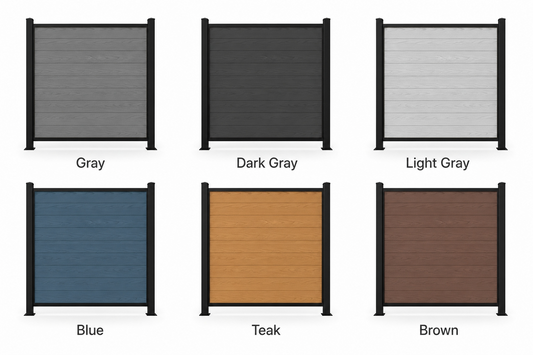
Charcoal, Light Grey, Teak, Walnut, Cedar, Dark Brown
Bohai WPC decking boards are available in six standard colourways: Charcoal, Light Grey, Teak, Walnut, Cedar, and Dark Brown. Charcoal and Light Grey are currently the most specified in the UK, driven by the strong preference for contemporary greyed tones in new-build landscape design. Both work well with rendered walls and aluminium-framed glazing. Light Grey shows less solar heat build-up than dark boards, which is a practical consideration for south-facing roof terraces and exposed commercial installations.
Teak and Walnut replicate the mid-brown to golden-brown tones of tropical hardwood — commonly specified on traditional garden schemes, pub beer gardens, and hospitality terraces where a natural wood appearance is preferred. Cedar provides a lighter honey tone suited to Scandinavian-inspired garden designs. Dark Brown is the deepest in the range and creates strong contrast against light stone or concrete paving.
All six colours are manufactured through the core WPC material rather than applied as a surface coating — they do not peel, flake, or require re-staining. On uncapped boards, some gradual weathering of the surface colour is normal in UV-exposed conditions, stabilising after a few months. Capped boards show minimal colour change over time. For large contracts or container orders, request a bulk sample from the same production run to confirm colour consistency.
Subframe and Joist Requirements

Joist Spacing for Composite Decking
Correct joist spacing is non-negotiable for a well-performing composite deck. Standard guidance:
- All boards, straight lay: maximum 350mm joist centres
- Diagonal lay: reduce by approximately 30%, to around 245mm centres
- Commercial loads: reduce centres by a further 10–15% to increase stiffness under concentrated loads
A minimum of 100mm ground clearance beneath the deck structure must be maintained to allow airflow, prevent organic matter accumulation, and reduce moisture retention. Where the deck is at near-ground level, a weed suppression membrane below the structure reduces upward moisture and weed growth. Bohai decking boards never need ground contact — the subframe carries all load transfer to the ground.
Compatible Frame Materials

Aluminium joists are the preferred subframe material for professional composite decking installations. Aluminium does not rot, warp, or require treatment, and its dimensional stability keeps joist spacing consistent throughout the deck's service life. Aluminium is the correct specification for elevated decks, roof terraces, podium decks over garages, and commercial applications.
Pressure-treated timber joists (C24 or better, treated to UC4 specification) remain widely used on ground-level domestic decks where cost is a consideration. When ground clearance, airflow, and drainage are properly managed, treated timber joists perform adequately, though they have a shorter service life of 15–20 years — typically less than the composite boards above them.
Composite (WPC) joists are available as a fully rot-proof alternative to timber, suited to pool surrounds and areas subject to chemical or salt water exposure.
Subframe design should be completed before specifying board lengths, since joist positioning determines where board end joints must fall — always on a joist centre.
Wholesale and MOQ Information
Minimum Order Quantities
Bohai Wood supplies UK buyers directly from its manufacturing facility in Sihui, Zhaoqing, Guangdong province, China. This factory-direct route eliminates UK distributor margin, saving buyers 30–40% compared with purchasing equivalent specifications from UK-stocked brands. For a full overview of factory-direct purchasing, see our composite decking wholesale UK guide.
Minimum order quantities are set at levels that make production and container loading viable. For smaller first-time orders, a part-container (LCL) arrangement allows mixed product selection below full container quantities. LCL pricing per square metre is marginally higher than FCL but remains competitive against UK retail. For distributors, merchants building a stocked range, or contractors running multiple simultaneous projects, FCL ordering delivers the strongest unit economics.
UK import duty on WPC decking products is approximately 3.7% under commodity code 3918.10, which is incorporated into the landed cost calculation provided on request.
Container Load Volumes
Total procurement lead time from confirmed order to UK warehouse is 7–9 weeks: production takes 2–4 weeks, with sea freight adding a further 25–35 days to UK ports (typically Felixstowe or Southampton). This lead time should be factored into project scheduling.
Container capacities for planning purposes:
- 20ft FCL: approximately 200–300m² of composite decking, depending on board dimensions and packing density. Suitable for single-product orders or projects with one primary board specification.
- 40ft FCL: approximately 400–600m², suitable for larger projects, merchant stocking orders, or mixed-product shipments including boards, subframe components, fixings, and fascia trim.
Mixed container loads combining different board widths, lengths, colours, and grades are accommodated on FCL orders. When calculating order quantities, use the project's square metreage plus a 5–8% waste allowance (higher for diagonal or complex shapes). Bohai's sales team can advise on optimal container utilisation to avoid dead freight.
FAQ
Q: What are the standard composite decking board sizes in the UK?
A: Standard Bohai WPC composite decking boards are available in widths of 135mm, 140mm, and 150mm; thickness of 22mm (hollow) or 25mm (solid); and lengths of 2.9m, 3.6m, 4.0m, and 5.8m. The most commonly specified combination in the UK is 140mm wide × 25mm thick in 3.6m or 4.0m lengths, which suits the majority of domestic and commercial garden deck projects. Board dimensions are nominal; allow for a 3–5mm clip gap between boards when calculating materials.
Q: What is the difference between hollow and solid composite decking?
A: Hollow composite boards contain longitudinal chambers within the cross-section, reducing weight by around 30–40% compared with solid boards of the same external dimensions. Hollow boards are lighter, more cost-effective (£37–£55/m² vs £55–£70/m²), and suitable for most residential applications. Solid boards offer greater bending stiffness, better sound absorption underfoot, and are preferred for commercial, high-traffic, or acoustic-sensitive environments such as hospitality terraces and roof gardens. Capped boards carry a 15-year limited warranty and uncapped boards a 10-year limited warranty; both are stepped by year rather than flat.
Q: Which is better: grooved or square edge composite decking?
A: Neither is objectively better — the right choice depends on the application. Grooved boards use hidden T-clip fixings that produce a clean, fastener-free deck surface and are preferred for most residential and commercial installations where appearance is a priority. Square edge boards are face-fixed with screws, are faster to replace mid-run, and are the correct choice for fascia boards and trim work. For a deck surface, grooved boards with hidden fixings are generally specified for their superior finished appearance and easier long-term maintenance.
Q: What joist spacing do I need for composite decking?
A: Maximum joist centres are 350mm for a straight lay, reducing to approximately 245mm for a diagonal lay. That figure applies to the board regardless of whether it is hollow or solid. Always maintain a minimum of 100mm ground clearance beneath the deck structure. Reduce joist spacing by a further 10–15% for commercial loads. Never use 600mm joist centres typical of timber decking for composite boards without first verifying board span performance with the manufacturer.
Q: What is the minimum order for wholesale composite decking boards?
A: Bohai Wood supplies UK buyers factory-direct from Sihui, Zhaoqing, Guangdong, China. Part-container (LCL) loads allow smaller mixed orders; full 20ft FCL orders cover approximately 200–300m² and 40ft FCL orders cover 400–600m². FCL orders attract the strongest per-square-metre pricing and are recommended for merchants stocking a range or contractors with ongoing project pipelines. Total lead time from confirmed order to UK delivery is approximately 7–9 weeks including production and sea freight.
Ready to Get Started?
Download our full composite decking specification sheet or request a wholesale quote at /pages/contact
Tags:
Previous
Composite Decking UK: The Complete Buyer's Guide (2026)
Next
Composite Decking Supplier UK — Factory Direct from Bohai Wood