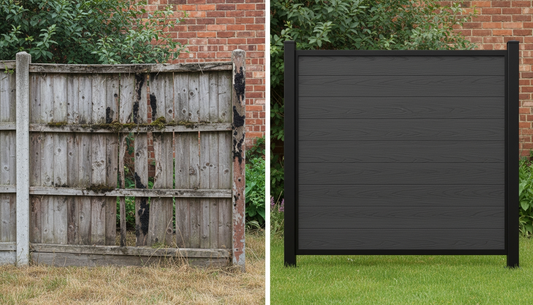
How Long Does Composite Fencing Last? Lifespan and Warranty Explained
Two numbers get quoted interchangeably and they measure different things. Service life is how long the fence stays fit for purpose. Warranty is how much of a replacement the manufacturer will fund, and for how long. Confusing them is expensive.
Lifespan and Warranty Are Not the Same Number
A manufacturer offering a 10-year warranty is not saying the fence lasts ten years. They are saying that for ten years they will contribute to remedying specific defects, on a schedule, subject to exclusions.
Quality capped WPC fencing is generally engineered for a service life well beyond its warranty term — the warranty is a commercial risk position, not an engineering estimate. Conversely, a supplier advertising a 25-year warranty is not necessarily offering a better product. They may simply be pricing the risk differently, or relying on a payout schedule that pays almost nothing in the later years.
The question that separates the two: ask the supplier what percentage of the goods value is payable in year 8. If the answer is a small number, the headline term is marketing, not cover.
When the Clock Actually Starts
This is the first thing to pin down, because three different start dates circulate:
- Date of manufacture — worst for the buyer, and it silently consumes the shipping and storage period
- Date of invoice or shipment — common, and it still burns 30 to 45 days of ocean transit
- Date of arrival and signed receipt at the destination port — best for the buyer
For an importer holding stock, the difference is not academic. A distributor who buys a container, holds it four months, and sells it into a project has already spent a meaningful share of the term before the fence is in the ground. Get the start date in the warranty document, not in an email.
The Payout Schedule Is the Part Nobody Publishes
Most composite fencing warranties are prorated: they pay 100% of the affected goods value for the first few years, then step down annually until cover expires.
A typical structure looks like this — the exact percentages vary by manufacturer, and they are the numbers that matter:
| Warranty year | Typical payout |
|---|---|
| Years 1–3 | 100% of affected goods value |
| Year 4 | 80% |
| Year 5 | 70% |
| Year 6 | 50% |
| Years 7–10 | Stepping down to 10% |
| Year 11 onward | No cover |
Two things follow.
A "10-year warranty" is really three years of full cover and seven years of declining contribution. That is not a criticism — prorated warranties are standard across the industry, including among US brands. It is only a problem when the headline number is quoted without the schedule.
Almost every warranty covers goods value only. Labour to remove and refit, freight for replacement material, and any site costs are normally the buyer's. On a fence, labour is often 35–50% of the installed cost, so a 100% goods-value payout still leaves the customer paying a substantial share. Check whether labour is mentioned at all.
Ask for the schedule in writing before you quote a warranty to your own customer. A distributor who advertises "25-year warranty" while holding a prorated 10-year manufacturer warranty has taken the difference onto their own balance sheet without noticing.
What a Composite Fence Warranty Typically Covers
Coverage is usually narrower than buyers expect, and it centres on defects that arise naturally in the material rather than anything that happens on site. The three that recur:
- Peeling — separation of the capped layer from the core
- Cracking — splitting arising from the material itself, not impact
- Overall uneven fading — note the wording carefully
That last one deserves attention. All composite fades. UV-stabilised capped WPC fades slowly and, critically, evenly — most of the change happens in the first six to twelve months and then stabilises. A warranty against "uneven" fading covers patchy or blotchy colour change; it does not cover the uniform lightening that every composite fence undergoes. A customer expecting the colour to be identical in year five has misread the cover, and it is the dealer who takes that call.
Set that expectation at the point of sale. Showing a weathered sample alongside a new one is more effective than any paragraph of warranty text.
What Voids It
Standard exclusions across the category:
- Improper installation — the largest single category, and the reason installation documentation matters commercially, not just technically
- External or human damage — impact, vandalism, vehicles
- Natural disasters — storm, flood, fire, seismic
- Chemical corrosion — pool chemicals, de-icing salt, solvents
- Improper use — loads the fence was never designed for
- Consequential loss — the fence is covered; the deck furniture it fell on is not
The installation exclusion is the one that bites. If a fence sags because the posts were undersized or the boards were fixed without expansion clearance, that is an installation failure and the manufacturer will decline it. This is why the fixing and spacing detail in the panel sizes guide is a warranty issue as much as a build-quality one, and why contractors should keep photographic records of post depth and spacing on any job they may need to claim on.
Why Fencing and Decking Carry Different Terms
Buyers frequently assume one manufacturer offers one warranty. They usually do not, and the reason is loading.
Decking is walked on. It carries live load, spans between joists, and its failure modes are structural — deflection, creep, fastener pull-through. Fencing carries no live load; its failure modes are surface and connection related. Because the risk profiles differ, the terms differ, and the fencing and decking warranty documents are separate. Ask for the one covering the product you are actually buying.
Bohai Woods composite fencing carries a 10-year product warranty. The decking range is covered under a separate document with its own term — request it specifically rather than assuming the fencing figure carries across.
What Actually Determines Service Life
The warranty is a contract. Service life is physics, and four things drive it.
Capping coverage. A co-extruded cap is the weather barrier. What matters is how much of the profile it covers. Four-sided capping — including the back face and the edges — leaves no exposed core. Three-sided capping leaves the back face open, and on a fence board the back face gets just as much rain as the front. That exposed strip is where water enters, and water in the core is what causes the swelling and cracking that ends a board's life. This is the single biggest specification difference between a fence that lasts and one that does not, and it is invisible once installed.
Board thickness and internal ribbing. Thickness resists long-term deformation. A 24 mm fence board holds its shape under wind cycling in a way a thin board does not, and warranty terms are built on that. But thickness alone is not the whole story: in a hollow profile, stiffness comes largely from the internal rib layout and wall thickness, so two boards of the same nominal thickness can behave very differently. Ask for the profile cross-section, not just the overall dimension.
UV stabiliser package. This determines how fast and how evenly colour changes. It is also the hardest thing to verify from a datasheet, which is why weathered samples are worth more than specification claims.
Fixings and posts. Fences rarely fail as boards. They fail as systems — a post that leans, a fixing that corrodes, a fastener over-tightened into the composite. The board can outlast the installation by years and still be replaced along with it.
For how these choices compare against timber over a full ownership period, see the composite vs wood cost comparison.
The US Problem: What Substantiates a Durability Claim
Here is the part most supplier content leaves out, and it matters more in the US than anywhere else.
In the United States, the standard that substantiates structural and durability performance for wood-plastic composites is ASTM D7032, usually alongside an ICC-ES evaluation report for code acceptance. Those documents are what a building official recognises, and they are increasingly what commercial buyers ask for by name.
Most Chinese WPC manufacturers, including Bohai Woods, are tested principally to European standards — EN 15534, CE, ISO, with SGS and Intertek reports — and do not hold ASTM D7032 or an ICC-ES evaluation report. That is a genuine gap and it should be stated plainly rather than papered over with a folder of generic certificates.
It is worth being equally precise in the other direction, because "no American testing at all" is also inaccurate. Individual ASTM methods have been run on our material — for example ASTM E84-23c surface burning, which returned Class A (FSI 10 / SDI 30) under SGS report GZIN2404000442CM01-1, and ASTM D4060 abrasion under Intertek 240712130GZU-001. Two caveats belong with those figures and should travel with them: both were run on co-extruded decking profiles, not fence boards, and a result obtained by an ASTM method is still not D7032 qualification or code acceptance. Buyers who know the category ask for the laboratory name, standard, report number, measured value and the exact profile tested — precisely because generic company certificates get sent instead.
What this means practically:
- For a residential boundary or privacy fence, ASTM documentation is usually not demanded, and a European-standard test package plus a clear warranty is normally sufficient
- For anything permitted, commercial, or specified by an architect, ask the local building department what they will accept before ordering
- In California WUI (Wildland-Urban Interface) zones, materials generally need CAL FIRE Building Materials Listing and SFM 12-7A-1 testing — a requirement that cannot be satisfied retroactively and that has genuinely disqualified suppliers mid-project
Testing can be commissioned on the material where a project needs it, but it takes weeks and has a cost, so it has to be raised at enquiry stage rather than after the container ships. The full picture of what is and is not held is in the WPC fencing certifications guide.
A warranty is not a substitute for a test report. A warranty is the manufacturer's own promise; a test report is a third party's measurement. Buyers evaluating durability need both, and conflating them is how sourcing decisions go wrong.
What to Verify Before You Resell a Warranty
For a dealer or distributor, the warranty is a product you resell. Verify these before you put a number in your own literature:
- The term, and which product it applies to — fencing and decking documents are separate
- The payout schedule, year by year
- The start date — manufacture, shipment, or arrival
- Whether labour and freight are included — usually not
- The claim process — who inspects, what evidence is required, and how long a decision takes
- Whether it is transferable to your customer, and whether it survives a change of property ownership
- What documentation you must retain — batch numbers, invoices, installation photographs
That last point is the one distributors skip. A claim without batch traceability is difficult to substantiate, and the paperwork requirement sits with whoever sold the goods.
Frequently Asked Questions
Q: How long does composite fencing actually last?
A: Service life and warranty term are different figures. Quality capped WPC fencing is generally engineered for a service life well beyond its warranty period, but actual life depends on capping coverage, board thickness and rib design, the UV stabiliser package, and above all the installation — posts and fixings usually fail before boards do.
Q: Is a 25-year warranty better than a 10-year warranty?
A: Not necessarily. Most composite warranties are prorated, so the later years pay a small percentage of goods value. A 25-year term with minimal cover after year eight can be worth less than a shorter term with fuller cover. Ask what percentage is payable in year eight, and compare that rather than the headline number.
Q: When does the warranty period start?
A: It varies by manufacturer — date of manufacture, date of shipment, or date of arrival and signed receipt at the destination port. Arrival is the most favourable to the buyer. Where stock is held before resale this matters, because a term starting at manufacture is partly consumed before the goods reach the end customer.
Q: Does the warranty cover fading?
A: Typically it covers uneven fading, not uniform fading. All composite lightens somewhat, mostly in the first six to twelve months, then stabilises. Patchy or blotchy colour change is a defect; uniform lightening is normal weathering and is excluded. Show customers a weathered sample at the point of sale.
Q: Does the warranty cover installation labour?
A: Usually not. Most warranties cover goods value only, leaving removal, refitting and freight with the buyer. Since labour is often 35–50% of installed cost, a full goods-value payout still leaves a significant share uncovered. Check whether labour appears in the document at all.
Q: What voids a composite fence warranty?
A: Improper installation is the largest category, followed by impact or human damage, natural disasters, chemical exposure such as pool chemicals or de-icing salt, and improper use. Keep photographic records of post depth, spacing and fixing method on any job you might need to claim on.
Q: Do fencing and decking have the same warranty?
A: Usually not, and they are separate documents. Decking carries live load and its failure modes are structural, so it is underwritten differently from fencing. Request the document for the product you are actually buying rather than assuming one term covers the range.
Before You Quote a Number
Get the warranty document for the specific product, read the payout schedule and the start date, and confirm what your local building department requires before ordering. Request the warranty and test documentation for the product you are specifying.
Tags:
Previous
Composite Driveway Gates USA: Styles, Sizes and Automation Options
Next
Deck Material Calculator: Board Count, Joists and a Metric Cut List