Bohaiwoods Composite Decking Solutions: Discover the Best composite Materials for Your Outdoor Space in 2024
Choosing Composite Decking, Fencing and Railing: What Actually Matters
Composite has become the default alternative to timber for decks, fences and railings. The marketing around it, though, is unusually noisy — comparison tables with invented competitor figures, certification logos nobody checks, and case studies that cannot be verified. This guide takes the opposite approach: where we have a third-party test result, we give the laboratory, the standard, the report number and the profile tested. Where we do not have one, we say so.

1. What Defines a Good Composite Decking Material?
Four things decide whether a composite board performs, and only the first is visible in a photograph.
-
Capping. A co-extruded (capped) board carries a polymer shell over the wood-fibre core. What matters is how many faces it covers — four-sided capping leaves no exposed core for water to enter. This is the single biggest difference between boards that look identical on a website.
-
Water absorption. The core reason composite outlasts timber. On our tested profile, Intertek report 240712130GZU-001 records 0.80% water absorption in the boiling-water test to EN 15534-4. Note the wording: low absorption, not "waterproof".
-
UV package. Ask for the ageing curve, not a single flattering number. Ours, from Weiput Shanghai report SHA03-23102974-JC-01En (ISO 4892-2 xenon arc): ΔE 0.53 at 500 h, 0.64 at 2,000 h, 0.96 at 3,000 h, 1.87 at 3,500 h, 4.58 at 4,000 h. The rise at the end is the honest part — any supplier showing you only the 2,000-hour figure is showing you half a curve.
-
Recycled content and its ratio. Our standard mix is approximately 60% recycled wood fibre and 40% recycled HDPE, plus UV stabilisers and processing additives.
On eco-credentials, one clarification worth having early: FSC and PEFC are chain-of-custody schemes for timber. They are largely beside the point for a composite board made from recycled wood flour, and we do not hold FSC or PEFC certification. If a project specification demands it, raise that before ordering.

2. Black Composite Decking
Dark boards are the strongest-selling colour family in contemporary design, and they come with one honest trade-off: dark surfaces run hotter in direct sun. That is physics, not a brand difference, and any supplier claiming their black board stays cool should be asked for the test method and the comparison conditions.
Practical guidance: on a roof terrace or a south-facing deck used barefoot in summer, consider a mid-tone rather than the darkest option, or plan for shade. Pair dark boards with a lighter railing for contrast.
3. WPC Fence vs PVC Boards
WPC (Wood-Plastic Composite)
-
Natural wood appearance and texture
-
Higher density and load-bearing capacity than PVC
-
Requires expansion gaps — measured linear expansion on the tested profile is 35 × 10⁻⁶/K (Intertek 240712130GZU-001), which is what the fixing gap has to accommodate
PVC Boards
-
Lighter, easier to handle on uneven substrates
-
Immune to insect damage
-
More limited colour range, and more prone to cracking in hard frost
We do not publish a WPC-versus-PVC cost table, because the answer depends entirely on profile, volume and destination port. Send us the specification and the quantity and we will price both.

4. Composite Deck Railing
Current design directions worth knowing about:
-
Mixed materials — aluminium balusters with composite caps
-
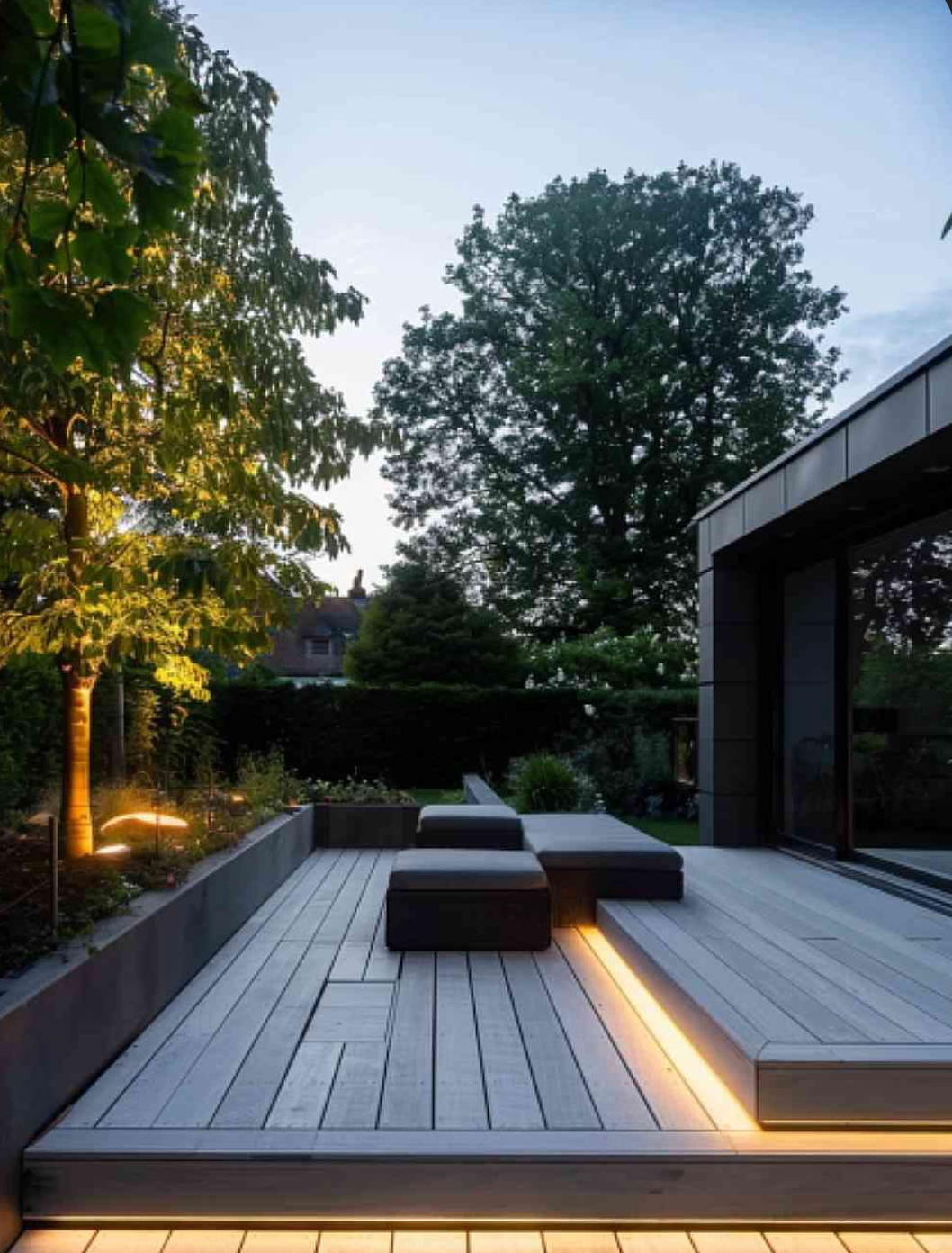
Integrated lighting — LED strips recessed into the handrail
-
Privacy panels — lattice sections for climbing planting
On sloping ground, use adjustable post anchors rather than packing under a fixed base.
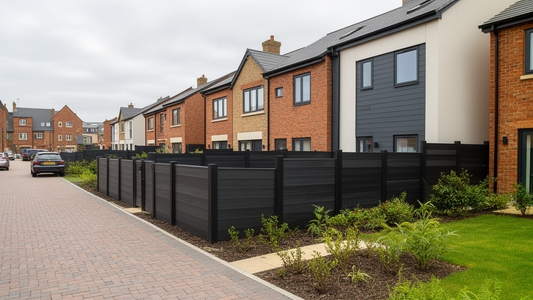
On wind: the only wind figure we can substantiate is for a fence system, not a railing. Intertek report 250710027GZU-001 records a 1.8 × 1.8 m privacy fence assembly — 170 × 24 mm WPC boards in 80 × 80 mm 6063-T5 aluminium posts — sustaining 372.1 N/m² of uniform horizontal load for three minutes without failure, roughly a Beaufort 9 gale. Two caveats belong with that number and we will not quote it without them: the test used an in-house method agreed with the client, not a published standard, and it applies to that assembly only. We do not have a mph rating for railings, and anyone quoting you one should be asked which report it comes from.
5. Cleaning and Maintenance
Composite does not need sealing, staining or painting. It does need occasional cleaning, because dirt, pollen and mildew sit on any outdoor surface.
-
Sweep debris with a soft broom.
-
Pre-treat mould-prone areas, particularly near pools and in shade.
-
Scrub along the grain with a nylon brush.
-
Rinse with a low-pressure hose. Keep well below 1,500 PSI — high-pressure washing damages the capped surface and is a common warranty exclusion.
For a mild DIY solution, dilute white vinegar 1:3 with water, and test on an offcut before using it on coloured boards.

6. Composite Fencing
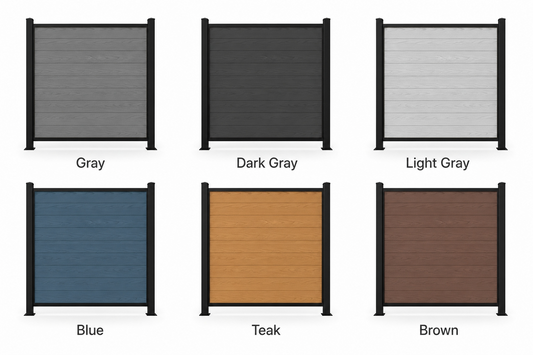
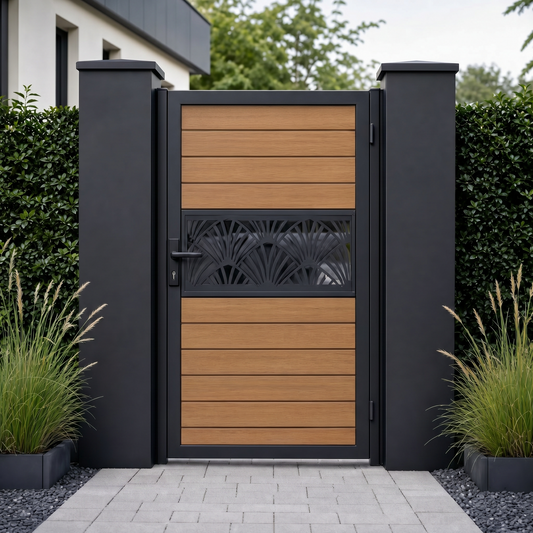
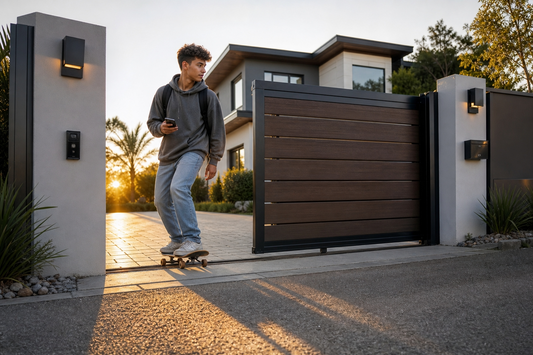
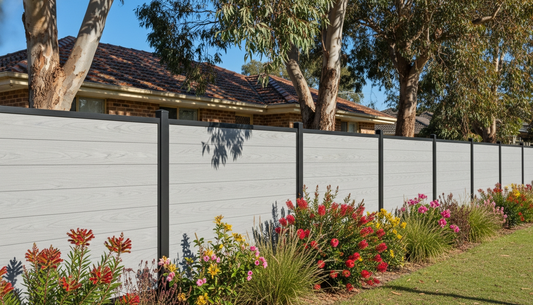
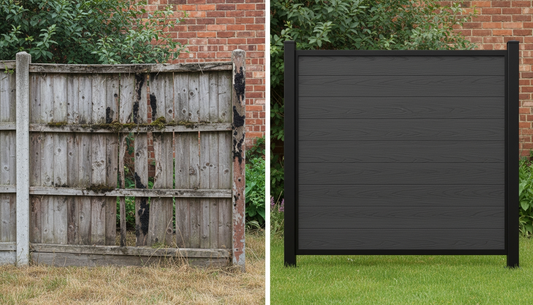
Composite fencing resists rot, warping and insect attack, needs no repainting, and holds a wood appearance without the maintenance cycle.
On coastal and salt exposure, the honest position. The board is not metal and does not corrode. We hold ISO 9227 salt-spray data — 96 hours, ΔE 0.61–1.73, grey scale 4–5 (Intertek 240712130GZU-001) — but read what that is: a colour-change measurement on a decking profile, not a corrosion rating and not a fence-system test. In a seafront installation the posts, rails, brackets and fixings govern service life, so specify the metalwork for the exposure with your engineer. Stainless 316 rather than 304 is the usual answer within about a mile of salt water.

7. Beyond Decks: Composite Square Tubes
Composite square tube is used for pergola frames, planter boxes and screen structures. It is considerably lighter than steel and does not corrode.
We do not publish load-capacity figures for square tube, and you should be wary of any supplier who does so without naming a test. Load capacity depends on span, fixing, orientation and duration, and a single number in a table is not a substitute for an engineer. For anything structural — a carport, a signage mount, anything overhead — have it designed properly and ask us for the section properties to give your engineer.
8. Our Certification Position, In Full
This is the section most supplier pages fill with logos. Here is the actual position.
What we hold:
-
ISO 9001 and ISO 14001 — certificates IAS25924Q1473R0M and IAS25924E0394R0M, valid to April 2027
-
CE / CPR — UDEM certificate M.2024.206.C97619, covering three profiles. Worth stating precisely: this runs under CPR Annex V System 4, which is a manufacturer's-responsibility route, and EN 15534 is not a harmonised standard under CPR. It is a declaration of conformity supported by notified-body documentation and third-party reports — not the same as "CE certified and mandatory for EU market access".
-
Third-party test reports from SGS, Intertek and Weiput — including ASTM E84-23c Class A (FSI 10 / SDI 30) on a white-faced co-extruded decking profile under SGS report GZIN2404000442CM01-1, and EN 13501-1 Bfl-s1 on profile ZS140H25B under SGS AJFTS26002282R02 — that report notes on its own face that it does not constitute a type approval
What we do not hold:
-
ASTM D7032 or an ICC-ES evaluation report — the documents a US building official recognises
-
CAL FIRE Building Materials Listing or SFM 12-7A-1 testing, required in California WUI zones — this cannot be obtained retroactively, and we have lost a project over it
-
FSC or PEFC chain of custody
-
GREENGUARD, and no verified product carbon footprint under ISO 14067
If a buyer needs the laboratory name and report number rather than a certificate cover page, ask — that is the correct question and we would rather answer it than send a folder of generic documents.
9. Frequently Asked Questions
Q: Can you paint composite decking?
A: Not recommended. The colour is through-coloured and capped, so paint adheres poorly and creates a maintenance liability where there was none. Choose the colour at order stage instead.
Q: How do I fix scratches on composite boards?
A: Light surface scuffs on an embossed board often become less visible after weathering. Heat-based repair is possible on some profiles but will change the surface texture — always test on an offcut first, and expect a visible difference on a capped board.
Q: What warranty applies?
A: Bohai Woods composite fencing carries a 10-year product warranty, prorated by year and running from arrival at the destination port. Decking is covered by a separate document with its own term — ask for the one covering the product you are buying, and ask for the year-by-year payout schedule rather than the headline number.
Q: What is the minimum order?
A: 70 sets for fencing and 70 m² for decking — well below the full-container minimum most factories quote. Samples are free; you pay the courier, and that cost is credited against your first order.
10. Getting a Real Quote
Send the product, the profile, the colour, the quantity and the destination port, and you will get a per-unit price rather than a range. If you need a specific test report, name the standard and we will tell you whether we hold it.
Tags:
Previous
Above Ground Pool Deck Plans: Layout, Framing and How to Build One
Next
Composite Decking Guide: Costs, Designs & Bohaiwood Tech