Composite Driveway Gates USA: Styles, Sizes and Automation Options
A driveway gate is the most expensive thing on a fence line and the one most often specified backwards — style chosen first, then weight and site geometry discovered later. Reverse that order and most problems disappear.
Swing, Slide or Cantilever: Site Geometry Decides
The gate type is not an aesthetic choice. Three site conditions decide it before style enters the conversation.
Swing gates need clear arc. A double swing gate on a 14-foot opening sweeps roughly seven feet into the property on each leaf. If the driveway rises away from the road, the leaf will ground out partway through its arc unless it is hung high — which then leaves a gap at the bottom. Swing gates suit flat or gently falling ground with room behind the opening.
Sliding gates need side room. A slide gate needs a clear run alongside the opening at least as long as the gate leaf, plus track and end post. Slope along the fence line is a bigger problem than slope through the opening, because the gate has to stay parallel to the track.
Cantilever gates solve the ground problem. They carry on rollers mounted to posts rather than a ground track, so nothing crosses the driveway surface — no track to fill with grit, ice or leaves. The trade is a longer counterbalance tail, meaning more side room than a tracked slider, and a heavier post structure.
The decision tree is short: no side room → swing. Rising ground or a track that would sit in the driveway → cantilever. Flat with room alongside → tracked slide is the cheapest of the three.
Sizing the Opening
US residential driveway openings cluster in a narrow range, and the gate should be specified to the opening, not the other way round.
| Opening | Typical use | Gate configuration |
|---|---|---|
| 10–12 ft | Single-car driveway | Double swing, or single slide |
| 12–14 ft | Standard residential | Double swing most common |
| 14–16 ft | Two-car or turning access | Double swing or slide |
| 16–20 ft+ | Commercial, RV access, farm | Slide or cantilever |
Two dimensions that get missed:
Clear opening vs post-to-post. The number that matters for a vehicle is the clear width between gate leaves when fully open, not the distance between post centres. Posts, hardware and hinge stand-off consume several inches. Specify the clear opening you need and let the supplier work back.
Height and the panel module. Gate height normally matches the fence, and standard composite panels are built to metric modules — 1800 mm, which is 70.87 inches rather than a true 6 feet. On a gate this rarely matters visually, but it matters if the gate forms part of a pool barrier where a minimum height is enforced. The panel sizes guide covers the metric-imperial conversions in detail.
The Weight Problem
This is where driveway gates diverge sharply from pedestrian gates, and where the gate type changes the engineering completely.
Using a standard privacy board at 2.69 kg/m with 172 mm effective coverage, at 1800 mm gate height — that is 11 boards per leaf, and the leaf width is what drives everything:
Double swing — infill weight per leaf (each leaf spans half the opening)
| Opening | Leaf width | Infill weight |
|---|---|---|
| 12 ft | 1.83 m | 54.1 kg / 119 lb |
| 14 ft | 2.13 m | 63.1 kg / 139 lb |
| 16 ft | 2.44 m | 72.2 kg / 159 lb |
Sliding — infill weight, single leaf (a slide leaf must exceed the opening by roughly 20% for overlap and carriage)
| Opening | Leaf length | Infill weight |
|---|---|---|
| 12 ft | 4.39 m | 129.9 kg / 286 lb |
| 16 ft | 5.85 m | 173.2 kg / 382 lb |
| 20 ft | 7.32 m | 216.5 kg / 477 lb |
The comparison is the point. A 16-foot opening as a double swing puts 159 lb of infill on each hinge set. The same opening as a slider puts 382 lb on a single carriage — well over twice the load in one place, before the aluminium frame is counted.
That single fact drives three downstream decisions: the operator class, the roller or cantilever hardware rating, and the post foundation. Specifying a slider because it looks tidier, without re-running the weight, is how projects end up with an operator that stalls in cold weather.
These are infill figures only. The aluminium frame on a long slide leaf is substantial — on a 20-foot slider the frame perimeter alone runs well over fifteen metres of extrusion. Ask for the complete leaf weight in writing before selecting an operator — every operator manufacturer rates by weight and leaf length, and both matter. If a supplier quotes you a driveway gate without ever stating a leaf weight, that is the number to insist on before anything else.
Wind Load and the Infill You Choose
A driveway gate is a sail. This is the most under-considered factor in gate specification and the reason solid-infill gates fail in exposed locations.
A full-privacy gate presents its entire area to the wind. A semi-privacy slatted gate, a lattice top, or a laser-cut decorative panel presents considerably less, because air passes through. The load difference is not marginal.
Practical consequences:
- On exposed sites, a slatted or laser-cut infill is not just a style choice — it reduces the load on hinges, operator and posts
- Full-privacy gates in wind-exposed locations need heavier posts and hardware than the same gate in a sheltered suburb
- Automated gates are more sensitive than manual ones: an operator fights the wind every cycle, and a gate that binds in gusts shortens operator life
If screening is the requirement and the site is exposed, the honest answer is a heavier structure rather than a lighter infill. State the exposure when requesting a quote — a supplier who does not ask about wind exposure on a driveway gate is not specifying, only selling.
Posts and Foundations
Gate posts are not fence posts. A line post carries a balanced load; a gate post carries the entire leaf weight as a cantilevered moment, plus every slam and gust for the life of the gate.
Swing gate posts need a larger section and a deeper, wider footing than the fence line — and the hinge post carries more than the latch post. Undersizing here produces a lean that no hinge adjustment corrects, and the symptom shows up as a latch that stops engaging.
Slide and cantilever gates transfer load differently: to roller posts and, on cantilever, to a counterbalance structure. The foundation is typically a continuous pad rather than individual footings.
Frost depth applies. In much of the US, footings must extend below the local frost line. A driveway gate post set at fence-post depth in a freezing climate will heave, and a heaved gate post is a full excavation to fix.
Set gate posts and pour footings before the gate is fabricated where possible, so final dimensions can be taken from the built opening rather than the drawing.
Automation: UL 325 and ASTM F2200
If the gate is automated in the US, two standards govern it, and buyers importing gates are frequently unaware of both.
UL 325 covers the safety requirements for the gate operator itself — entrapment protection, obstruction sensing, and the classification of the operator by usage class (residential, commercial, industrial).
ASTM F2200 covers the construction of the automated gate assembly. It sets requirements including guarding of pinch points and openings, protection against the gate falling if a roller fails, and restrictions on what the gate itself may present when moving.
Three things follow that matter at the ordering stage:
- A gate can fail F2200 on its infill pattern. Openings within reach of the moving gate that could trap a hand are a construction issue, not an operator issue. A decorative laser-cut panel is fine in a manual gate and may need review in an automated one.
- The operator and the gate are certified separately. A UL 325 listed operator on a non-compliant gate assembly is still a non-compliant installation.
- Most Chinese-manufactured gates are not supplied with F2200 documentation — they are built to different market conventions. This mirrors the wider standards gap covered in the WPC fencing certifications guide. Establish before ordering who is responsible for compliance: the factory, the importer, or the installing contractor. In most US installations it lands on the installer, and that needs to be known and priced.
For manual gates none of this applies — which is a legitimate reason to specify a manual driveway gate with the option to automate later, provided the gate is built to accept an operator.
Style Options and What They Change
Style affects more than appearance, and it is worth knowing which choices carry engineering consequences.
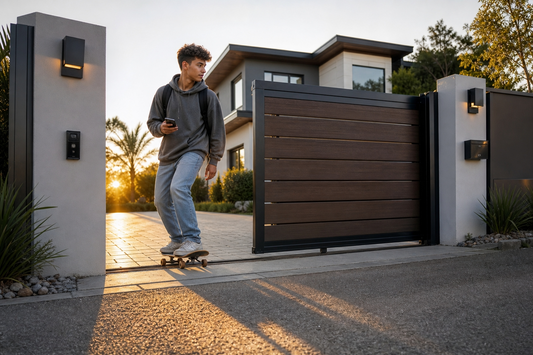
- Full privacy, horizontal boards — maximum screening, maximum wind load, heaviest leaf
- Semi-privacy slatted top — spaced upper section reduces wind load and weight while keeping a solid lower barrier
- Lattice or trellis top — similar effect, more traditional appearance
- Laser-cut decorative panel — geometric, floral or scroll patterns; wind load depends on how much of the panel is actually open
- Arched top — the arch is cosmetic but the frame is more complex, so confirm how the arch is constructed and whether it affects the fixing points
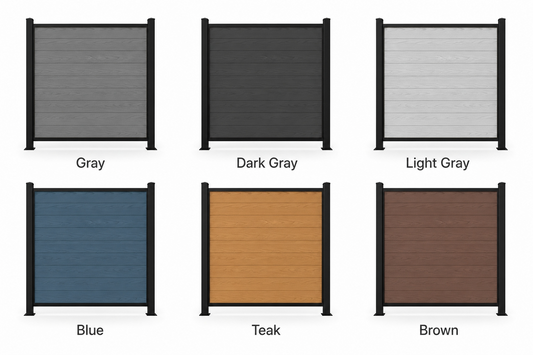
All of these are available on the same aluminium-framed system, which means the structural decisions — post size, hinge or roller rating, operator class — can be made independently of the visual one. Browse the driveway gate range and sliding gate options to compare configurations.
What to Specify When Ordering
For a dealer stocking gates or a contractor quoting a project, this list is the difference between a clean install and a return visit:
- Clear opening width required, and post-to-post if already built
- Gate type — swing, tracked slide, or cantilever — with the site condition that drove it
- Complete leaf weight, not board weight
- Infill style, with wind exposure stated
- Post section, and whether posts are supplied with the gate
- Manual or automated, and if automated, who supplies and certifies the operator
- Hardware list — hinges or rollers, latch or lock, drop rod for double swing
- Whether the gate ships assembled or flat-packed, and how it is crated
The last point matters more on gates than on panels. A fully assembled driveway gate leaf is a large, heavy, awkward item that consumes container volume disproportionately. Flat-packed leaves ship better and cost less to freight but require assembly labour on arrival. Decide which, at quote stage. For how these choices flow into landed cost, see the composite gate cost guide.
Frequently Asked Questions
Q: What size should a composite driveway gate be?
A: Specify the clear opening the vehicle needs, not post-to-post. US residential driveways commonly need 12–14 ft, with 16 ft and up for two-car, RV or commercial access. Posts, hinges and hinge stand-off consume several inches, so state the clear width required and let the supplier work back to the post spacing.
Q: Should I choose a swing or sliding driveway gate?
A: Site geometry decides. Swing gates need clear arc into the property and flat or gently falling ground. Sliding gates need side room at least as long as the leaf. If the ground rises through the opening or a ground track would be a problem, a cantilever slider avoids both. Style should be chosen after the type.
Q: How much does a composite driveway gate weigh?
A: More than most buyers expect, and the gate type matters more than the opening size. At 2.69 kg/m and 172 mm coverage on an 1800 mm high gate, each leaf of a 16 ft double swing carries about 72 kg (159 lb) of infill, while a single sliding leaf for the same opening carries about 173 kg (382 lb) — because the slide leaf has to span the whole opening plus overlap rather than half of it. The aluminium frame adds on top, so ask for the complete leaf weight before selecting hinges, rollers or an operator.
Q: Do composite driveway gates need special hardware?
A: Yes. The leaf is heavier than a comparable wood gate and the load must go into the aluminium frame, not the infill boards. Swing leaves in this weight range typically need three hinges rather than two; sliding leaves need rollers or cantilever carriages rated for the complete leaf weight, which on a long slider runs into several hundred pounds.
Q: What standards apply to automated gates in the US?
A: UL 325 covers the gate operator's safety requirements, and ASTM F2200 covers the construction of the automated gate assembly, including pinch points and openings within reach of the moving gate. Both apply — a listed operator on a non-compliant gate is still a non-compliant installation. Most imported gates are not supplied with F2200 documentation, so establish who is responsible for compliance before ordering.
Q: Does gate style affect performance?
A: Yes, through wind load. A full-privacy gate presents its whole area to the wind; slatted, lattice and laser-cut infills let air through and reduce the load on hinges, operator and posts. On exposed sites the infill choice is a structural decision as much as a visual one.
Q: Can a manual driveway gate be automated later?
A: Usually yes, if the gate was built to accept an operator — adequate frame rigidity, a post able to carry the operator, and provision for power. Confirm this at order stage rather than assuming. Retrofitting an operator to a gate not designed for one often means replacing the posts.
Getting the Specification Right
Let site geometry pick the gate type, weight pick the hardware and operator, and style come last. Request a driveway gate specification with clear opening, complete leaf weight, post section and hardware list before you price the job.
Tags:
Previous
Composite Gate Hardware Guide: Hinges, Latches, Locks and Self-Closing Kits
Next
How Long Does Composite Fencing Last? Lifespan and Warranty Explained