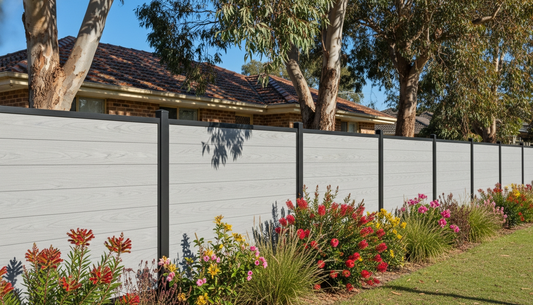
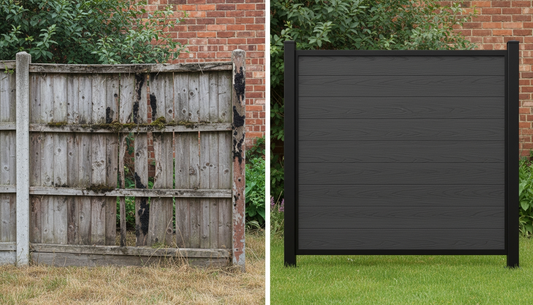
Why Our Composite Fencing Is the Best Fencing Material for the American Market
Across the United States, fencing is not just a boundary — it is a question of durability, design and long-term value. Few materials perform across the country's extreme and diverse climates. From the heat of Arizona to the winters of Minnesota, from Florida's humid coastlines to high-altitude UV exposure in Colorado, choosing a fencing material is about performance under pressure as much as appearance.
This is where co-extruded WPC composite fencing earns its place. Below is what the material actually does in each of those conditions — and, where a claim rests on a test, the report it rests on.

Surviving Desert Heat: Arizona & Nevada
In states like Arizona and Nevada, summer temperatures frequently exceed 110°F (43°C), and intense dry air degrades traditional fence materials quickly. Timber dries out, cracks and splinters. PVC becomes brittle, warps under the sun and fades. Metal fences heat rapidly and can become unpleasant to touch.
Composite fencing handles these conditions better on two counts. The boards are co-extruded with a UV-resistant outer shell that slows colour fading, and the composite core does not dry out or check the way natural wood does in low humidity. It holds its dimensions under prolonged sun exposure — no warping, no sagging.
Withstanding Freezing Winters: Minnesota, North Dakota & Maine
In the upper Midwest and Northeast — Minnesota, North Dakota, Maine — winter temperatures drop below -20°F (-29°C), with snow, ice and relentless freeze-thaw cycling. For wooden fences that means moisture absorption, expansion, splitting and eventual rot. Even metal posts can shift under frost heave.
Composite is built for this. The core has low water absorption and the capped board is encapsulated on all four faces, so there is very little water in the board to freeze. The practical result is no swelling, no splitting and no frost cracking through repeated thaw cycles — a real advantage in climates where a timber fence can fail structurally in a single winter.

High Humidity & Coastal Challenges: Florida & Louisiana
Along the Gulf Coast and southeastern states like Florida and Louisiana, high humidity is the norm. Add salt air and heavy seasonal rain and you have the conditions that rot wood and corrode metal.
Composite fencing does not rot, mildew or rust, and the capped outer layer is non-porous. One honest qualification worth making, because coastal buyers ask: the boards are not metal, so they do not corrode — but we hold no salt-spray or accelerated-corrosion testing. In a salt-air installation the variable that actually governs service life is the metalwork: the posts, rails, brackets and screws. Specify those for the exposure rather than inferring them from the board material.

Wind Loading: Texas Plains & Oklahoma
In central US regions such as the Texas Panhandle, Oklahoma and Kansas, extreme wind events are a serious challenge to any fence. Homeowners and contractors routinely see fences tip, splinter or come apart after severe storms.
Here is the test result we actually hold, stated in full so you can judge it. Intertek report 250710027GZU-001: a 1.8 × 1.8 m fence assembly — 170 × 24 mm WPC boards in 80 × 80 mm 6063-T5 aluminium posts and aluminium rails — held a maximum horizontal uniform load of 372.1 N/m², roughly a Beaufort 9 gale, for three minutes with no failure, no component disengagement and no visible cracking.
Two caveats belong with that number. The method was an in-house procedure agreed with the client, not a published standard, so it is not directly comparable with a result generated under an ASTM or EN test. And it applies to that assembly configuration only — substitute a lighter post section or different fixings and the result no longer describes what you are building. If your project is in a design-wind-speed jurisdiction and needs an engineered figure, tell us at design stage; that is a different test and it can be commissioned.
UV Intensity & Altitude Exposure: Colorado & Utah
In high-altitude regions like Colorado and Utah, the air is thinner and sunlight more intense, which accelerates UV degradation. Paint fades, plastics yellow, untreated wood greys and cracks.
Composite fencing is shielded by a co-extruded UV-stable outer layer that takes the UV exposure instead of the pigmented core. Our UV ageing evidence is xenon-arc testing to ISO 4892-2. Expect a slight, one-time settling of tone in the first months outdoors on any composite board, after which a capped board holds its colour far better than PVC, which tends to chalk, or timber, which needs repainting.

Coastal Environments: California & the Carolinas
Even in temperate climates like California, South Carolina or southern Texas, coastal air carries salt and humidity that compromise metal components, discolour wood and degrade coated fences.
The composite board itself is non-corrosive. For the metalwork, specify stainless or anodised aluminium fixings appropriate to the exposure — and note again that we hold no salt-spray test data, so that specification should come from your engineer or fixing supplier rather than from us. It is the honest answer, and it is also the one that protects the installation.
A Fence for Every Climate — One Material, Nationwide
The American market needs materials that perform reliably across wildly different environments. Composite fencing does that across heat, cold, humidity and UV, and the wind evidence above is real and specific rather than a round number.
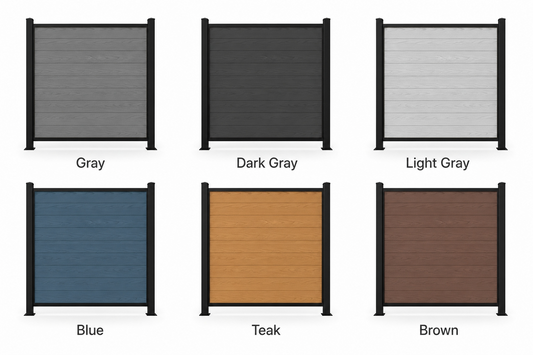
Whether you are a contractor trying to minimise callbacks, a homeowner looking for long-term value, or a distributor expanding into premium materials, use the form on this page for a real per-unit price — tell us the height, colour, volume and destination port. Minimum order is 70 sets.
Tags:
Previous
Why Homeowners Are Switching to Composite Fencing: A Smarter, Stronger, and Better-Looking Alternative
Next
Is Composite Fencing Worth the Investment? A Full Cost Breakdown