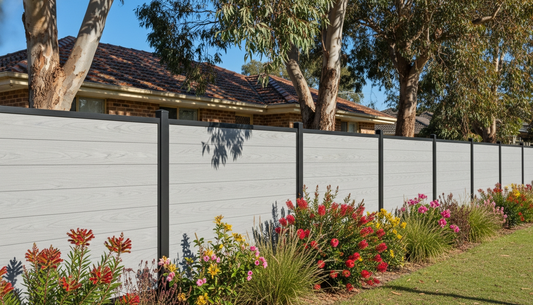
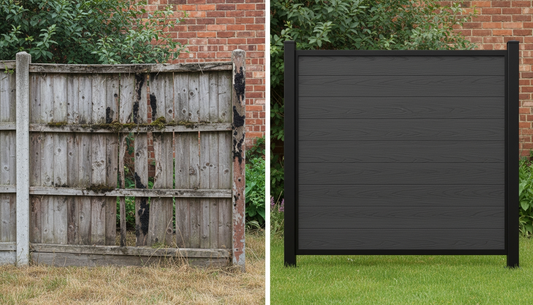
Why Composite Fencing Is the Perfect Solution for South America's Extreme Climates
Climate Extremes and Outdoor Materials in South America
South America is a continent of striking climatic diversity. The Amazon has perpetual humidity and rainfall; the Andean highlands combine intense UV with cold; arid zones such as northern Chile face high daytime heat and almost no precipitation. That range is hard on any material left outdoors, and fencing takes the full force of it. Natural wood, PVC and metal each fail in a different way — warping, fading, rusting, decaying. Wood-plastic composite handles the range better, and this article sets out where, and on what evidence.

Weather-Driven Challenges Across the Continent
In Brazil's tropical zones, particularly the Amazon basin and coastal regions, materials must withstand rainfall that often exceeds 2,000 mm a year and humidity averaging 80% or more. Argentina's Patagonian steppe is exposed to high winds and sub-zero winter temperatures. Cities such as La Paz and Quito sit above 3,000 metres, where thinner air means UV exposure that degrades unprotected plastics and untreated timber quickly. In the Atacama, daytime temperatures reach 40°C while nights drop below 5°C — a daily expansion and contraction cycle that works joints loose in almost any material.

What the Material Is, and What It Does
Our WPC boards are approximately 60% recycled hardwood fibre and 40% recycled HDPE, with UV stabilisers and processing additives. Compared with natural timber, which absorbs moisture and eventually decomposes, WPC takes on very little water — which is what prevents the swelling, rot and mould growth that ends a timber fence in a humid climate. On a capped (co-extruded) board the composite core is encapsulated on all four faces, so the moisture path is closed off entirely.
For the Colombian and Ecuadorian coasts, where salt air accelerates corrosion, one qualification matters and we would rather give it plainly: the board is not metal and does not corrode, but we hold no salt-spray or accelerated-corrosion test data. In a coastal installation the posts, rails, brackets and screws are what govern service life. Specify the metalwork for the exposure with your engineer rather than inferring it from the board.

Heat, UV and Colour Retention
Thermal stability matters most in the desert and high-altitude zones, where the daily temperature swing is the real stressor rather than the peak. WPC holds its dimensions better than PVC through those cycles, which is why sagging and warping are less of a problem.
On UV, the evidence we hold is xenon-arc accelerated ageing to ISO 4892-2. What that supports in plain terms: a capped board goes through a slight, one-time settling of tone over its first months outdoors and then holds colour far better than PVC, which tends to chalk, or timber, which greys and needs repainting. We do not publish a "percentage of colour retained after five years" figure, because a number like that is only meaningful tied to a specific test, duration and colour — and any supplier quoting one should be asked which report it comes from.
Mould, Termites and Fungal Growth
The tropical and subtropical regions are breeding grounds for mould and termites, both of which need moisture and cellulose. WPC is far less vulnerable on both counts: the polymer fraction and the low porosity leave termites nothing to tunnel and mould little to hold onto. A capped board, with its non-porous shell, is the stronger specification in year-round high humidity such as Manaus or the Ecuadorian coast.
Wind Loading and Installation
Here is the structural test result we actually hold, in full. Intertek report 250710027GZU-001: a 1.8 × 1.8 m fence assembly — 170 × 24 mm WPC boards in 80 × 80 mm 6063-T5 aluminium posts and aluminium rails — sustained a maximum horizontal uniform load of 372.1 N/m², roughly a Beaufort 9 gale, for three minutes with no failure, no component disengagement and no visible cracking.
Two limits belong with that figure. The method was an in-house procedure agreed with the client, not a published standard, so it is not directly comparable with an EN or ASTM result. And it describes that assembly only — change the post section, the alloy or the fixings and the result no longer applies. For Patagonia or coastal Uruguay, where design wind speeds are genuinely demanding, treat this as a starting point for a conversation with your engineer, not as a rating.
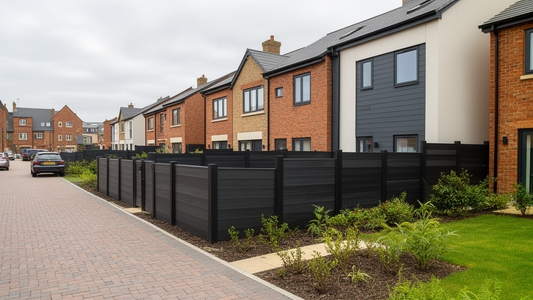
On installation: composite panels go up as modules against a prepared post line, which is markedly faster than concrete or stone — useful where the weather window is short or the site is remote. Remember that a run of N panels needs N+1 posts.
Low Maintenance

The main commercial argument in South America is maintenance. A timber fence needs sealing, painting or termite treatment on a cycle; composite typically needs occasional cleaning with water. Over a ten-year ownership period that difference compounds, which matters in markets such as Chile and Peru where development is active but long-term maintenance budgets are tight.
Environmental Considerations
Composite fencing is manufactured from recycled wood flour and recycled plastic, which supports circular-economy objectives and aligns with tightening regulation around deforestation and plastic waste in Brazil and Colombia. On certification specifically, we hold ISO 9001 and ISO 14001 (certificates IAS25924Q1473R0M and IAS25924E0394R0M, valid to April 2027) and CE / CPR certification M.2024.206.C97619. We do not currently hold FSC or PEFC chain-of-custody certification — if your project requires it, say so before ordering rather than after.
Conclusion
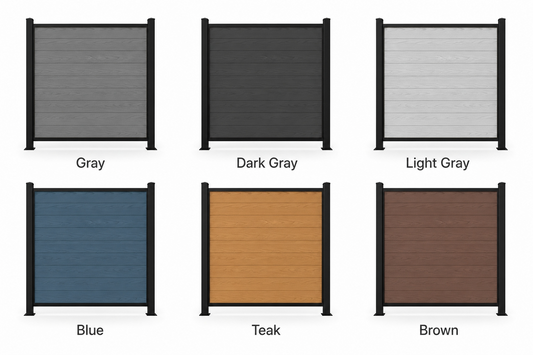
As South America's climatic range continues to test conventional building materials, WPC composite fencing holds up well across UV, rain, wind and temperature swing, with minimal maintenance. For developers, architects and homeowners working across the Amazon, the Andes and the Atacama, use the form on this page for a real per-unit price — tell us the height, colour, volume and destination port. Minimum order is 70 sets.
Tags:
Previous
Is Composite Fencing Worth the Investment? A Full Cost Breakdown
Next
How to Upgrade Your Old Fence with WPC Fencing: Step-by-Step Guide