Fire-Retardant Safety
Designed for public and outdoor projects where safety requirements are higher.
Testing documents and selection guidance can be provided upon request.


| Product Name | Elite WPC Privacy Fencing System (Tongue & Groove) |
| Manufacturer | Bohai Wood — Factory Direct, China |
| Materials | 60% wood fibre, 35% HDPE polymer, 5% UV stabilisers & additives |
| Standard Height | 1.2m / 1.5m / 1.8m / 2.0m (Customizable) |
| Panel Size | 180mm × 24mm |
| Post Options | Heavy-duty Aluminum Post / Reinforced WPC Post |
| Application | Garden boundaries, Villa perimeter fencing, Privacy screening |
| Surface Finish | 3D Natural Wood Grain / Sanded / Brushed |
| MOQ | 40 sets (Negotiable for project orders) |
| Warranty | 15 Years Residential / 10 Years Commercial |
Interlocking structure with zero gaps, protecting your private space completely.
Modular slotting system allows for installation speeds 50% faster than traditional wood.


Teak-finish WPC privacy fence panels deliver the warmth and elegance of natural tropical hardwood — without the extreme maintenance challenges of real timber in the Middle East's intense heat, sand abrasion, and UV radiation. The rich teak tone complements the villa architecture, landscaped gardens, and infinity pool surrounds typical of Dubai, Abu Dhabi, Riyadh, and Qatar residential developments. Co-extrusion polymer cap technology provides exceptional resistance to temperatures up to 70°C and UV index levels common across the GCC region. Supplied factory-direct from Guangdong, China with full export documentation and competitive pricing for large-scale residential and hospitality projects across the UAE, Saudi Arabia, and wider Middle East.
Key specs:
Panel: 1800 × 1800mm (6ft × 6ft)
Profile: Co-extrusion WPC with UV polymer cap
Colour: Teak
Temperature resistance: -40°C to +70°C


Here’s some of our products people are buying. Click to discover trending style.
Panel size is where fencing orders go wrong, and it goes wrong in two different places — the panel itself, and the boards inside it.
Composite fence panels are bought and sold as 6 ft × 6 ft, and for most runs that is exactly how they behave. But a true 6 ft is 1829 mm and ours is 1800 mm — every bay is about 29 mm shorter than the timber panel it replaces. One bay, nobody notices. Twelve bays, it is roughly a third of a metre. If you are matching into an existing fence line, or working to a boundary of fixed length, that is the number that decides whether the last bay fits. Measure the run. Do not assume 6 ft. The full imperial-to-metric table is in our composite fence panel sizes guide.
The privacy profile is 180 × 24 mm, but the boards lap — the effective cover is 172 mm. Work quantities from 172 mm. Using 180 mm under-orders by about 4.4%, and at container scale that is the shortfall you end up air-freighting. The slatted profile is a different section again: 178 × 24 mm covering 160 mm. The two are not interchangeable in a take-off.
Each set includes one post. A run of N bays needs N + 1 posts, and every gate opening needs two more. This is the single most common short-order on a fencing project, and it is the one that stops an installation dead — you cannot finish a run with the last post missing.
1800 × 1800 mm = 3.24 m² per set, roughly 55 kg including packaging. Two people per panel on site, and it is the weight figure that governs container loading — see the ordering table below.
Five panel styles, all 1800 × 1800 mm, all sharing the same posts and capping rail. Six colours run across the range — choose the style from the exposure and the use, then choose the colour.


Most search results for a composite fence factory are trading companies reselling containers they bought from plants like this one. These four photographs are ours, taken at the plant in Sihui, Zhaoqing, Guangdong — the same address that appears on the invoice and on the ISO certificates.


Four styles, six colours, chosen independently. Pick the style from the exposure and the use; colour is the last decision, not the first.
| Style | Screening | Wind through the panel | Specify it when |
|---|---|---|---|
| Privacy | Full — solid boards, no gaps | None | Screening is the requirement and the boundary is sheltered |
| Half trellis | Solid to two thirds, open above | Through the upper third | Exposed or coastal. Screening at eye level, load out of the posts |
| Full trellis | None — open lattice throughout | Through the whole panel | Definition rather than screening, or support for climbing planting |
| Carved | Partial — pattern cut through the face | Through the cut-outs | Feature bays where the view matters more than the screen |
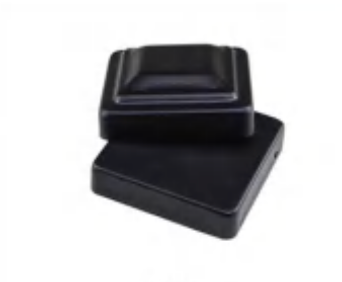
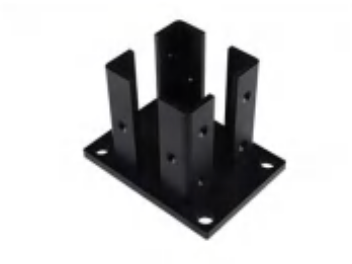
Browse each style: privacy panels · half trellis · full trellis · carved and decorative · posts and accessories
Composite is dense. On almost every fencing order the container reaches its weight limit before its volume limit, so plan in tonnes rather than cubic metres.
| Figure | What it means | |
|---|---|---|
| Minimum order | 70 sets | Counted across the whole order — styles and colours can be mixed to reach it |
| One set | 1800 × 1800 mm | 3.24 m², about 55 kg including packaging |
| 20GP | 200 sets | 360 linear metres, roughly 11.5 t gross |
| 40HQ | 400 sets | 720 linear metres, roughly 23 t gross |
| Posts | N + 1 | One per set, plus one to close the run, plus two per gate opening |
| Privacy board cover | 172 mm | Section is 180 × 24 mm — calculate from 172, not 180 |
| Slatted board cover | 160 mm | Different section: 178 × 24 mm. Do not mix the two figures |
| Colours | Six | Black, blue grey, light grey, teak, walnut, white — available across the styles |
They are sold as 6 ft × 6 ft and used that way, but the panel is 1800 × 1800 mm. A true 6 ft is 1829 mm, so each bay is about 29 mm shorter than the timber panel it usually replaces. Over one bay it is invisible; over a twelve-bay run it is about a third of a metre. Measure the boundary and count the bays before ordering, especially if you are matching into fencing that is already there.
Divide the run by 1.8 m and round up — then add one post. A run of N bays takes N sets and N + 1 posts, plus two extra posts for every gate opening. If the run turns a corner or steps down a slope, count each straight length separately rather than measuring the boundary as one number.
A 20GP takes 200 sets — 360 linear metres, roughly 11.5 t gross. A 40HQ takes 400 sets — 720 linear metres, roughly 23 t. Composite is heavy for its bulk, so the weight limit binds before the volume limit on nearly every order. If you are combining fencing with decking in one container, work the tonnage first.
70 sets. That is counted across the whole fencing order, not per style or per colour, so you can mix privacy, trellis and carved panels and several colours to reach it. 70 sets is well under a full container.
Half trellis, in most cases. A solid 1800 mm panel is a sail — wind load goes straight into the posts and their foundations, and that is what takes a fence down. The open upper third of a half trellis panel lets air through and takes load out of the system while keeping screening at eye level. If a timber fence on the same line has blown over before, that is the reason, and it is the argument for half trellis over full privacy.
Neither. All six colours — black, blue grey, light grey, teak, walnut and white — run across the styles, and any of them ships to any market. Choose the style from the exposure and the use, then choose the colour separately.
Partially. A carved panel has the pattern cut through the board face, so it screens the view without blocking it, and light and planting read through it. That is a screen rather than a barrier. Most projects use carved panels as feature bays — the run facing a terrace or a seating area — with plain privacy panels along the rest of the boundary.
A factory. The panels are extruded on our own lines in Sihui, Zhaoqing, Guangdong — the photographs above are ours, taken at the plant — and they ship FOB Nansha or Yantian. Buyers searching for a composite fence factory are welcome to ask which port we load from and who the legal entity on the invoice is: Guangdong Bangying New Material Co., Ltd., the same name on our ISO certificates. Those two answers separate plants from resellers faster than anything else.
We hold no EN 13501-1 reaction-to-fire classification — not a lower class, not a pending one: none. We do not publish a wind load rating for the panel or the post fixing, because foundations depend on ground conditions we cannot see. Tell us what your specification names and we will answer with the report number, the laboratory and the date, or say plainly that we do not hold it. A supplier who claims everything has usually tested nothing.
Yes, and for fencing we would encourage it. Samples are free — you cover the courier and we credit it against your first order. Ask for a board in the colour you are considering rather than a swatch: colour reads differently at panel scale, and on a carved pattern the depth of the cut and the way light passes through it are the two things a photograph does not convey.
Bohai Woods is the brand; the legal entity is Guangdong Bangying New Material Co., Ltd., which is what appears on the business licence, the ISO certificates and the invoice. If you are verifying us as a supplier, those are the two names to expect, and they should match on every document we send you.
Give us the boundary length, the number of corners and gates, the exposure, and the destination port. We come back with the panel and post schedule, the container split, and a plain statement of which documents we hold.